Ann St Leger Wood of Ashridge, other related Anns & their families
A while ago, as part of my imagined reinventions of some women erased from Devon’s recognised past, I drafted a fragment of fiction about a certain
Ann St Leger, visualising her as an individual woman from a lost literary network. Ann was a real woman, named in various genealogical charts. As a child Ann may have lived at
Court Green and after marriage to
Alexander Wood (another leading North Tawton/Ashridge family) - must surely have lived just up the lanes north east from North Tawton, at
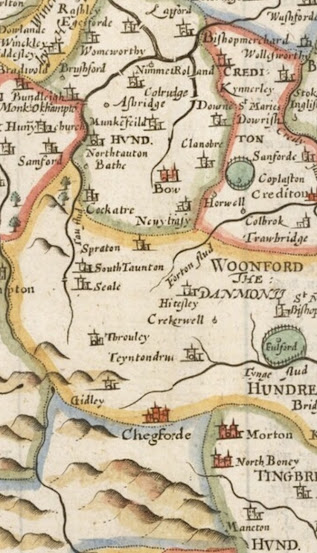
Ashridge Court the ancient estate just short of 5 miles southwest of Coldridge. (See map heading this post).
Ann was daughter of
Bartholomew St Leger and
Blanche Bourchier St Leger, and her husband
Alexander Wood or Atwood, was one of the judges who helped to quell the
Sampford Courtenay Rebellion, in 1549. In my fictional fragment I had in mind that Ann was from a circle of literary inclined women. It is entirely feasible that the real women appearing in this fictional fragment did have literary interests, for at these times noble women close to the royal courts were educated and literate.
Ann St Leger’s ancestral background took in
Eleanor de Bohun, Duchess of Gloucester, her great grandmother x 3, whose 1399 will listed fourteen books, including ‘a book of vices and virtues and another in rhyme of the history of the knight of the swan, all in french.’ (See
Women of the Engish Nobility). In my fiction close connections are hinted at between
Ann St Leger Wood,
Katherine Courtenay, Countess of Devon and Margaret Beaufort, Countess of Richmond (who may during this period have been staying at her South Peverell home - see more about her below). And the women are preparing to enjoy a feast. Here's a snippet from the start:
.. You’ll never really know how it was or what really happened here, but I’ll try to tell you, or at least tell you as much as I know. You must cast your mind back a long time – no, further than that.Concentrate now. We’re in the C15, late C15. It takes time to readjust to the new light of old history,and don’t forget, we weavers of the re-invented writing have also to realign our creative mode to that of the imagined space. Try to imagine the clothes. It might help. Start at the top. Our lady’s head was adorned with a coif - a kind of net - stiffened with gold threads and to fix it in place she wore a chaplet - a crown like band; it sparkled with gems of garnet that she’d been presented with during travels in France.
(From unpublished fiction sequence).
More recently, as I took in the intricacies of the
Coldridge mystery it occurred to me how
Ann St Leger Wood must have been closely related to some of the elite individuals involved. A glance at Ann’s kinship chart quickly forks out to encompass people closely embroiled with those at
Coleridge. The St Leger’s family’s main Devon estate was at
Annery near
Monkleigh, but by the C14/15, the family had
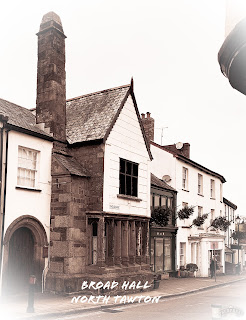
also inherited the manor of North Tawton (see
The Book of North Tawton) through dispersal of the chain of descent of ownership amongst several co heiresses, whilst the Wood/Attewood family became holders of
Ashridge, a mile and a half or so north-east.
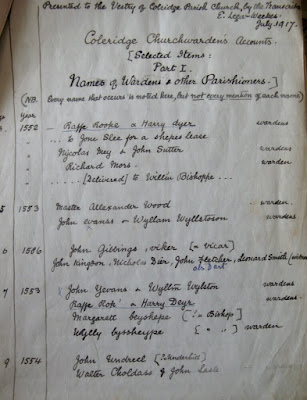 |
| Churchwardens at Coldridge in C16. |
At least one document suggests that the Wood family were also closely associated with Coldridge during the time an individual named ‘John Evans’ (perhaps Evans' son) was there; it is a list of church wardens at Coldridge, which for 1553 names Master Alexander Wood (perhaps the son/grandson? of
Ann St Leger and her husband) as well as 'John Yevans'. (See photo)
As far as I’m aware although she must have known all about the fate of her father amid the turmoil of this period,
Ann St Leger-Wood of Ashridge did not leave a shred of documentation for us to find in an archive; but other women also named Ann St Leger in her family did.
For, there are quite a few 'Ann St Legers' dotted round the networks of interconnected families during this late medieval period. It’s easy to confuse them! A cursory glance at various records in
Discovery archives suggests that there are a cluster of documents relating to women of that name from Ann’s extended kin group, who could be useful for those seeking contextual information relevant to research around the Coldridge matter. Any of them could have had close links with the family clusters around North Tawton and or Ashridge, and nearby Coldridge. For example, Ann of Ashridge was first cousin of
Anne St Leger Manners, Baroness de Ros, daughter of
Thomas St Leger 1440-1483, Ann St Leger Wood's s uncle (her father Bartholomew’s brother), who was also indicted following Richard III’s accession, in 1483, and executed at
Exeter castle in 1483. This branch of the St Leger family were at the very heart of the political intrigue which may have impinged on the events around John Evans’s/Edward V's presence in nearby Coldridge.
Thomas St Leger had married (as her second husband)
Anne Duchess of Exeter 1474 Kent, eldest sister of Edward IV and Richard III, so he was uncle to the lost princes by marriage (whilst through her uncle’s marriage
Ann St Leger Wood of Ashridge was
Anne Duchess of Exeter's niece). Anne’s first husband was
Henry Holland Duke of Exeter of
Dartington. Anne of Exeter died (probably) during or shortly after the birth of her daughter
Anne St Leger Manners, in 1476. One A2A document references Thomas' daughter 'Anne St Leger 's inheritance following his death; but I've not had a chance to read it because of the cost of access. Anne is Plaintiff, whilst defendants are the two brothers (Ann of Ashridge’s father and uncle) - main players, in
Buckingham’s Rebellion - Bartholomew Leger and
James St Leger: C1 109 18 Seyntleger v Seynteleger. Plaintiffs: Anne Seyntleger [St Leger], daughter of Sir Thomas Seyntleger, knight, deceased Defendants: James and Bartholomew Seynteleger, and others, administrators of the goods of the said Sir Thomas. Subject: Jewels and plate of the said Sir Thomas. Annexed is an account by the said James of jewels and plate coming to his hands.
James St Leger was another of
Ann St Leger Wood of Ashridge’s uncles, who married (as her 2nd husband),
Lady Ann Butler, whose father was
Thomas Butler 7 Earl Ormonde (1424-1515). I’ve noted above that the Butlers were another in the maze of interrelated families associated with North Tawton manor /and or /church patrons. Said to be a close friend of Henry VII and holding over 72 manors, and one of the wealthiest men in the country,
Thomas was captured by the Yorkists at the Battle of Tewkesbury and partially attainted. Following Henry VII’s accession, he was pardoned and became a Privy Councillor.
Again and again as I write this I find myself naming people from the circle of individuals whose names keep resurfacing in the discussions around the disappearance of the two princes. I ask myself why.
Extending out the Family Circle Wheel- St Leger – Bourchier – Dynham - North Tawton and beyond
Ann St Leger Wood of Ashridge was also related to several of the main Coldridge players (See
Part One) through her mother
Blanche and the extended Bourchier family. As with the St Legers many of these people hook not only into the network of families who were linked with North Tawton manorial and church patronage, but also with
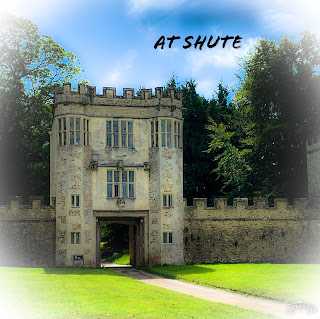
other nearby parishes such as Affeton and their associated medieval Tudor families - all of which ought to be considered in light of the Coldridge mystery. (See Part One) We can open out the family circle from North Tawton and Ashridge into other Devon places such as Sampford Peverell, Tiverton, Shute, Bampton, Nutwell, Colebrook and Umberleigh, which were all important sites where others from this cluster of noble families held estates, I can't include them all here as this is a blog post not a thesis! And to be honest the possible Devon-based networks within and across these families which may connect back to Coldridge are mind-boggling and nowadays well-nigh beyond my brain power.
It was in the midst of this cluster of Devon based families that I stumbled on our 'gateway ancestor'
Katherine Affeton Stuceley (mentioned at the head of this post) who I discovered married (as his second wife)
William Bourchier; Katherine was thus
Blanche's step-mother. Perhaps part of her life was spent at
Bampton. It was an eye-opener to trace other branches of
Katherine’s history, especially in light of the alleged
Coldridge conspiracies - and as inspiration toward the development of my own 'gateway' poetry sequence. Intriguingly, t
here is also suggestion of a link between the Stuceleys of Affeton, the St Legers, the Woods of Ashridge/North Tawton, and Coldridge, though as yet I have not been able to fathom exact kinships. There is a record of a birth of a Thomas Stuceley son of Thomas Stuceley Sheriff and his wife Anne Wood, baptised 1498 in Coldridge. It seems this family is descended from Katherine of Affeton's son Nicholas Stuceley, and possibly Anne Wood is connected to the Woods of Ashridge, but I have not been able to confirm the latter supposition. As yet all I can find is that Anne's father, another Thomas, is recorded as having been Chief Justice of the Common Pleas, of Childrey, co. Berks. Was he related to the Devon Ashridge Woods?
Another significant Bourchier was Archbishop of Canterbury, Thomas Bourchier, who was Blanche and Fulk Bourchier's uncle. Thomas was their father William’s brother; as Archbishop of Canterbury Thomas was closely embroiled in the events leading up to the kerfuffle around the time of the young princes’ disappearance:
Archbishop Thomas Bourchier crowned Edward IV and persuaded
Elizabeth Woodville to let her younger son Richard go to the Tower with his brother
Edward V; Archbishop Thomas Bourchier also crowned Richard III, in 1483.
While
Blanche Bourchier, Archbishop Thomas’s niece, married into the St Leger family, her brother
Fulk Bourchier (
Ann St Leger Wood’s uncle) married into another of the ‘interconnected families [of the leading Devon nobility/gentry] in a small area’ referred to (somewhere) in the
Richard III blog. His wife was
Elizabeth Dynham, one of four wealthy sisters and co-heirs of Lord High Treasurer,
John Dynham, of Nutwood, (in Woodbury; by marriage
Elizabeth was an aunt of
Ann St Leger Wood). Their son was
John Bourchier 1st Earl of Bath).
John Dynham was one of the few men who supported all three kings Edward IV Richard III and Henry VII and was one of the judges who tried rebels following the
Cornish Rebellion of 1497. Extend out this family cluster a little and we get to John Dynham’s other sisters/co-heirs, whose marriages also hook them into the ever growing number of people whose names and lives can be drawn into any debate about what may or may not have happened at Coldridge. For instance, his sister
Katherine Dynham married
Thomas Arundell, from Lanherne, in Cornwall;
he had been loyal supporter of both Edward IV and Richard III but apparently changed loyalties and was another of the men in this kinship network who was attainted in 1483 following
Buckingham’s Rebellion, when his estates passed to his half-sister’s
Anne Arundell’s husband
Sir James Tyrell (who allegedly eventually later under torture confessed to the murder of the young princes):
The reasons behind Arundell’s involvement are unclear, as he was among a number of rebels who had received grants from Richard III only shortly before the rebellion, as Rosemary Horrox has shown. A possible explanation offered by Dr Horrox, that of family ties, is questionable in the case of Sir Thomas, as he had close relatives on both sides. Quite possibly he was simply prompted by the loyalty he felt for his former lord Edward IV and his young son, and outraged by the actions of Richard (‘The Reburial of Expenses of Sir Thomas Arundell’, Hannes Kleineke)
Following Henry VII’s accession Thomas Arundell was forgiven and his estates restored, but he died shortly after Bosworth. There were others in the Arundell/Dynham family involved in Buckingham’s Rebellion, including Thomas’ brother in law Charles Dynham, who fled to Brittany following the rebellion. However it is Thomas’ mother in law Dame, or Lady Joan Dynham of Nutwell near Lympstone whose life has attracted recent attention from historians.
An apparently formidable woman who had fingers in many pies - political and other – it is not unreasonable to suppose Joan was interested and involved in literary pursuits. As a start, her early life links her with the medieval times’ most iconic poet and author Geoffrey Chaucer. Joan Arches (birth name) had lost her father at the age of 7; he’d arranged for her to be in the wardship of the then influential royal servant Thomas Chaucer, who was Chaucer’s son. (Joan’s marriage to the wealthy Westcountry Dynham landowner was probably arranged for the profit with which it would supply the said Thomas). According to one source – (Social Attitudes and Political Structures in the Fifteenth Century, edited by Tim Thornton) Lady Joan – who kept Nutwell as her main home base - was an exceedingly proactive medieval noblewoman. Not only did she maintain close control of her extensive land holdings round the country, she also gathered together a household of female attendants; her reeve was a woman and in her will she left a bequest of clothes to her female servants. Lady Dynham also seems to have taken an active role in some of the key dramas and political machinations of her time. In 1459, for example. following the battle at Ludford when Edward, the future Edward IV, had to flee, it is thought she took a pivotal role in the support of her son John in aiding the duke’s escape to Calais - which involved travel through Devon and along Dartmoor tracks known to her servants and then acquisition of a boat. One document held in A2A shows us that following her son in law Thomas Arundell’s death it was Lady Dynham who sent out the order to fetch home his body across the Westcountry landscapes: ‘Costs of Richard Wagot for Lady Dynham, in fetching home the body ('bonys') of Sir Thomas Arondell knight, from Odysdon (also as 'Wodysdon') to Dorchester (via Harbyngdon, Hungerford, Amysbury and Blanford)’. The order includes ‘Black cloth and its tailoring’; ‘wax and tapers left at various places on route and Chideock and Nutwyll’; ‘Timber and ironwork for the horse-litter, and equipment for the 2 horses; Carrying the horse-litter from Exeter to Nottewyll’; ‘Torches, etc., from Nutwyll to Dorchester; Fodder for horses and other expenses’. According to the record’s notes the order ‘is written in a late fifteenth centu'ry hand and can be dated to between October 1485, the date of Sir John Arundell’s death, and the death of Lady Joan Dinham’.
A few years later in 1492 another document of
‘Dame Joan Dynham’ (widow of Sir John Dynham) is a complex marriage settlement, jointure, for her granddaughter
Elianor, one of the daughters of the now deceased
Thomas Arundell and his wife Katherine. Here is an excerpt:
J.S. to provide all wedding requirements except bride's garments which are to be provided by Dame J.D., C.D. and Sir J.B. John, Lord Dynham, Sir Walter Denys, John Arundell and Charles Dynham esqs., Sir John Biconyll, John Choke and John Hymford, esqs. and John Pole to hold the premises to the use of J.S. till N.S. comes of age, then to N.S. and Elianore for their lives, then to the heirs of their bodies, then to J.S. and his heirs. If N.S. die before he is of age and "Elianore then of the age of 17 years", she to have a life estate in the premises.
Remaining in favour with all three kings, Edward IV Richard III and Henry VII, perhaps to allow her to steer her path and family according to the prevailing political winds, Lady Joan Dynham apparently managed to steer a judicious way through the turmoil of the last decades of the C15. I’m not sure whether it occurred before or after Perkin Warbeck’s Rebellion, but her death was in 1497 the same year as that event.
Unlike many women of her time and ilk
Joan Dynham’s life has been quite well-documented. For me she is exemplary as a reminder that other women of her kin and circle may well have been actively involved in all kinds of events and happenings of their time; we can’t assume that just because they now only exist as names in a family tree the women were always passively silent, their lives the background stage-set against which their husbands, brothers, sons and uncles played out the star-roles on the main stage of conspiracies of the times. It was probably not only the still famous women, such as
Margaret Beaufort or
Elizabeth Woodville, who became notorious for their various involvements in affairs of state. There may have been other noblewomen, such as
Lady Joan Dynham, who were ‘She-Wolves’, some even living out their life-journeys deep in the Devon landscape folds. It seems to me that if a redoubtable woman such as Joan could scheme and organise the get-away of a prospective king then it is quite feasible that others could do the same...
… Ok if you’re still with me you might think I’m ‘scatter-gunning’, straying far from my intended objective to comment on interesting material relevant to the
Coldridge Lost Princes theories, and so it might seem, but I’m trying to gather up bits and pieces which are round the edges, begin a kind of cross-section-of-women of the time linked with the mid-Devon vicinity who were linked 1. with the geographical area around
Coldridge and 2. closely linked with men who were 'key players', and 3. (in some cases) women whose interests may well have included some kind of literary pursuits.
These women were at the heart of the turmoil during the Wars of the Roses with all the political and familial dramas of the time and must have gathered together to discuss with the female kin in their close familial circles and taken keen interest in proceedings as they unfolded around them. Their loyalties must so often have been split.
And although it might seem as if I am straying from the woman whose name inspired my fictional piece,
Ann St Leger Wood of Ashridge, who began my reflection into the connected lives of apparently disparate women only distantly linked with her, I’m not! Ann was connected by blood or/ and marriage with all of these individuals; they were all part of the genealogical jungle of Devon nobility of that time, and even more interesting, they were all in one way or other closely linked with various events or and people that occurred about the time that John Evans was supposedly living in Coldridge. (See
Portrait).
Copplestones hooking into Others Another local branch of the extensive and intricate genealogical network who had close links with
Ann St Leger Wood’s close family circle was the
Copplestone family, the site of whose medieval house was once in wooded hills near the main road from Exeter to Barnstaple. Through his second wife (identity unknown)
Ann of Ashridge’s father
Bartholomew St Leger was also father of
Margaret Copplestone who was wife of
John Copleston, (1475–1550). John was son of
Ralph Copplestone (called ‘The Great’ because of the family’s immense wealth) and his wife
Ellen, who was a sister of the
Thomas Arundell (whose marriage to
Katherine Dynham I’ve commented on above). The two women, Ann from Ashridge and
Margaret were therefore half-sisters. John Copplestone, Ann’s ‘half’ brother-in-law was co-heir of his great-grandfather
John Bonville.). One writer speculating about the Coldridge affair suggests that it was probably one of the Copplestones whose wealth enabled them to arrange for Coldridge’s screen to be brought over from Brittany. (Chris Brooks and Martin Cherry
The Prince and the Parker in
The Journal of Stained GlassVol. XXVI). The theory is that the glorious screens at Coldridge and
Colebrooke are similar and probably were brought back from Brittany late in the late 1480s by one of those who’d accompanied Henry there, in 1483.
However, it is not known whether any of the Copplestones were in exile with Henry. If not, then for sure several also wealthy men in
Ralph Copplestone’s kinship network did go to Brittany with Henry, including Ralph’s brother in law
Thomas Arundell - who was son and heir of
Sir John Arundell of Lanheme, said to be the richest landowner in Cornwall and through whom Copplestones link up with the Dynhams of
Nutwell (including the evidently indefatigable
Joan Arches/Dynham). According to
Kleineke Thomas had joined Henry Tudor in Brittany and was quickly an ‘integral part of the inner circle around the pretender’; he provided a ‘supply of money’ to the campaign but was himself accumulating debt. And of course as I've shown, the Copplestones also link up with the St Leger family members who were so closely bound up with all the events at this time.
It is interesting that the wonderful Coldridge screen is linked with those who supported
Henry Tudor when he was in exile in Brittany because for the most part it is considered that Henry (and therefore his supporters) would not have been in favour of helping the young prince and indeed it is often Henry's mother Margaret Beaufort who is accused of being the main instigator of the children's murder. However, Coldridge's possible link with Brittany through the screen also indicates that there could be another interpretation. Perhaps it was Henry who aided the boy, as suggested in the following comment on one of the posts about Coldridge:
'... On the other hand it’s possible it could even have been HT himself who agreed Edward could be left alone and in peace as long as he stayed incognito. After all he, Henry, intended to marry his sister. Was that perhaps part of the marriage negotiations?'(See Medieval PotPourri)
Margaret and Cecily
....But I find myself drifting from the focus of my literary focused blog and Devon women who wrote in the landscape taken and carried away in this reflection which came about because of the stream of genealogy and its link with lost church history. It's time to try and gather threads together a little. The more I have tried to research some of the family webs who were concentrated in Devon during the years when the country was going through the tumult of the late
Wars of the Roses, including the events around the disappearance of the two princes, the more I've realised that the possible scenarios were and are endless. My meditations on the Devon family webs here are just the tip of the genealogical iceberg. I do not have enough detailed knowledge about the timings of specific events nor in particular about the comings and goings of various individuals around the events under discussion, but the theories which are swirling around
Edward V and Coldridge are so incredibly plausible, whilst the scenarios involving the possible agency of several of the women seem equally important to consider. There could have been several other
Joan Dynhams, women who became actively involved in protecting the young prince; or, for sake of argument, active participants in pursuing his demise. For instance, considering the latter, I have only mentioned
Margaret Beaufort, Henry VII's mother in passing so far, in connection with the fictional piece I wrote about Ann St Leger - and the comment above but I must now amend that lack as because of her close associations with
Sampford Peverell and
Great Torrington, Beaufort was very much linked with Devon.
I've already written a post about
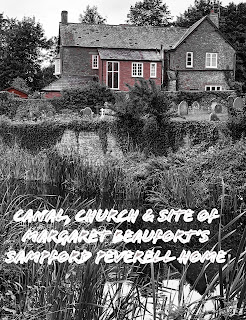
Margaret Beaufort and Sampford Peverell in which I mentioned that the historical narrative assessment of this important royal woman tends to stress her political involvements - especially with regard to the focus of this post, as one of the main instigators of Buckingham's Rebellion - and work as patron of literary texts, but
Margaret Beaufort is an important literary woman in her own right. It is perhaps not generally known that she had close connections with the south west and in particular with Devon. (In my previous post I also reflected on the likely Devon network of other women who may have been active during the time Beaufort spent time in the county).
As far as I'm aware it is not known exactly how many times, or for how long Margaret Beaufort stayed in Devon. In 1487, a couple of years after plans to get her son on the throne finally succeeded for example, in 1485, the countess was definitely down in Devon staying at her important manor in
Sampford Peverell.
By now, with popular consent she was called 'My Lady, the King's Mother'. During this time, as a keen and avid reader and translator, Margaret may have been reading a then popular chivalric French romance, called
Blanchardine and Eglantine. (The moste pleasaunt historye of Blanchardine, sonne to the King of Friz; & the faire lady Eglantine Queene of Tormaday, (surnamed) the proud ladye in loue). Around this period she is said to have purchased a
copy of the text from Caxton, then commissioned him to print and publish it in the vernacular, which he did, in 1489.
According to various sources at the time of its first printing in the vernacular, in 1489,
Blanchardine and Eglantine was read as a political roman à clef. During the years approaching the text's first appearance, but presumably before the countess had tasked Caxton to work on it, Margaret was plotting for her son's success in taking the throne; this goal turned on the uniting of the rival factions of Lancastrians and Yorks, which depended on a marriage between Lancastrian Henry and Yorkist
Elizabeth, eldest daughter of
Edward IV. Some believe that the C13 courtly tale of the 'exiled knight returning to claim his amour' (Thomas Penn,
Winter King: Henry VII and the Dawn of Tudor England), might have paralleled the couple's own relationship. Like Blanchardine, Henry was exiled from his intended bride Eglantine, who in the romance, described as a 'proude pucelle in love', is being besieged by her enemies.