Followers

Showing posts with label Devon churches. Show all posts

Coldridge Church; Conspiracy; the Canns, Connections and Beatrix Cresswell Part One


Coincidentally, and to my delight and surprise - a week after I posted this trio of pieces inspired by Coldridge and the unsolved Edward V affair the mystery has made national news, I believe for the first time, Here is a link to the version published in The Mail. I've not read the first account in The Telegraph as I don't subscribe to that paper but see Edward V The Coldridge Mystery and it's also available on Yahoo

Part 1

Setting the Scene/s

‘And finally did Elizabeth Wydville who died in 1492 in Bermondsey Abbey go to her grave with the knowledge that at least one of her sons was safe and living in rural Devon on his half-brother’s property?’ MedievalPotporri

‘When the princes’ mother, Elizabeth Woodville, sent her daughters out of sanctuary and into Richard III’s care in spring 1484, can she really have believed he had killed his nephews months earlier? Her daughters were a threat to Richard; the eldest, Elizabeth of York, was to marry Henry Tudor if he could win Richard’s throne. Yet they all survived. The simplest explanation for all this is that she knew her sons were safe’. The simplest explanation for all this is that she knew her sons were safe’.(Princes in the Tower)
         It began with a mid Devon church ...

        It is not often that apparently disparate passions and projects come together in and from an unexpected source - in such a way that they demand that one stop everything else and step off at a tangent from a schedule to explore a different journey than originally planned - then lead unexpectedly to a new project interweaving all of them. Such happened to me back in the late summer during and after a mini day trip back to explore a couple of churches in Devon.

 
     We all love a conspiracy! Such I found out of the blue in the second church of my tour. (The first church, Nymet Rowland, just up the rolling Devon hills from Lapford, with its porch entrance carvings of ancient spirals, sun-circle iconography and mysterious Roman letters spelling EMER was equally fascinating). 
Photo Nymet Rowland church
But when I reached Coldridge Church,


where, just as with neighbouring St Bartholomew’s at Nymet Rowland, the door was not locked - and not only that, but the church was beckoning me inside with the seasonal visual and scented arrangements of its recently arranged glories of local harvest fruits and flowers still displayed on the window sills and tables. The porch displayed a dazzle of golden sunflowers and inside, gracing one of Coldridge’s ancient Chantry Chapels, when I saw the green apples circling the base of a vase of sunshine whose light cascaded upon the bowl of the season’s last yellow roses, I knew something special was in store; and not just harvest’s feast of apples.

Photo Harvest display Coldridge
Happily taken back to various nostalgias of my own childhood in other not far away Devon churches quickly it felt as if I was being pulled back, firstly to childhood where, every year in North Tawton and Cheldon, two other nearby churches, I’d spent many childhood and teenage autumnal hours decades ago, along with my mother and other local women, decorating ancient brass paraphernalia with garden and nature’s glories, ready for the forthcoming Harvest service spectacular. (Sadly in my case the splendid floral arrays didn’t ever materialise; my artistic talents did not, and still do not lie in the realms of flower arranging – much I’m sure to my mother’s disappointment).


       (A small digression here. A moan! How different here the church’s fate from that of Cheldon, the tiny church - which I still visit fairly regularly to place flowers on my parents’ grave). Here, at Coldridge and Nymet Rowland, the churches are obviously cherished; whether out of religious fervour or commitment, or purely because they are places of deep beauty and historical fascination, as soon as the visitor steps inside he or she is aware of a local community taking care to reach out care for and preserve their parish church, to celebrate it as unique fount of historical knowledge. In contrast, at Cheldon, lately neglected and (though arguably in accordance with the demands of rewilding) left to the attention of nesting swallows, prolific weeds, and general deterioration, there’s a sense of abandonment - which almost veers towards contempt for the Old and old-fashioned; even an aggressive security alarm sounding out to anyone who dares to venture to the nearby gate to contemplate at the beauty of the wooded Little Dart valley down there below the meadows).

***

     In the fifties, from fields near our home on the ridge north of nearby North Tawton we could see Coldridge on the sky line; it’s only four miles away and my friends and I, child sleuths, would sometimes decide to have an ‘adventure’ (mode of Lone Pine Club or Famous Five), take our duffle bags stuffed with sweets and drinks and wander through the fields and along paths and into nearby Ashridge woods. We’d get the occasional glance of the village on the far ridge. There'd be a mystery to solve. We were certain. We must wander along the lanes over the fields until we reached the place. But no, we didn’t ever quite make Coldridge. Usually our need to get back for dinner or for my friends to go back down to their own home at the bottom of our town called us back before we’d reached the end of the back lane out of Ashridge. Anyway, even if we had trekked that far, in those days the treasures of Coldridge church would have eluded us, although I’m sure we realised that the place was another of our special local landscape sites. We were daughters of the ridge and longed to become as familiar with the village on the other ridge as we were with our Wildridge … and Ashridge

    In the present day, I wandered round the nave at Coldridge investigating the church’s obvious and astounding historical treasures – the stunning pulpit with its grape-frieze; its C15 oak rood-screen with carved oak leaves and floral bosses; the barrel-vaulted roof with Tudor rose bosses and fantastic creatures - DevonChurchland calls the overall effect a ‘bobby-dazzler’. 


    Then I turned my attention to why I’d travelled here in the first place. My original reason for wanting to explore Coldridge church was to see first-hand where one of my grandmothers x three was married, in November 1826, nearly two hundred years ago. Having been baptised and I believe born in the nearby parish of Bondleigh, the woman in question, twenty years old Nan Passmore, apparently had no direct connection with this village. Just like so many others of our family's foremothers Nan was just a scribble of a name (actually a series of names depending which record you looked at – Nan, Nann, Ann, and Nancy) - had no real identity other than her connection with the places that the archives listed as places of baptism and marriage and the facts of her links with the menfolk in her life. Nan’s married life had been spent in Broadwoodkelly, another parish within a crow-throw from Coldridge.

    Also, excitedly, Nan had married a man whose own ancestry I’d recently discovered led me as amateur genealogist into the exciting new territory of ‘Gateway’ ancestors - a lines of predecessors which when the amateur genealogist stumbles upon it means that an individual in your family tree links you to already known genealogies, usually from history’s great and good, thus allowing you as researcher to add a bounty of fascinating personages to their previously - at least superficially - nondescript family tree. As I understand it, a Gateway ancestor is invariably from a landed family with money and land, mostly just one degree from then royalty, which makes tracing this family-branch path through life pre-1837 much easier – and more or less without exception, means you will be linked up in a direct line to someone of real ‘status’ from the deep past, ie royalty or aristocracy. As a bonus, a Gateway ancestor also inevitably takes the family researcher back to fascinating places of history, such as large manorial estates and old castles!

    So, I’d wanted to follow Nan Cann, see where her wedding journey led me; step inside the church, stroll up the aisle, conjure the young bride, my great great great grandmother tying the knot with Bartholomew Earland, the bridegroom - who, baptised in another of the mid to north Devon parishes, at Iddesleigh - may have been linked with nearby Nymet Rowland. I wanted to rekindle Nan’s life-journey. I hoped to stumble upon something, a clue which might suggest why the couple were married here, hoped also to find a few gravestones outside that might open up new avenues for genealogical research. (I did note several stones with a family name, which may eventually lead something more productive about my quest after Nan. But hey, that’s another story)!

    Well, there you have it, one of my own personal passions - family history. Not directly connected to writing blogs or poetry or texts about neglected women writers from Devon you might think, or generally with the life-journey of a poet – one of my ‘other’ main creative passions - though in actuality during the long solitudes of lockdown the disparate interests had already begun to draw closer. As I began to trace some of the so-called Gateway ancestors ideas following the discovery of Bartholomew Earland, I’d started drafts of a sequence of poems whose focus was and is a kind of poetry ‘mapping’, an evocation of some of these long lost 'gateway' women, many of whom, even though their names and complicated kinships appear on archival records, have left not even a recorded snippet or trace of their own unique life-journey; and in this respect they are nigh identical to the other 'commoners' in one’s family history, whose names in the listings occur with the bare fact of an accompanying baptism, or and marriage or, and if you’re lucky, a burial date. In common, all these women, aristocratic, or poor as church mice, are history’s invisibles. Here is the beginning of one gateway poem in the as yet (unpublished) sequence: 


***

Before leaving Coldridge church I returned to sit in one of the pews to have another more careful read through the guide book. Make sure I’d not missed anything of importance. Well, I had! In behind the rood-screen (and not easily reached as its now used as vestry) there is an effigy, not your common-or-garden memorial of a once Lord of the local manor, but a late C15/early C16 mystery man. (Didn't get a photo when I was there but here is a link to the amazing image on the out of this world website Devon Churchland). 


That’s when it began to dawn on me why this old church is so uniquely intriguing; where the mystery, the conspiracy come in. I couldn’t believe I’d not heard of it all before. You can read a variety of comments about Coldridge’s possible connection with Edward V, the young ‘disappeared’ Prince who was briefly King, on various websites - especially this piece; but the general gist is that the young Prince may have turned up and spent his life in Coldridge in the guise of a certain Sir John Evans - whose monument it turns out is in the church behind the screen, behind the organ, in what was once the Evans Chantry originally built in about 1511. Then, in the Evans Chantry there's the rare portrait of Edward V. And it turns out the church contains other equally unique features. Here’s the companion account of the Coldridge conspiracy theory, taken from A Medieval Pot-porri:

‘The effigy is wearing chainmail under his robe and the story goes that John turned up in Coldridge in 1485 after the battle of Bosworth. IF he had been Edward he would have been around 15 at that time. There is however reason to believe that he had arrived earlier in 1484. His mother Elizabeth Wydeville had emerged from sanctuary at Westminster accompanied by her daughters on the 1st March of that year. She had reached an agreement with Richard III and wrote to her son Thomas Grey, Marquess of Dorset, who had owned Coldridge prior to it being confiscated by Richard, but was now in France with Henry Tudor, to return home as Richard would pardon him. Two days later on the 3 March a trusted follower of the king, Robert Markenfield was sent from Yorkshire to Coldridge. Was this to keep an eye on the young lad who had been king for such a short time, Edward V, and who had been secreted away at the former property of his half brother, Dorset, a property which was about to returned to him if it had not already been done so?’ 

     Currently, I understand Philippa Langley, whose determination was responsible for the discovery Richard III at Leicester, is leading an investigation into the intriguing Mystery of the Princes and that one avenue of exploration is that centred on Coldridge. 

***

    And it is in the spaces of credulous unknowing that the second project I mentioned above comes in. My drafts of a manuscript about the lost history of Devon’ s women writers includes sections in which I try to re-imagine the lost lives of women of the higher classes from the deep past of our local history through non-fictional re-castings and fictional imaginings. For example, in Heliodora; an Excerpt I’ve tried to evoke two women of high status during Roman times, at the site of the large Roman fort, 'Nemetostatio' at North Tawton. I’ve researched and written about the mysterious medieval poet Marie De France, (whose identity is as yet un-established) and have concluded that it is possible that she may have been brought up in an aristocratic family in mid Devon. (See Excerpt How Do You Solve a Problem like Maria?). I wrote a poem and then fragment of fiction about Margaret Beaufort, Countess of Richmond, who'd often stayed at her various manors in Devon. 

    I’ve also investigated and found records of names and fragments of writing that seem suggestive of networks of literary communication threading between women from various families of high status. When I came across papers written by Micheline White about some Devon based C16 literary ‘power couples’ I decided my theory was vindicated. ("See Power Couples and Women Writers in Elizabethan England: The Public Voices of Dorcas and Richard Martin and Anne and Hugh Dowriche.” In Framing the Family: Narrative and Representation in the Medieval and Early Modern Periods, edited by Rosalyn Voaden and Diane Wolfthal). 

    I’d come to believe that many of the forgotten noblewomen, chunks of whose lives were spent in and around their Devon estates, left traces of significant contributions to our lost literary history, which if known about might help challenge the norms of the canonical understanding of the county’s literary history. However, gradually I’ve almost reconciled myself to seeing that I was on to a lost cause. A non-starter. To begin with, as a background and by default Devon is often considered as a county on the side-lines of important history. Too many historical reports cast aside comments which denigrate Devon as a county of rural 'yokels’, a backwater of the country where people who mattered did not congregate or live and certainly did not feature in events of national significance. For example, apropos the Coldridge church, as the writer of the brilliant blog DevonChurchland, comments: ‘why would a small church ‘in a gritty little village lost in the boondocks of Devon’ have such a wonderful royal and extremely rare window?’ If Devon per se is not important in the unfolding of history's narratives, then the lives and writings of long lost and forgotten women whose secrets - literary and other - are squirreled away in the archival deposits of various Record Offices/Heritage Centres etc., might as well be denigrated and abandoned to their desolate fate. In actuality, this default belief is so far from the facts that it is ridiculous. Just as a start, as far back as the notorious murder of Thomas a Beckett, Archbishop of Canterbury several of the murderers were Devon men. Then there’s the Sampford Courtenay or Prayer Book Rebellion of 1549; there’s the Spanish Armada 1588; connected to Coldridge's mystery there’s the Perkin Warbeck Rebellion (more of which later). Through the centuries intricate networks of powerful people of both sexes planted firmly on Devon’s soil contributed to the unfolding of history’s national happenings.  When it comes to the women, who frequently inherited lands and title and through marriage passed them onto add to the wealth of their often previously less well-off spouses, they are everywhere in archives, between lines in small print, often cast aside in favour of often detailed information about their husbands, fathers, brothers, uncles or cousins.
    And here is where the Coldridge mystery comes in. 

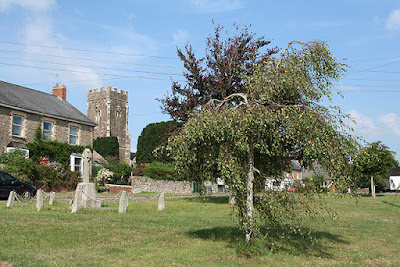
                      Coldridge: village green cc-by-sa/2.0

            © Martin Bodman - geograph.org.uk/p/216476

    What fascinates – but, in light of consideration of the real import of Devon in our national history, doesn’t surprise me about Coldridge is that events from an unsolved puzzle of the past, which is implicitly of national importance, may have had their heart in Devon, too often, as noted, debunked as a county on the sidelines of history. Coldridge is one of a cluster of parishes in the vicinity of mid Devon which in medieval and Tudor times were controlled by and often inhabited by a tangled kin network of the most powerful in the land, many of whose genealogical charts linked them closely to the Crown. Key individuals who had links with Coldridge during the period when John Evans was in the parish included Robert Markenfield, Sir John Speke and Thomas Grey. And then there were a handful of important women linked with Coldridge (whose lives were to some extent documented) such as Anne Duchess of Exeter and Cecily Bonville, All of these immediately link up with extensive networks of other Devon-rooted and powerful people.

    Ok, you may now be thinking, how could the beliefs about the lost networks of possibly literary linked medieval and Tudor women be relevant in any exploration of the Coldridge Edward V mystery? Well they may not be, but during my research I’ve uncovered various names of intriguing women whose direct connections with other parishes/places very near Coldridge -including North Tawton and Ashridge - could help lead to new threads of discovery about some of the important players involved in the dramas of the time. I’ll explore this idea further below.

***
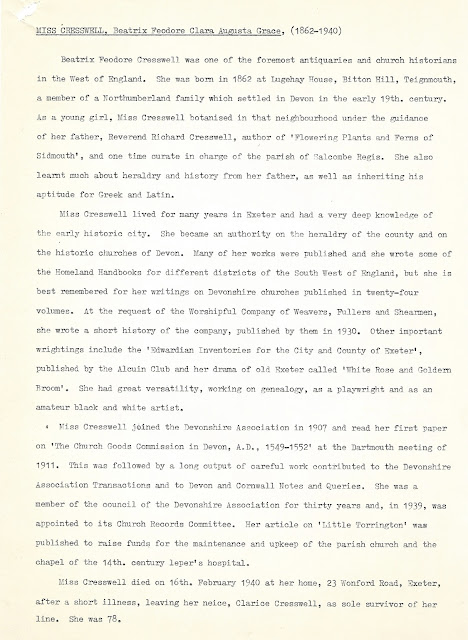
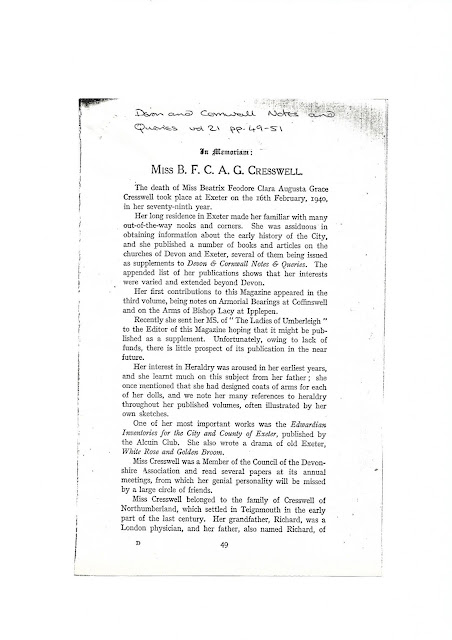
    First though I want to return to where I began this post and introduce the next on my list of current what I thought were disparate projects which the visit to Coldridge launched - the next, ie this post of my Blog. During a time when we've all been preoccupied by pandemic issues I’ve been mulling over scraps of archival material about Devon historian/author Beatrix Cresswell; I wanted to write a post featuring Cresswell and her writings but didn’t know where to start as she was an extremely generous, prolific writer about all things Devonian. Then, out of the blue Holly Morgenroth FLS | Collections Officer at Exeter Museum, another generous researcher and reader of my blog sent me during one of the lockdowns in 2020 asking if I was interested in archival material about Beatrix, which Exeter Museum held, along with other documents about the Cresswell family. Holly then sent me some papers pertaining to Beatrix, They included a copy of an article/obituary, In Memorian; Miss B FC A G Cresswell. (published in Devon and Cornwall Notes and Queries vol 21 - see image of first page above); and a typed page of a brief account of her life. It may be rather faint but here is the image of that page:

 Holly also sent me a link to information held in the Collections at ramm Exeter concerning Beatrix' father Richard Cresswell. All of these inevitably stirred me to look via Google into other related papers and information. 


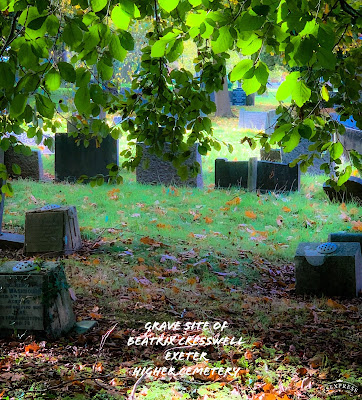
    Any serious local historian studying Devon history will soon stumble upon a feature about a place or person which has been written by Cresswell. Amongst a wide variety of writings her most extensive work is the multivolume typescript account of every parish church in Devon arranged by deanery, which is held by the Westcountry Studies Library. Many of the sites which focus on the past of a church, parish or place take their information directly from the previous work of this significant author, And yet, other than the fragments and files held about and by her at Exeter Museum and Devon West Heritage Trust (mostly a series of her Diaries which may well be richly informative, but which as yet I've not had opportunity to view) and  The Cresswells of Winchmore Hill: A Gifted Victorian Family, the book about the  Cresswell family written by Peter Hodge, and little features such as the one linked with Crediton Museum, there does not appear to be any special paper or indeed book about Beatrix’ life and remarkable individual contribution - an amazing body of work - about Devon’s history and antiquities. Indeed, on a recent trip to locate Cresswell’s grave at Exeter's Higher Cemetery I found the site unmarked (except in cemetery records); there is no memorial). Perhaps one day that will be remedied.

    I wanted to begin some kind of write-up about Beatrix, but couldn’t decide how to focus it, so yet again I put off doing so. That changed following my visit to Coldridge. Reading the church guide book I smiled when I read that Beatrix Cresswell had been one of the first ‘experts’ to remark upon and verify the stained glass image in the chantry as being that of Edward V. Of course, it had to be her. Who else? Then, as I read about the people involved in the Edward V enigma and the events of the time within their historical context I stumbled across a reference to Perkin Warbeck’s wife and widow Katherine, or Catherine Gordon, and remembered I’d noticed several times that Beatrix Cresswell had written a short drama based on a fictionalised reinvention of an episode in Gordon’s life, which had been performed at Exeter at the beginning of the C20, I believe in 1910. Why would Beatrix choose to write about a medieval woman whose connections with Devon were minimal I’d wondered?

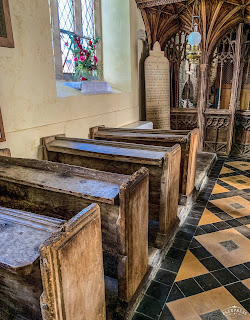
In Coldridge Church looking towards Rood Screen
    Yet, now, sitting in the atmospheric nave beneath one of the ornamental brass lamps which hang from Coldridge church's Rood Screen, I understood. 

Of course, when she visited the church and researched its strange links with Edward V,  Cresswell was probably reminded of the famous events during the Second Cornish Rebellion in 1497, when Perkin Warbeck travelled through the Westcountry with his wife and son. One of the spin-off theories from the Coldridge and Edward V mystery is that Perkin Warbeck was indeed Richard of Shrewsbury, the younger brother of Edward and that the two brothers might have met up when Warbeck was on the way to Exeter and his brother alias John Evans was at Coldridge. (See for example (Medieval Potpourri). I wondered what Cresswell's take on the Perkin Warbeck affair might have been and especially why she had chosen Perkin Warbeck’s widow as the focus for her pageant/play.

  I had to get a copy of the play and find out for myself ...

Acknowledgements 

I'm grateful for the generous help given by Holly Morgenroth of Exeter Museum. 

Links

Ian Churchward's songs inspired by Philippa Langley’s missing Princes project  

A Ricardian Argosy

 See Part Two - Through the Gateways


K ... Keeping West along Devon's Way to Kelly


Looking over Kelly, in west Devon
Photo Julie Sampson
Women Writing on the Devon Land
A-Zof Devon Women Writers' Places 

K for Kelly

       Compared to my post for J and Jacobstowe, the K entry, in this A-Z of Devon Women Writers' Places, is going to be relatively easy. Admittedly, I was a bit split as to which Devon parish to choose for 'K.  Kentisbeare came close second because of E.M. Delafield, whose home was near the village, but the manuscript of Writing Women on the Devon Land includes extensive commentary about that author and she appears in several blog-posts in my other blog, Scrapblog of the SouthWest. (See especially Delafield's Devon DoubleScapes and Sad December at Kentisbeare; E. M. Delafield's Tragedies).

       So, here, I thought I'd travel westwards to Kelly, the small parish near Tavistock, which is straddling Devon's border with Cornwall. So you will find the village on Genuki for Devon and also on Cornwall's Launceston Then. Although I don't really know the area well, having only passed through a couple of times (that's when I took the photos), I am rather fond of the place. It shares its name with the suffix of Broadwoodkelly, another Devon village in the middle of the county, the parish where many of our family's ancestors originated. Various sources note that the word Kelly has Celtic associations with 'grove', hinting at sacred links with the past; both parishes seem 'special'.

       It was in this little village, tucked away in one the south-west's most remote corners, that Mary Kelly, C20 pageant writer/dramatist, lived as a child and spent some of her life. I've already written a short piece about Mary Kelly, at Mary Kelly Devon's Dramatist from Kelly and would like to have lots more time to look into her very interesting life. That's not going to happen just at present, and unfortunately Mary Elfrida Kelly does not put in an appearance in Writing Women on the Devon Land, but at the very least, I can mark her links with Kelly and Devon and post several bits and pieces collected from round the internet, whilst (though the photos will be the same) trying not to repeat what I've said in the other blog article. I hope other readers and researchers might find these useful.

       Well ... I was about to begin to do just that - and you will find various literary bric and brac apropos Mary Kelly below - and accordingly, began a customary google search, only to be temporarily stopped in my tracks. I found on Kelly House's website that rather than provide information about Mary the dramatist, the present Kelly family/owners are, instead, rolling out fascinating extracts from Mary's half-sister Margaret's WW1 Diary. It is always exciting for a researcher when something or someone new turns up unexpectedly, out of the blue. I'm sure that Margaret Kelly is just one of many as yet unknown other women diarists from Devon. With the dawning of the internet, new publishing opportunities and current interest in women writers there are going to be many such revelations.

       I have taken a little snippet from this important new diary just to whet your appetite, but to read more you must swiftly switch windows to the KellyWebsite where, in the Introduction you will find more about Margaret, the diarist and about how she is related to Mary, her dramatist half-sister.

     
Snippet from Margaret Kelly's World War I Diary
See Margaret Kelly's WWI Diary


The Kelly Family History Chart
see Kelly Biographies
       

So to return to Mary Elfrida Kelly, whose connections with Kelly prompted me to select that Parish for this A-Z. I found that in 1954 (?) a plaque was unveiled to the writer at Kelly church. I have not yet had a chance to visit the church and can not find this plaque mentioned in descriptions of it, so am not sure if it is still there.


        You will find a biographical outline of Mary Elfrida's life at Oxford Index. whilst several online sites provide information about this woman, whose main achievement as far as her home county is concerned was that following the end of World War One she founded The Village Dramatic society. The Redress of the Past tells us that Mary Kelly composed and organised the performance of pageants herself:
The Redress of the Past about Mary Kelly

       You'll find Kelly's book How to Make a Pageant is available to read online at universallibrary

I have not as yet had a chance to read or study this book or to find any of the scripts of the original pageants she authored. However, it seems from British Theatre Between the Wars (which I already linked to in Mary Kelly, Devon's Dramatist from Kelly),  that Kelly's approach was frequently to promote women's interests, as well as to set down a realistic reflection of the local Devon community as she herself witnessed or observed it. In other words, she evolved and set-into-future-stone a cameo of her village and other surrounding communities as they were at the time, which is such a valuable way of promoting social history. Anyone out there whose historical interest is linked with the locality around Kelly or west Devon would surely find it valuable to seek out Mary Kelly's works.

      A journal article Unlocking the Secret Soul; Mary Kelly, Pioneer of Village Theatre by Mick Wallisis available through the New Theatre Quarterly (vol 16, issue 4 2000). Although I've not had a chance to read this, the abstract suggests it presents a much more detailed and informative resume and analysis of Mary Elfrida's life and contribution to her county's (and nation's) literary heritage.


Looking toward Kelly 

         See also Women Writing on the Devon Land: From the Devon Ridge where a Book Began

Featured post

  Finding a Forgotten Devon Author's Grandmother; Who was Edith Dart’s Granny Jane Sampson? Lanes, distant moor and ‘Lydcott’, a farm (o...