Followers

Showing posts with label North Tawton. Show all posts

Coldridge Church; Conspiracy; the Canns, Connections and Beatrix Cresswell Part One


Coincidentally, and to my delight and surprise - a week after I posted this trio of pieces inspired by Coldridge and the unsolved Edward V affair the mystery has made national news, I believe for the first time, Here is a link to the version published in The Mail. I've not read the first account in The Telegraph as I don't subscribe to that paper but see Edward V The Coldridge Mystery and it's also available on Yahoo

Part 1

Setting the Scene/s

‘And finally did Elizabeth Wydville who died in 1492 in Bermondsey Abbey go to her grave with the knowledge that at least one of her sons was safe and living in rural Devon on his half-brother’s property?’ MedievalPotporri

‘When the princes’ mother, Elizabeth Woodville, sent her daughters out of sanctuary and into Richard III’s care in spring 1484, can she really have believed he had killed his nephews months earlier? Her daughters were a threat to Richard; the eldest, Elizabeth of York, was to marry Henry Tudor if he could win Richard’s throne. Yet they all survived. The simplest explanation for all this is that she knew her sons were safe’. The simplest explanation for all this is that she knew her sons were safe’.(Princes in the Tower)
         It began with a mid Devon church ...

        It is not often that apparently disparate passions and projects come together in and from an unexpected source - in such a way that they demand that one stop everything else and step off at a tangent from a schedule to explore a different journey than originally planned - then lead unexpectedly to a new project interweaving all of them. Such happened to me back in the late summer during and after a mini day trip back to explore a couple of churches in Devon.

 
     We all love a conspiracy! Such I found out of the blue in the second church of my tour. (The first church, Nymet Rowland, just up the rolling Devon hills from Lapford, with its porch entrance carvings of ancient spirals, sun-circle iconography and mysterious Roman letters spelling EMER was equally fascinating). 
Photo Nymet Rowland church
But when I reached Coldridge Church,


where, just as with neighbouring St Bartholomew’s at Nymet Rowland, the door was not locked - and not only that, but the church was beckoning me inside with the seasonal visual and scented arrangements of its recently arranged glories of local harvest fruits and flowers still displayed on the window sills and tables. The porch displayed a dazzle of golden sunflowers and inside, gracing one of Coldridge’s ancient Chantry Chapels, when I saw the green apples circling the base of a vase of sunshine whose light cascaded upon the bowl of the season’s last yellow roses, I knew something special was in store; and not just harvest’s feast of apples.

Photo Harvest display Coldridge
Happily taken back to various nostalgias of my own childhood in other not far away Devon churches quickly it felt as if I was being pulled back, firstly to childhood where, every year in North Tawton and Cheldon, two other nearby churches, I’d spent many childhood and teenage autumnal hours decades ago, along with my mother and other local women, decorating ancient brass paraphernalia with garden and nature’s glories, ready for the forthcoming Harvest service spectacular. (Sadly in my case the splendid floral arrays didn’t ever materialise; my artistic talents did not, and still do not lie in the realms of flower arranging – much I’m sure to my mother’s disappointment).


       (A small digression here. A moan! How different here the church’s fate from that of Cheldon, the tiny church - which I still visit fairly regularly to place flowers on my parents’ grave). Here, at Coldridge and Nymet Rowland, the churches are obviously cherished; whether out of religious fervour or commitment, or purely because they are places of deep beauty and historical fascination, as soon as the visitor steps inside he or she is aware of a local community taking care to reach out care for and preserve their parish church, to celebrate it as unique fount of historical knowledge. In contrast, at Cheldon, lately neglected and (though arguably in accordance with the demands of rewilding) left to the attention of nesting swallows, prolific weeds, and general deterioration, there’s a sense of abandonment - which almost veers towards contempt for the Old and old-fashioned; even an aggressive security alarm sounding out to anyone who dares to venture to the nearby gate to contemplate at the beauty of the wooded Little Dart valley down there below the meadows).

***

     In the fifties, from fields near our home on the ridge north of nearby North Tawton we could see Coldridge on the sky line; it’s only four miles away and my friends and I, child sleuths, would sometimes decide to have an ‘adventure’ (mode of Lone Pine Club or Famous Five), take our duffle bags stuffed with sweets and drinks and wander through the fields and along paths and into nearby Ashridge woods. We’d get the occasional glance of the village on the far ridge. There'd be a mystery to solve. We were certain. We must wander along the lanes over the fields until we reached the place. But no, we didn’t ever quite make Coldridge. Usually our need to get back for dinner or for my friends to go back down to their own home at the bottom of our town called us back before we’d reached the end of the back lane out of Ashridge. Anyway, even if we had trekked that far, in those days the treasures of Coldridge church would have eluded us, although I’m sure we realised that the place was another of our special local landscape sites. We were daughters of the ridge and longed to become as familiar with the village on the other ridge as we were with our Wildridge … and Ashridge

    In the present day, I wandered round the nave at Coldridge investigating the church’s obvious and astounding historical treasures – the stunning pulpit with its grape-frieze; its C15 oak rood-screen with carved oak leaves and floral bosses; the barrel-vaulted roof with Tudor rose bosses and fantastic creatures - DevonChurchland calls the overall effect a ‘bobby-dazzler’. 


    Then I turned my attention to why I’d travelled here in the first place. My original reason for wanting to explore Coldridge church was to see first-hand where one of my grandmothers x three was married, in November 1826, nearly two hundred years ago. Having been baptised and I believe born in the nearby parish of Bondleigh, the woman in question, twenty years old Nan Passmore, apparently had no direct connection with this village. Just like so many others of our family's foremothers Nan was just a scribble of a name (actually a series of names depending which record you looked at – Nan, Nann, Ann, and Nancy) - had no real identity other than her connection with the places that the archives listed as places of baptism and marriage and the facts of her links with the menfolk in her life. Nan’s married life had been spent in Broadwoodkelly, another parish within a crow-throw from Coldridge.

    Also, excitedly, Nan had married a man whose own ancestry I’d recently discovered led me as amateur genealogist into the exciting new territory of ‘Gateway’ ancestors - a lines of predecessors which when the amateur genealogist stumbles upon it means that an individual in your family tree links you to already known genealogies, usually from history’s great and good, thus allowing you as researcher to add a bounty of fascinating personages to their previously - at least superficially - nondescript family tree. As I understand it, a Gateway ancestor is invariably from a landed family with money and land, mostly just one degree from then royalty, which makes tracing this family-branch path through life pre-1837 much easier – and more or less without exception, means you will be linked up in a direct line to someone of real ‘status’ from the deep past, ie royalty or aristocracy. As a bonus, a Gateway ancestor also inevitably takes the family researcher back to fascinating places of history, such as large manorial estates and old castles!

    So, I’d wanted to follow Nan Cann, see where her wedding journey led me; step inside the church, stroll up the aisle, conjure the young bride, my great great great grandmother tying the knot with Bartholomew Earland, the bridegroom - who, baptised in another of the mid to north Devon parishes, at Iddesleigh - may have been linked with nearby Nymet Rowland. I wanted to rekindle Nan’s life-journey. I hoped to stumble upon something, a clue which might suggest why the couple were married here, hoped also to find a few gravestones outside that might open up new avenues for genealogical research. (I did note several stones with a family name, which may eventually lead something more productive about my quest after Nan. But hey, that’s another story)!

    Well, there you have it, one of my own personal passions - family history. Not directly connected to writing blogs or poetry or texts about neglected women writers from Devon you might think, or generally with the life-journey of a poet – one of my ‘other’ main creative passions - though in actuality during the long solitudes of lockdown the disparate interests had already begun to draw closer. As I began to trace some of the so-called Gateway ancestors ideas following the discovery of Bartholomew Earland, I’d started drafts of a sequence of poems whose focus was and is a kind of poetry ‘mapping’, an evocation of some of these long lost 'gateway' women, many of whom, even though their names and complicated kinships appear on archival records, have left not even a recorded snippet or trace of their own unique life-journey; and in this respect they are nigh identical to the other 'commoners' in one’s family history, whose names in the listings occur with the bare fact of an accompanying baptism, or and marriage or, and if you’re lucky, a burial date. In common, all these women, aristocratic, or poor as church mice, are history’s invisibles. Here is the beginning of one gateway poem in the as yet (unpublished) sequence: 


***

Before leaving Coldridge church I returned to sit in one of the pews to have another more careful read through the guide book. Make sure I’d not missed anything of importance. Well, I had! In behind the rood-screen (and not easily reached as its now used as vestry) there is an effigy, not your common-or-garden memorial of a once Lord of the local manor, but a late C15/early C16 mystery man. (Didn't get a photo when I was there but here is a link to the amazing image on the out of this world website Devon Churchland). 


That’s when it began to dawn on me why this old church is so uniquely intriguing; where the mystery, the conspiracy come in. I couldn’t believe I’d not heard of it all before. You can read a variety of comments about Coldridge’s possible connection with Edward V, the young ‘disappeared’ Prince who was briefly King, on various websites - especially this piece; but the general gist is that the young Prince may have turned up and spent his life in Coldridge in the guise of a certain Sir John Evans - whose monument it turns out is in the church behind the screen, behind the organ, in what was once the Evans Chantry originally built in about 1511. Then, in the Evans Chantry there's the rare portrait of Edward V. And it turns out the church contains other equally unique features. Here’s the companion account of the Coldridge conspiracy theory, taken from A Medieval Pot-porri:

‘The effigy is wearing chainmail under his robe and the story goes that John turned up in Coldridge in 1485 after the battle of Bosworth. IF he had been Edward he would have been around 15 at that time. There is however reason to believe that he had arrived earlier in 1484. His mother Elizabeth Wydeville had emerged from sanctuary at Westminster accompanied by her daughters on the 1st March of that year. She had reached an agreement with Richard III and wrote to her son Thomas Grey, Marquess of Dorset, who had owned Coldridge prior to it being confiscated by Richard, but was now in France with Henry Tudor, to return home as Richard would pardon him. Two days later on the 3 March a trusted follower of the king, Robert Markenfield was sent from Yorkshire to Coldridge. Was this to keep an eye on the young lad who had been king for such a short time, Edward V, and who had been secreted away at the former property of his half brother, Dorset, a property which was about to returned to him if it had not already been done so?’ 

     Currently, I understand Philippa Langley, whose determination was responsible for the discovery Richard III at Leicester, is leading an investigation into the intriguing Mystery of the Princes and that one avenue of exploration is that centred on Coldridge. 

***

    And it is in the spaces of credulous unknowing that the second project I mentioned above comes in. My drafts of a manuscript about the lost history of Devon’ s women writers includes sections in which I try to re-imagine the lost lives of women of the higher classes from the deep past of our local history through non-fictional re-castings and fictional imaginings. For example, in Heliodora; an Excerpt I’ve tried to evoke two women of high status during Roman times, at the site of the large Roman fort, 'Nemetostatio' at North Tawton. I’ve researched and written about the mysterious medieval poet Marie De France, (whose identity is as yet un-established) and have concluded that it is possible that she may have been brought up in an aristocratic family in mid Devon. (See Excerpt How Do You Solve a Problem like Maria?). I wrote a poem and then fragment of fiction about Margaret Beaufort, Countess of Richmond, who'd often stayed at her various manors in Devon. 

    I’ve also investigated and found records of names and fragments of writing that seem suggestive of networks of literary communication threading between women from various families of high status. When I came across papers written by Micheline White about some Devon based C16 literary ‘power couples’ I decided my theory was vindicated. ("See Power Couples and Women Writers in Elizabethan England: The Public Voices of Dorcas and Richard Martin and Anne and Hugh Dowriche.” In Framing the Family: Narrative and Representation in the Medieval and Early Modern Periods, edited by Rosalyn Voaden and Diane Wolfthal). 

    I’d come to believe that many of the forgotten noblewomen, chunks of whose lives were spent in and around their Devon estates, left traces of significant contributions to our lost literary history, which if known about might help challenge the norms of the canonical understanding of the county’s literary history. However, gradually I’ve almost reconciled myself to seeing that I was on to a lost cause. A non-starter. To begin with, as a background and by default Devon is often considered as a county on the side-lines of important history. Too many historical reports cast aside comments which denigrate Devon as a county of rural 'yokels’, a backwater of the country where people who mattered did not congregate or live and certainly did not feature in events of national significance. For example, apropos the Coldridge church, as the writer of the brilliant blog DevonChurchland, comments: ‘why would a small church ‘in a gritty little village lost in the boondocks of Devon’ have such a wonderful royal and extremely rare window?’ If Devon per se is not important in the unfolding of history's narratives, then the lives and writings of long lost and forgotten women whose secrets - literary and other - are squirreled away in the archival deposits of various Record Offices/Heritage Centres etc., might as well be denigrated and abandoned to their desolate fate. In actuality, this default belief is so far from the facts that it is ridiculous. Just as a start, as far back as the notorious murder of Thomas a Beckett, Archbishop of Canterbury several of the murderers were Devon men. Then there’s the Sampford Courtenay or Prayer Book Rebellion of 1549; there’s the Spanish Armada 1588; connected to Coldridge's mystery there’s the Perkin Warbeck Rebellion (more of which later). Through the centuries intricate networks of powerful people of both sexes planted firmly on Devon’s soil contributed to the unfolding of history’s national happenings.  When it comes to the women, who frequently inherited lands and title and through marriage passed them onto add to the wealth of their often previously less well-off spouses, they are everywhere in archives, between lines in small print, often cast aside in favour of often detailed information about their husbands, fathers, brothers, uncles or cousins.
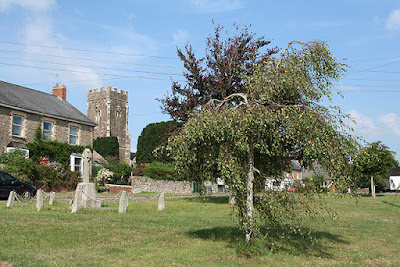
    And here is where the Coldridge mystery comes in. 

                      Coldridge: village green cc-by-sa/2.0

            © Martin Bodman - geograph.org.uk/p/216476

    What fascinates – but, in light of consideration of the real import of Devon in our national history, doesn’t surprise me about Coldridge is that events from an unsolved puzzle of the past, which is implicitly of national importance, may have had their heart in Devon, too often, as noted, debunked as a county on the sidelines of history. Coldridge is one of a cluster of parishes in the vicinity of mid Devon which in medieval and Tudor times were controlled by and often inhabited by a tangled kin network of the most powerful in the land, many of whose genealogical charts linked them closely to the Crown. Key individuals who had links with Coldridge during the period when John Evans was in the parish included Robert Markenfield, Sir John Speke and Thomas Grey. And then there were a handful of important women linked with Coldridge (whose lives were to some extent documented) such as Anne Duchess of Exeter and Cecily Bonville, All of these immediately link up with extensive networks of other Devon-rooted and powerful people.

    Ok, you may now be thinking, how could the beliefs about the lost networks of possibly literary linked medieval and Tudor women be relevant in any exploration of the Coldridge Edward V mystery? Well they may not be, but during my research I’ve uncovered various names of intriguing women whose direct connections with other parishes/places very near Coldridge -including North Tawton and Ashridge - could help lead to new threads of discovery about some of the important players involved in the dramas of the time. I’ll explore this idea further below.

***
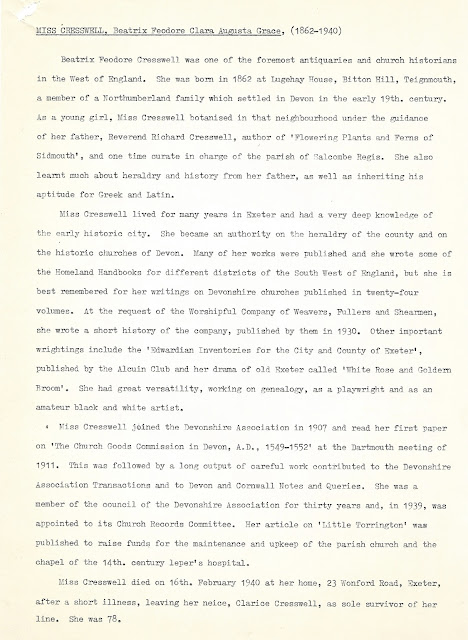
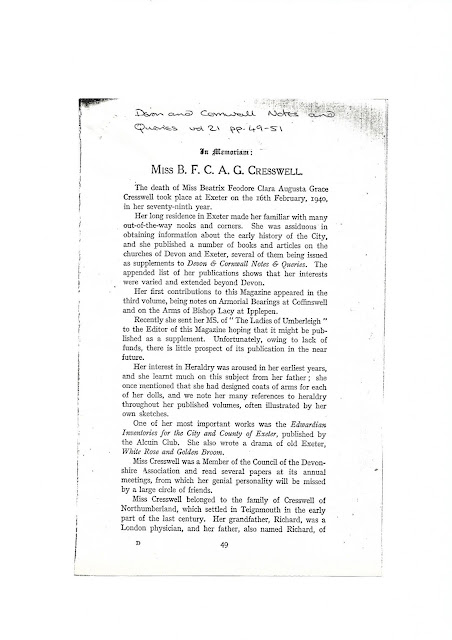
    First though I want to return to where I began this post and introduce the next on my list of current what I thought were disparate projects which the visit to Coldridge launched - the next, ie this post of my Blog. During a time when we've all been preoccupied by pandemic issues I’ve been mulling over scraps of archival material about Devon historian/author Beatrix Cresswell; I wanted to write a post featuring Cresswell and her writings but didn’t know where to start as she was an extremely generous, prolific writer about all things Devonian. Then, out of the blue Holly Morgenroth FLS | Collections Officer at Exeter Museum, another generous researcher and reader of my blog sent me during one of the lockdowns in 2020 asking if I was interested in archival material about Beatrix, which Exeter Museum held, along with other documents about the Cresswell family. Holly then sent me some papers pertaining to Beatrix, They included a copy of an article/obituary, In Memorian; Miss B FC A G Cresswell. (published in Devon and Cornwall Notes and Queries vol 21 - see image of first page above); and a typed page of a brief account of her life. It may be rather faint but here is the image of that page:

 Holly also sent me a link to information held in the Collections at ramm Exeter concerning Beatrix' father Richard Cresswell. All of these inevitably stirred me to look via Google into other related papers and information. 


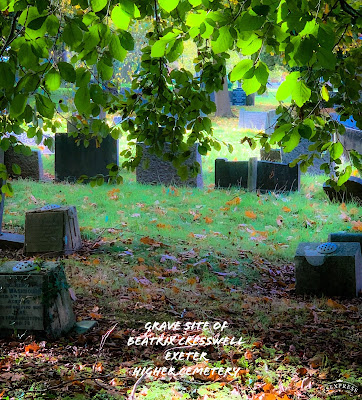
    Any serious local historian studying Devon history will soon stumble upon a feature about a place or person which has been written by Cresswell. Amongst a wide variety of writings her most extensive work is the multivolume typescript account of every parish church in Devon arranged by deanery, which is held by the Westcountry Studies Library. Many of the sites which focus on the past of a church, parish or place take their information directly from the previous work of this significant author, And yet, other than the fragments and files held about and by her at Exeter Museum and Devon West Heritage Trust (mostly a series of her Diaries which may well be richly informative, but which as yet I've not had opportunity to view) and  The Cresswells of Winchmore Hill: A Gifted Victorian Family, the book about the  Cresswell family written by Peter Hodge, and little features such as the one linked with Crediton Museum, there does not appear to be any special paper or indeed book about Beatrix’ life and remarkable individual contribution - an amazing body of work - about Devon’s history and antiquities. Indeed, on a recent trip to locate Cresswell’s grave at Exeter's Higher Cemetery I found the site unmarked (except in cemetery records); there is no memorial). Perhaps one day that will be remedied.

    I wanted to begin some kind of write-up about Beatrix, but couldn’t decide how to focus it, so yet again I put off doing so. That changed following my visit to Coldridge. Reading the church guide book I smiled when I read that Beatrix Cresswell had been one of the first ‘experts’ to remark upon and verify the stained glass image in the chantry as being that of Edward V. Of course, it had to be her. Who else? Then, as I read about the people involved in the Edward V enigma and the events of the time within their historical context I stumbled across a reference to Perkin Warbeck’s wife and widow Katherine, or Catherine Gordon, and remembered I’d noticed several times that Beatrix Cresswell had written a short drama based on a fictionalised reinvention of an episode in Gordon’s life, which had been performed at Exeter at the beginning of the C20, I believe in 1910. Why would Beatrix choose to write about a medieval woman whose connections with Devon were minimal I’d wondered?

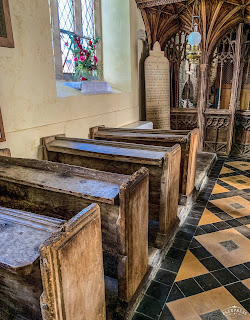
In Coldridge Church looking towards Rood Screen
    Yet, now, sitting in the atmospheric nave beneath one of the ornamental brass lamps which hang from Coldridge church's Rood Screen, I understood. 

Of course, when she visited the church and researched its strange links with Edward V,  Cresswell was probably reminded of the famous events during the Second Cornish Rebellion in 1497, when Perkin Warbeck travelled through the Westcountry with his wife and son. One of the spin-off theories from the Coldridge and Edward V mystery is that Perkin Warbeck was indeed Richard of Shrewsbury, the younger brother of Edward and that the two brothers might have met up when Warbeck was on the way to Exeter and his brother alias John Evans was at Coldridge. (See for example (Medieval Potpourri). I wondered what Cresswell's take on the Perkin Warbeck affair might have been and especially why she had chosen Perkin Warbeck’s widow as the focus for her pageant/play.

  I had to get a copy of the play and find out for myself ...

Acknowledgements 

I'm grateful for the generous help given by Holly Morgenroth of Exeter Museum. 

Links

Ian Churchward's songs inspired by Philippa Langley’s missing Princes project  

A Ricardian Argosy

 See Part Two - Through the Gateways


A Zeal Monachorum author who was 'Queen of Romance' - Margaret Pedler's 'big R' fictions and Devon

     Women Writing on the Devon Land


A-Z of Devon Women Writers and Places  

Z is Zeal Monachorum


A passage taken from The Splendid Folly, Pedler's first novel, published in 1917.


It is not just Devon's 'Queen of Crime' Agatha Christie whose prestigious textual contribution to the genre of crime left its distinctive mark on the literary achievements provided by women writers from the author's home county. Less well-known nowadays - and admittedly, some might judge, a less 'worthy' Devon writer than Christie - was 'Queen of Romance', Margaret Pedler, whose first novel The Splendid Folly, was published just over one hundred years ago, in 1917. The novel received fair reviews from newspapers at the time, including The Western Times, which reported that 'Mrs Pedler would herself make no high literary claims for The Splendid Folly. She set herself simply to write a readable, entertaining, love story with a touch of Devonshire setting and a topical thread running through its plot'. That reviewer's conclusion may be valid; I cannot say whether Margaret Pedler would have assessed her work in these terms, but in any case over the years, as (similarly, in terms of her prestigious literary output to Christie), Pedler produced more and more novels, her fans apparently raved about her them and she became increasingly popular. As I read through some of the many reviews picked up by her work, the contemporary public acclamation of Pedler (whose works came out regularly between 1917 and the 1940s) - became evident. 


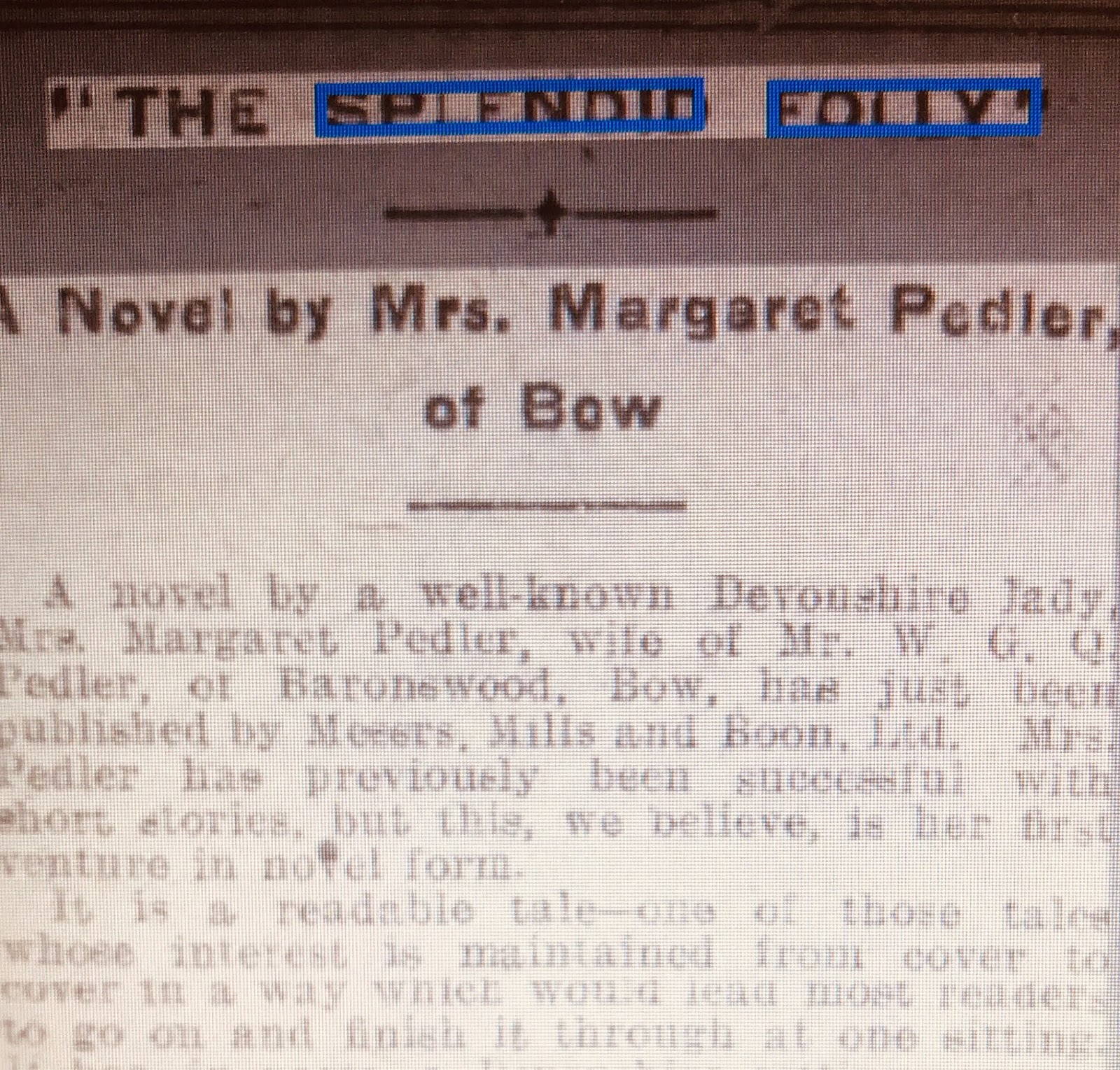
Review of Pedler's first novel The Splendid Folly,
 in The Western Times, 28th March 1917

       And Pedler didn't have to wait long to achieve success, for soon after the publication of The Splendid Folly, a silent film adaptation of the book starring Manora Thew was produced by Arrigo Bocch. The film's treatment of the novel's plot, in which the repercussions caused by the jealousy of a girl (who's established a career as a famous singer) of her husband, whose royal connections she is initially unaware, unfolds against the dual backdrops of Devon and London. In part set in luxurious Capri, rather than at the rural and subdued Devon landscapes of its literary original, it may have been the film version of her story that initially propelled public interest in Pedler's writing.

Taken from a review of the film of Splendid Folly, published 
in The Bioscope, 11th December 1919.


A review of the film Splendid Folly, in The Bioscope, in 1919, noted that its stand out features included the 'enchanting glimpses of the Naples seaport'. However, the review concluded that although 'the tale is well suited for film treatment … the scenario, by Hegley Sedgwick has been somewhat clumsily constructed'. Whatever its ultimate appeal, the film version of the book must have brought public attention back to the budding author in Devon, who must have felt encouraged to pen more novels in the romance mode; as you will find if you look her up on Wikipedia, by the time of her death, in December 1948, Margaret Pedler had about thirty novels to her credit. Newspaper coverage around the time of many of their publications promotes her work in such terms that public demand must be assumed. Catchy headlines such as 'Book of the Week'; 'It's a Pedler Story'; 'Margaret Pedler Writes AGAIN for The Red'; 'New Book by Margaret Pedler'; or 'Wonderful New Romance by Margaret Pedler', appeared in a variety of nationwide newspapers and magazines. (I'll add a few images here to give you an idea of the variety of media coverage that Pedler's books received).
Vision of Desire, 'good honest romance', advert in The Scotsman, 1922.
Synopsis of The Shining Cloud in Hastings Observer 1935


Red Ashes, in Dundee Courier, 1924


          Promoting her third novel House of Dreams Come True, The Red Magazine even declared that 'Margaret Pedler is without doubt the most popular woman author of the day', which indicates that her rise to celebrity status in what contemporary C21 'Queen of Romance' Nora Roberts labels 'the big R', fictional genre, happened swiftly. Pedler's popularity evidently continued for some years, for during the interwar years several sources name her books as best sellers.


        However, the young writer had not chosen to take up writing as first choice of artistic career. One source suggests that before completing The Splendid Folly, she may already have written short stories. However, as a young and talented musician who studied both piano and singing at The Royal Academy of Music, Pedler, or, as she was born, Margaret Bass, initially composed and published classical songs. I found two of Margaret Pedler-Bass' songs held at The British Library, including 'Where we Met at Morn' (see inserted image). a traditional classical lyric, which is reminiscent of songs such as 'Linden Lea' or 'Silent Noon' written by Pedler's contemporary, Vaughan Williams.
Page taken from song Where we Met at Morn
by Margaret Bass/Pedler
   
       Here is a copy of the record the Academy forwarded after I requested information from them about Miss Margaret Bass:


Name: Bass, M.
Home address: Greenroyd, Teignmouth, S. Devon
London address: 35 Dorset Square N.W.
Date and place of birth: 4 August 1877, Streatham S.W.
Father’s name, address and occupation: Deceased
Guarantor’s name, address and occupation: Emma Bass, Greenroyd, Mother
Date of entrance exam: 21 September
Date of entering Academy: 25 September
Principal study: Singing
Second study: Piano
Harmony
Elocution
Extra studies: Italian, Sight singing
Achieved bronze medal for singing (level of attainment, not a prize)
Margaret Bass attended the Academy between 1899 to 1902.


       Interestingly, Bass/Pedler's musical passions show up in several of her later novels, either in the form of repeated refrains, which preface and then reappear throughout the text, or/and with a heroine who is an outstanding musician, either as singer, or pianist, dancer, or composer. At least one book has a plot which revolves around the dilemma faced by its heroine concerning the conflict between the demands of her musical career and the need to relinquish her own career for the sake of the man she loves. But, I'll return to that in a minute.
   
         As I explained in 'House of Dreams Come True', a short feature about the writer in my previous blog, I already knew a little about Margaret Pedler when I was a child growing up in mid Devon. But at the time I wrote that piece and then included a revision of it in the manuscript about Devon women writers, I'd not had a chance to look in more depth at the author's life and books. So, I decided for this blog piece I'd explore the background of her life a little more, and although Romance books per se as a genre, are not exactly my own reading cup of tea, I'd also give Margaret Pedler's novels a bit of a go. Given that she was once an acclaimed Devon woman writer, I owed her the reading-time; I'd hang-out with her books via kindle, for a week or two. (After noticing that mid-Devon featured as one of The House of Dreams Come True's important locations, I'd already skimmed that novel - the second she wrote (published 1919) - and included a bit about it in House of Dreams 1919); but, I had not then allowed myself to drift into the text, to follow the plot and get a feel for the characters.

                                                                                       ****


        I knew that Margaret had married, as his second wife, William George Quick Pedler, a well-to-do yeoman farmer from Zeal Monachorum in mid Devon, whose family were well established in the area. Although she evidently spent time in London after her writing career took off, Baron's Wood was probably Pedler's Devon home for many years and its location in the parish of Zeal Monachorum is the reason I decided to feature this half-forgotten author for this concluding post of this series, A to Z of Devon women writers. As well as Baronswood and Reeve in Zeal Monachorum, in the mid C19 one of Pedler's forefathers held estates in North Tawton (Great Hole and Great Wooden - See Will of William Pedler 1841). A2A holds other files about the Pedler family which I've not had a chance to look at as yet - see Pedler Family of Zeal |Monachorum. William was cousin of William Carter Pedler, the builder of Reeve Castle. (See the previous blog-post House of Dreams Come True).


Baron's Wood at Zeal Monachorum

      Margaret Pedler appears in the 1911 Census, at Baronswood, with her husband and three servants - a cook, a parlour maid and other servant. However, I wanted to explore Margaret's own birth family to see if I could find more about her early background than the facts of her musical training. Margaret's father's name was given on online sources, which stated he was 'from Teignmouth', but unfortunately he didn't show up on any records I could find via various genealogy websites. I thought I was stuck and that Margaret's own identity was to remain elusive. However, I struck gold when, after finding he had recently given a talk on Margaret Pedler, to a local group, I contacted Dr Nigel Browne of Bow in Devon, who was very generous in providing me with fascinating new information about Margaret's birth family. I am indebted to Dr Browne for the following account of Margaret's early life:


'Margaret Pedler ... was born Margaret Bass, to Thomas and Emma Bass. Thomas was born in about 1830 in Ripley, Derbyshire, the son of George Bass, corn miller, and by the age of 21 was working for a tea dealer in Halifax, to whom he may well have been apprenticed. In 1857 he married Emma Firth of Haworth, daughter of a worstead spinner, and by this time he had established his own business in Halifax as a tea dealer. In the mid 1860s he moved to London and established a wholesale tea dealership in the City. This evidently prospered, for by 1871 he was living in a large house in Christchurch Road, Streatham Hill with his wife, four children and five servants, and his eldest son, Charles, was at Clevedon College, Northampton. He seems in all to have had five daughters and three sons, of whom the eldest, Charles, entered the Anglican ministry. / Margaret Bass was born in the third quarter of 1877, seemingly the youngest of Thomas and Emma’s daughters, and benefitted from a thorough and liberal education. She was sent to Laleham School in Clapham Park, a boarding school founded and run by a remarkable lady, Hannah Pipe, who was both a devout Methodist and a progressive educationalist, who employed some very able teachers and gave the girls in her charge a broad and thorough education. Miss Pipe herself came from the Manchester area, and many of her earlier pupils were from Lancashire and Yorkshire, and this may possibly have been a factor in Thomas Bass’s choice of school./ Laleham was a large house on the Clapham Park Estate, laid out by Thomas Cubitt with his own palatial house at the centre. The school had ample room for the 25 girls, and large grounds including a lake, lawns and shrubberies. Hannah Pipe retired while Margaret was still a pupil, but the school continued to be run on the same lines by her successor./At some time in the 1890s Thomas Bass retired from active business and moved to Teignmouth, where he died at his house, Greenroyd, Woodway Road, on 6 April 1898, leaving almost £30,000. His estate was to be held in trust to provide an income for his widow and children, with his sons Arthur and Thomas to manage the tea business'.


          So, here was a wonderful way of entry into the genealogy websites to see if I could stumble upon and expand the information concerning Margaret Pedler's parents' families, the Basses and the Firths. Interestingly, what I found apparently slightly contradicted the facts about Thomas Bass's birth place and family. After following the census of 1871, which, though it confirmed Thomas, Tea Dealer, in Christchurch Road, Streatham (and married to Emma with their four children, governess and servants) - also stated Thomas' birth place as being Langar, in Nottinghamshire - rather than in neighbouring Derbyshire. Out of curiosity, I whizzed back along the archives to see if there was a matching birth for a Thomas in the parish of Langar. Sure enough there was, a Thomas baptised there in 1829, but the entry opened up more questions than it answered because it noted Thomas' mother as Amy Bass - and no father's name was given. After that I only came up with blanks - no easily found facts about who Amy (Margaret Pedler's paternal grandmother) was. One of the Bass daughters (one of Margaret's elder sisters) was christened Amy, which perhaps confirms Thomas' mother's name. I'm including this about Thomas just in case any one else decides to research Margaret Pedler's life; there may be more confirmation required as to the background of her father's family. 

      I had a little more luck when it came to finding Margaret's maternal family; but again, what I found apparently branched a little from the information so far obtained. On the 1871 census in London, the record states that Margaret's mother Emma, born Firth, came from Sowerby Bridge, in Yorkshire, which is just west of Halifax, already mentioned in connection with Emma's parents and about ten miles south of Haworth. Sure enough, an Emma is recorded baptised at Sowerby in 1839, daughter of Thomas Firth and Ann. Emma appears also in the census 1841, three years old, and in the 1851 census, 'scholar', twelve years old, where the family are at 'Green Terrace', Halifax and Thomas, 65, is listed as 'Retired Yarn Agent'. Thomas is listed as coming from Rastrick and his wife Ann from Worley. A Thomas, son of Joseph Firth is baptised in Rastrick in 1786; he may well be one and the same as Margaret's maternal grandfather. Other Firths are recorded in Rastrick during this time, which suggests the family were based in the area over a long period.

       The following may be a red herring, but it is possible there is a connection between Emma Firth's father's family and a Quaker family of Firths who, during the C18/19 owned an estate called Toothill, in Rastrick. Perhaps it is just coincidence, but the names listed as owners of the house are also Thomas and Joseph. If this family should be related to Margaret Pedler's maternal ancestors then these sources will be valuable for anyone who wants to find more about the author's background. I have a feeling there is more out there to find when someone has time to pursue the Firths. 

         But time constraints meant I had soon to take my leave of Margaret Pedler's family, so reluctantly I closed the genealogy websites and opened up my kindle to begin reading her own books. To be honest, other than showing up more Devon-links-as-locations in her novels, I expected to be bored; I assumed my 'big R' read would be more duty than anything else. This time around, after I'd downloaded from Kindle (free or very cheaply) four of Margaret Pedler's books from the early group - including the first, The Splendid Folly, and House of Dreams Come True, Moon out of Reach and Lamp of Fate, then spent a few hours for a day or so in their company, I was agreeably surprised. In each case, once I'd swiped through the pages of the first few chapters, and once I'd accepted the pat-formulae of the plot construction, and the completely contrasting-with-our-own moral universe within which the novels' plots unfolded, I found I was drawn in to the characters' worlds and actually, wanting to find the heroine's 'fate', felt quite compelled to know how they panned out. Noticeably, Pedler's command of language impressed me. Several times, with each novel, I found I needed to resort to kindle's word definition tool; here was someone who had a sophisticated vocabulary and more to the point, knew full well how to employ her understanding to its best advantage. Not to be scorned in our own day and age I thought, given the prolific drip-feed of new often self-published fiction available out there, much of which is hardly worth picking up, or downloading on kindle.

      As far as my own research about women writers with important links with Devon is concerned, Pedler's novels held much of interest. What soon occurred to me was that most of the books I read - or browsed - pinpointed Devon (or if not Devon, other westcountry places) locations as meaningful sites, each one important for the plot's unfolding. So, although, other than the fact her father had retired to Teignmouth in Devon, genealogical research tells us that Margaret Pedler's family background was apparently not closely associated with Devon, the county appears to have become a beloved home territory for the writer. Admittedly I must qualify that statement, as at least one out of this early groups of novels - Moon Out of Reach - features Cornish rather than Devon sites; but it is still safe to conclude that for Pedler the westcountry became a favoured place of retreat and source of creativity.   

       Even DoveGreyReaderScribbles, Devon's popular bookblog, is apparently unaware of our county's once famous romance-writer, (although maybe DoveGrey does not feature books written in the 'big R' genre). However, Pedler's books have caught the attention of at least one recent book blogger, whose assessment of the C20 writer is unfortunately dismissive, scathing and distinctly unfavourable. LeavesandPages's piece on Pedler's novel Bitter Heritage - which came out in 1928 - describes 'A hugely predictable melodrama about a young woman whose father has disgraced himself' and judges it 'of “period piece” interest only, and forthwith shelved accordingly.' 

       As I've already said, I'm not a huge reader of books written in escapist fictional/romance genre, but I believe that this blogger's judgement of Pedler after reading only a sample of her books is rather cursory and hasty. Although, by default Pedler's novels are judged as 'middlebrow', exemplars of popular mass market fiction, with predictable plot lines and somewhat stereotyped characters, they are worthy of scrutiny. It wasn't for nothing that Pedler became an acclaimed novelist during her lifetime, when (as already noted in the previous blog-post), her reputation was compared to other then sought-after women romance writers such as Ethel M Dell and Ruby M Ayres, and sometimes her novels' titles featured as 'books of the week' with such notable authors as Lawrence Durrell. (See for instance Bournemouth Graphic in 1935, which names her latest title The Shining Cloud as 'Book of the Week' alongside his new novel).  There are other indications of the contemporary popularity of Pedler's work: it was often serialised in popular literary magazines (see for example, The Red, 1919, where one headline states that 'Margaret Pedler writes for The Red'); and during the 1930s her books were often held in school libraries. 

      Pedler's work, like so many of our country's half-forgotten women writers, deserves our attention, especially for what it can inform the C21 reader about the ways in which, during a time when women's place in family and wider circles was rapidly changing, early to mid C20 women novelists depicted issues about female lives and roles in society. For someone who is fascinated with westcountry (and specifically Devon) territories, her books can also be telling in their representation of local landscapes - and particularly the ways in which the author interweaves Devon settings with experiences and concerns from her own life. 


Cosdon on Dartmoor from near Zeal Monachorum
        Time constraints and an already over long blog-post mean I need soon to bring this piece to an ending, but as an example of what I mean, Pedler's first novel The Splendid Folly is an excellent book to consider. Ostensibly, in several ways the novel's plot matches its author's own life trajectory. Similarly to the young Margaret, its heroine, named Diana Quentin, whose 'adopted' home is at the rectory in 'the primitive [and'tiny'] Devon village of Crailing', where she was brought up by its rector, her guardian Alan Stair, is building an established career as musician, a singer. As the book begins, Diana is dividing her life between Devon and her boarding-house in London and back down in Crailing, which frequently appears in the novel as a place of reflection, refuge and safety.  The Devon locations in the novel (just as others that appear in other and later novels by Pedler) are fictionalised; but there are reasons to assume that they are sometimes, if not all, based on the author's own life in the county and therefore are places with which she was familiar.  It is tempting to guess and match the imaginary locations with the real-sites - although of course Pedler may well have simply cast them all from her writerly imagination! (I've already conjectured in my previous blog-post House of Dreams, that the house in House of Dreams Come True, her second novel may be modelled on nearby Reeve Castle). 

      In The Splendid Folly Devon's familiar and famous Dartmoor landscape pops up as a place where Diana and her beau Errington take long pleasurable drives, 'tramping ... with the keen moorland air, like sparkling wine, in their nostrils...'. Dartmoor is unmistakable, but other locations in the novel are more uncertain.
Of course, there could be other such apposite examples, but when I read about the 'Crailing' rectory entrance as the narrative describes it, my imagination sped to such a door leading to the old rectory in North Tawton (the neighbouring parish to Zeal Monachorum in rural mid Devon):

'The little wooden door, painted green and over-hung with ivy, was never bolted...The little green door innocent of lock and key, stood as a symbol of the close ties that bound the rector and his flock together...' 

However, quickly we learn that the fictional church is square-towered (so not North Tawton), that Crailing is a 'tiny fishing village', full of thatched roofs, that 'it straggled down to the edge of the sea in untidy fashion', where the 'bold headland of red sandstone, Culver Point, … thrust itself into the blue of the water'. A mid-Devon rural location is therefore out of the question (unless, which is also quite possible, the author mixed and matched her imagined real sites). The red cliffs may take us down to Dawlish, which was once a small fishing-village. The Dawlish area also makes sense for the main Devon setting of this first novel in accordance with the last home of Margaret's father at nearby Teignmouth, where presumably after their move during the 1890s the young Margaret must have spent much time in between school and college terms. It is at a headland site named 'Culver Point', 'which thrust itself into the blue of the water like an arm stretched out to shelter the little village nestling in its curve from the storm of the Atlantic', where 'great red cliffs … reared up against the sapphire of the sky', that Diana experiences heightened emotion, danger, revelation and drama. A dramatic location, it establishes and reflects the novel's emotional tone, crucially as the site of the climatic scenes of its heroine's passionate love encounters. Perhaps Culver's scenery with it 'numerous little bays that fringed the foot the great red cliff' is based on the coastline around Teignmouth, between Hope's Nose and Holcombe. 
   
         Even more interesting, in light of the writer's own life and career - especially with regard to our current obsession with the place of women in the early C20 - it's fascinating to look at the way in which Pedler's first novel tackles some then topical gender issues, especially apropos woman's role in the contemporary world. Specifically, as the narrative explores its heroine's journey-to-find-her-self, the fiction probes the conflict regarding a woman's individual career with her 'duty' as wife. It's hard not to read the story as a take on Pedler's own young self as she negotiates the conflicting needs of her own developing vocation (first as musician, then as gradually highly successful author), with contrasting societal expectations, which demanded that a married woman forfeit her own talents and careers for the sake of her husband's needs. In The Splendid Folly Diana first relinquishes her own rapidly burgeoning career as singer in favour of her new husband; but then she decides to return to her abandoned profession and to find that lost self. Given that the book is defined by its romance novel mode, its heroine's fate is curiously uncertain, for at the ending the narrative strays from its expected happy-ever-after certainty. Its title's potential is shown to be apposite. Is she wise in her choice to leave? Will she regret her decision? We do not know. In keeping with its title, Diana's soon to be future to follow 'love', join her husband in a foreign country, which will take her far away from the professional environment of her singing career, leaves us with suggestively sinister connotations as to her possible 'folly'. It is left to her long-term male singing master to warn:


For long he argued and expostulated upon the madness, as he termed it, of Diana's renouncing her career, trying his utmost to dissuade her. ..
You haf not counted the cost! he fumed at her.
But Diana only smiled at him.
Yes I have. And I'm glad it's going to cost me something - a good deal, in fact - to go back to Max. Don't you see Maestro, it kind of squares thing the tiniest bit? .... and it's such a little price to pay - for love.' …
 
'So, then, the most marvellous voice of the century is to be wasted reading aloud to a Grand Duchess! Ah! Dearest of all my pupils, there is no folly in all the world at once so foolish and so splendid as the folly of love'.


         Given the contemporary C21 fascination with women from our past apropos many disciplines, it seems to me that it is so important not to cast literary-linked names aside as if their achievements were inconsequential to our heritage and as though, because their writings were categorised within genres considered 'non-literary' - 'trivial', 'populist' - their accomplishments were therefore less worthy than those whose books became exemplars of literary endeavour. When I took a little downtime to read a selection of Pedler's novels I found them a true breath of fresh air. Not only was it intriguing to try and work out where the various fictional Devon places in the narratives were really located. Given the current ultra sophisticated online world and unstable cultural milieu with its chaotic and fluctuating moral compass, these novels provide a means to an escapism to a more stable world, where (although occasionally tedious when viewed from our C21 lens and where a woman's own role in society is sometimes questioned) self control, self sacrifice and moral integrity are held up as standards to be emulated. Once you discard your initial annoyance with their predictable narratives, it can be healing and restorative to take a few hours out and revel in these novels' company; ideal perhaps for someone needing to reduce their online social-media, news-obsessed screen-time to wallow instead in the camaraderie of individuals, who greet us, as though drop-ins from another parallel universe....


Well, there we have it, it's taken me much longer than intended but I've now blogged (almost), a post about one or other Devon parish or place and its connections with one, or in some cases, several women writers. If you're out there keeping an occasional eye on this book related blog, do check in sometime in to see where in Devon I'm going next and more to the point, which woman writer from the past will be featuring ...

See also From the Devon Ridge Where a Book Began


Mid-Devon; Spirit of Place & Plath & Pedler


North of North Tawton 


'This topographical heartland of Devon’s palimpsest of invisible and lost criss-crossing labyrinthine landscapes and texts happens also to be the focal point of several of Devon’s foremost and famous literary sites. North Tawton is a place of pilgrimage for writers seeking other famed writers, for it is where the literary couple Ted Hughes and Sylvia Plath spent the last years of their marriage.'

See Extract 3 from 


on the Blog-page -


Near Roman road south of North Tawton


Featured post

  Finding a Forgotten Devon Author's Grandmother; Who was Edith Dart’s Granny Jane Sampson? Lanes, distant moor and ‘Lydcott’, a farm (o...