Followers

Showing posts with label Gytha. Show all posts

Across Devon Lands - Looking towards Literature post Saxon Queens


Across Devon Lands
Looking towards Literature post Saxon Queens

See Extract 7 from


Exeter Castle
from Rougemont Gardens

'As with so many other royal Saxon women linked with Devon’s history, Gytha’s life has descended into one of the dark ‘Her/storical’ holes, although there are glimpses of her movements transcribed within the manuscripts of contemporary texts, such as the Anglo-Saxon Chronicles.' 


Just in Jacobstowe

At Jacobstowe church

Women Writing on the Devon Land

A-Zof Devon Women Writers' Places 

Just in Jacobstowe


Well, for anyone who may previously have stumbled upon this blog and given up bothering to look again, thinking I'd forgotten to update it, here I am - and it is - again. Yes, admittedly I have been preoccupied with other writing projects, but the impasse here, in this A-Z was the letter. 'J' - and the complex deliberations involved as I tried to identify the identity of a certain Saxon lady.

      If any of you out there knows of a woman writer back through the centuries (before about 1960) who has lived in or has an important connection with a parish in Devon beginning with J, please let me know! 


     But then, at the outset I am restricted, given that there is only one 'J' parish. Jacobstowe! I love the parish; before the large family decamped down to Brixham it was the childhood home of my maternal grandmother, who recounted many nostalgic memories about her family. For several years their father Robert Abbott was Farm Bailiff of the Broomford estate (which, incidentally, in a future life was to be the sometime home of Noel Edmonds). 


Entrance gate of Broomford Manor, near Jacobstowe
cc-by-sa/2.0 - © David Smith - geograph.org.uk/p/3498311

(Anyone reading this who's keen on family history might like to skip over to my other 
familyhistory site). I write up this piece in memory of Annie and her siblings. 


     I will pop in an old photo, where Grandma appears as pupil teacher in Jacobstowe; it must have been around the late 1890's as she was about 16/17, having been born in 1884.


Annie Abbott a pupil teacher at Jacobstowe with her class.
Annie is at the back 4th from right. Several of her younger siblings are also in the photo.

       But, no Annie Abbott was not a writer, though scribblings in her sister's autograph book suggest she enjoyed writing lyric verse. 


    Perhaps, in another life, or if she were living now, when, in one way or another anyone who wants to be can be writer, Annie may have pursued her literary interests. But during those days, late C19, life in rural Devon was hard; Grandma had, instead, to earn her keep, learn to cook and care for her younger siblings. That was the story of a great many women's lives for at least one more generation. 


      Before I go on, I will include a short extract from Annie's daughter's memoirs; here she describes the family's life in Jacobstowe. You will see at the end of this extract how, with regard to education and literary endeavour Annie's life journey, as girl, meant a totally different destiny from that of her brother:


My mother seemed to enjoy those teenage years in Jacobstowe when the Rector and Schoolmaster were the most important people in the village. The years she spent there must have been good for her, as, with her affinity with the Schoolmaster, the Rector, his wife and the Lady of the Manor, Lady-White-Thomson, many of her talents were encouraged and given their expression. Much of her cooking she learnt from her mother, Elizabeth, and from the cooks in the Main Kitchen where she spent many hours of her time. She learnt to appreciate music from her piano lessons with Mrs Kruger, the Rector's wife. Some of this knowledge she passed on to her younger sisters, Fran and Ida. They all three became very enthusiastic members of the Church Choir. A group of them met in the Schoolmaster's house where they held Gilbert and Sullivan evenings, where they performed on various instruments. Annie played the Mandolin, Will Stone the Violin. Suzy, his sister had a good voice. My mother also had Wood-Carving lessons. To the ensuing role of Farmer's wife she brought experiences which were to benefit her children, in later years.
    At the age of 16 Annie became a pupil-teacher in the school at Jacobstowe and would have liked to have gone on to College to train but her father couldn't afford the fees; in those days there were no grants. Her brother, Fleetwood, fared better because he went on to St. Luke's College in Exeter paid for by Mr. Stone, the headmaster. 
(written by Clarice Sampson).


       Anyway, to return to the main theme in this post, the more I considered it the more I realised that Jacobstowe is an excellent choice to include in this A - Z, but not because the parish can be identified as the home of one or more famous, respected, or even a single amateur female author. Anything but, apparently. But instead, because of the dearth of specific names associated with the parish, I see the place as a kind of case study, a blank-page, which exemplifies how (in general) until the mid C20 women as writers have tended to face the same fate: eventual absence from the literary canon. Just because there are no names rising above the parapet about a particular place doesn't mean they were not there. Once you begin to delve into the records in any way - i.e., google, or old books, or record offices etc, there are tiny little snippets of data staring up at you. From spaces in the ether. From the depths of history. In the archives they are just names, often passed over, as if irrelevant. 


       Jacobstowe, just as so many of its surrounding Devon parishes is an enigma; its history is fascinating. The Old English meaning of 'Stowe' is Place, often with the added implication of 'Holy', or 'Meeting' Place. Inevitably, as with any rural place in this part of the country, you need to start with the church; if there is anything of historical interest to be found, you can bet it will be there. And Jacobstowe really does come up with the treasured goods, because only a couple of years ago whilst the church's pew platforms were being repaired an unexpected discovery turned up a find, which in context of Devon church history was described 'as rare as hens’ teeth’. The archaeologists found  'the building’s original Eastern wall and a semi-circular wall – or apse'. A piece in Tavistock Times about the excavations notes that 


An apse is a semicircular or polygonal termination to the choir, chancel or aisle of a church building. First used in pre-Christian Roman architecture, the apse often functioned as an enlarged niche to hold the statue of a deity in a temple.

       The findings suggest there may have been a building here during Celtic i.e., pre-Anglo-Saxon times and are so important that they may mean complete re-evaluation of the history of church construction in the south-west. (See Antiquarian's Attic). Jacobstowe may have been a very early holy-site. As Antiquarian's Attic notes,


We know that Irish monks were coming to the West Country in the 5th-7th centuries so perhaps they came here too and formed a Christian community.

(You may like here to wander off and take a look at Boniface's Other Women a previous post in  my other blog, for an alternative or supplementary view about the beginnings of Christianity in the south-west. This piece is part of a much longer and now revised chapter included in Writing Women on the Devon Lands).


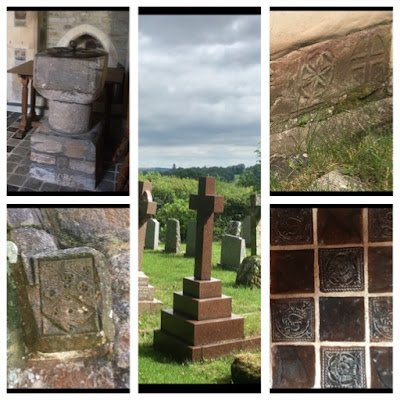
       Apropos Jacobstowe's early church, in the eastern wall of the porch there are two stone motifs - a daisy wheel, or rosette and a Greek cross, which experts believe may be of the C12. 


motifs in stone at Jacobstowe church
Photo Julie Sampson


artist's impression of how Jacobstowe church may
have looked in the Anglo-Saxon and Norman period
(See The Parish Church of St James
Jacobstowe; A History and Guide to this Ancient Church
-

my copy obtained in the church)


      The first female name surfacing in any archive with a (possible) connection with Jacobstowe coincides with the late Saxon, early Norman period, the days of the original church. 


       I say possible with good reason, because recent commentators argue that Ælfgifu, Aleuea, Aleuesdef, Allef, Alueua, Alueue, Aluiua, Alveva, Alwewe, Aueue, Elfgiuæ, Elueua, Æleueua, Ælueua, Ælueue (all forms of the same name used in the Domesday Book) was not associated with Jacobstowe. 


       Many sources about the Domesday Book tell us the following: 


        Iacobescherca
Alueuia habet I mansionem queae nocatur Iacobescherca quam ipsa tenuit ea die qua rex Eduuardus fuit uiuus et mortuus et reddidit gildum pro i uirga et dimidia. Hanc potest arare i carruca. In ea habet Alueuia i carrucam et ii cotarios et i suruum xiiii oues et ualet per annum xl denarius.- Exon D. (487) 450

Alueuia has a manor called Jacobeschurca, which she herself held on the day on which King Edward lived and died, and it rendered geld for one virgate and a half. This can be ploughed by one plough. In this Alvevia has one plough and two cottars and one serf, (and) fourteen sheep; and it is worth by the year forty pence.
      And in the volume Devonshire written in the early C19, it is noted that it was probable that Alveva, a Saxon lady, held Jacobstowe at the time of Domesday:


        Risdon confirms this link between Alveva and Jacobstowe in
A chorographical description or survey of the county of Devon, which I think was published in 1811
:


And yet another C19 source relates how Alveva and Jacobstow/e are connected: 


       However, one hundred years later, at the beginning of the C20, local historians began to change their minds and in one issue of Devon & Cornwall Notes and Queries (see below) the writer was adamant that Jacobscherche, Alveva's holding as stated in Domesday was not Jacobstowe, but rather, St James' Priory in Exeter. 


        Who am I to argue with the specialist historians? I can't. And yet, in some ways, why not? It is far more romantic to imagine Alveva, whoever she may have been, as connected as landholder of the lands circling the then new Celtic church of the little Devon parish. If nothing else, the recent unexpected discoveries at Jacobstowe church tell us that our assumptions about the history of this area are still to be challenged. And the so-called 'expert' historians do not always get their facts (or spellings) correct, because, or for example (as in the passage above) a frequent confusion seems to be to conflate, or swop, Jacobstowe in Devon with Jacobstow, in Cornwall. Although I understand the reasoning in the extract above, what puzzles me is that if Jacobscherche in the DB is the church or priory in Exeter, rather than Jacobstowe, why is the latter not mentioned in said DB? Fair enough, C11 Jacobstowe might indeed have been part and parcel of Hatherleigh, as suggested, but now the remains of the original church have been discovered, does that not suggest otherwise? Was Domesday Jacobstowe, a distinct estate with its own special little holy site - where the 'river Ock streameth by Stow'? (Risdon) I wonder.


        Perhaps we ought to change tack and consider the identity of  Alveva, Alvenu, or Aelfgifu. Who, in any case, was she? Well as far as I can tell, the sources do not seem to make much effort to explain or examine her specific identity. And where they do there is not necessarily agreement. Re Aelfgifu and its alternative names/forms, the domesday pase website notes that 
'A provisional attempt has been made to identify the people recorded in Domesday Book who bore this name; however, the material remains to be checked and edited, and profiles of these people remain to be written.'

This is not surprising perhaps, given the complex variations in spellings of this name. It is hard to be sure and I am not Janina Ramirez. But I have some ideas.  Firstly, the chances are Aelfgifu was from the heart of the then Saxon/Norman royal network, many of whom held lands recorded in Domesday Book. During the time of the late Saxons and early Normans many of these were closely and intricately connected with what is now Devon. And Jacobstowe is situated on the edge of what was then a large royal estate or demesne, whose centre was the upper reaches of the river Taw. In 1066 North Tawton was still royal and South Tawton was held by Gytha, mother of Harold. (See, for example, below taken from W.G. Hoskins, Provincial England; essays in social and economic history). 


from Hoskins' Provincial England
      Some of the women from the royal clan were born in Devon, or/and lived there, or/and held lands there. Famously, Gytha, Harold's mother, was in and made her escape from Exeter in 1067, at the height of the Norman Invasion. 


from Pauline Stafford
Women in Domesday

        I have written about some of these Saxon and early Norman royal women in the manuscript of Writing Women on the Devon Land (See From the Devon Ridge)In particular, I have tried to emphasise these women's probable literary expertise. For example, Elfrida or Aefthryth, a Devon daughter who became Queen of England, whose own words when in the throes of a land dispute apropos lands near Taunton, can still be read, when she sends her humble greetings to an Archbishop:


I bear witness that Archbishop Dunstan assigned Taunton to Bishop Aethelwold, in conformity with the Bishop's charters ... And the king said that he had no land to grant out, when he durst not, for fear of God, retain the headship himself; and moroever he then put Ruishton under the Bishop's control. And then [Wulfgyth] rode to me at Combe and sought me 

     This rare example of a text attributed solely to an Anglo-Saxon queen' is a 'writ, composed sometime between 999 and 1001, which stands out as the only extant document in Ælfthryth's own voice ... Ælfthryth not only acts primarily on behalf of female litigants, but the surviving record explicitly highlights gender as the principal reason behind her intervention [but] as an authority specially qualified to represent female concerns to male authority. (See Old English Newsletter). I quote here from Ælfthryth's writ directly because I wanted to give the sense of these historical women's vivid presence, as well as their commitment to literacy and intellectual pursuits. 


        Surely, we can take as given that Countess Alveva/Aelfgifu of the disputed Domesday 'Jacobscherche' came from the inner circle of the then Wessex royals; or if not, was jostling amongst them. But even that narrowing of the field leaves a tangle of possible candidates. Aelfgifu was a very popular Old English female name and if you begin to look it up in a google search (for the appropriate time period) you may, like me, soon become bemused by the results. Taking into account my own peace of mind and the focus of this blog-post I am trying to narrow my selection of possible women to two; one of them was Queen Aelfthryth's daughter-in-law, AElfgifu or Emma of Normandy wife of  Etheldred the Unready, then of Cnut; the other, through Emma, Aelfthryth's granddaughter-in-law Aelfgifu, or Edith (I have seen her named Edith of Wessex); she was wife of Elfrida's grandson, Edward the Confessor) who happened also to be one of Gytha's daughters - but I must stress that other women of the time could equally have been the elusive Alveva of Domesday Devon. For example, another daughter of Gytha, also Aelfgifu, who died before her arranged marriage to a Norman nobleman, is said to be named in the DB - see The Godwins. Then, there is Aelfgifu of Northampton, Cnut's first wife/mistress.

        Both Emma and Edith had intricate connections with Devon lands, as well as networks of kin from the region. As well, both Emma and Edith, typical of royal women of their day, were highly educated and both commissioned literary works celebrating the lives of their husbands. As far as dates are concerned we may take Emma of Normandy out of the equation in our search for Aelfgifu, for Emma died in 1052, before the Domesday Book was compiled. But, my understanding of the complex issues that swirl round any analysis of the DB is that some of the DB records are of people who had previously held stated land; so, in my mind, Emma of Normandy (who had the title Lady of Exeter) is not yet quite ruled out. There are many links between her and Devon and recently it was discovered that a copy of the literary text she commissioned, the story of her own life The Courtenay Compendium had been stored for many years at Powderham. 

       Emma's daughter in law Edith of Wessex was known to be the wealthiest women of her time, her intellectual accomplishments were also celebrated:


You teach the stars, measuring, arithmetic, the art of the lyre,
The ways of learning and grammar.
An understanding of rhetoric allowed you to pour out speeches,
And moral rectitude informs your tongue

(Godfrey of Cambrai)

Said to be mentor of the spiritually inclined Margaret of Scotland, Edith studied the lives of English saints and her hagigographic account of her husband's life, the Vita Ædwardi Regis was one of the distinctive manuscripts of the period. Edith's name is usually given as Ealdgyth rather than spelled in the form of Aelfgifu, but I have noticed that other Ediths of the Saxon period were alternatively Aelfgifu


       So, either of these women; if she were (or is) identified as the Countess Alveva/Aelfgifu of the Devon Domesday Book' and if Jacobscherche might indeed be Jacobstowe, as pre-C20 scholarship reappraisal, C19 historians assumed; and if she did have any real connection with the place, rather than being just a name inscribed on parchment marking her position as distant landowner, then, as looking back we read the name of a woman from that distant past, we can begin to flesh out a sense of a real person: a noblewoman of the time, who may have visited and tramped across the lands that she held and even, dare I suggest, composed narratives about her life-journeys.


****
       Well, my intention in this piece was to thread up along the centuries through the historical chain and muse upon the possible literary links of several other named women whose names pop up quite often with a google search including Jacobstowe. But time, space and Aelfgifu of The Domesday Book mean that instead I must let them go back into the archival ether from where I first retrieved them and wait for another chance (another researcher?) to re-invent their lives. But before I do I will just jot down a couple of their names together with a little snippet, found somewhere or other on the Internet.  

1.   There is C14 Juliana de Bromford
She was previously married as the second wife of John de Bromford of Bromford and Jacobstowe. She could not have been married to him for very long if he had a son by a previous wife born after 1362 and his own death occurring in early 1363.Julianne married as her third husband Matthew de Hordelegh by 15 December 1387 when they presented at Rackenford. He was again named as ‘Matthew Hordelegh who has married the widow Julianna Cruwys’ when Robert Cruwys confirmed the ‘dower from her late husband Alexander Cruwys’ in 1388 (Wiki Tree)

       2. There is C15 Sybil de Durneford.
         National archives hold a document concerning the Will of Sybil de Durneford at Discovery -
1435: 12d to Rector of Church of Stowe St James (Jacobstowe) to pray for her soul. 12d to the furniture of St. Cross in the said church. 20s for Masses to be celebrated immediately after her death. Residue to her executor, Thomas Prous, to distribute for her soul and the souls of those to whom she is bound, and for the execution of her will. (Who was Sybil?)
       

****

        I realise I must now let this 'homage' to Jacobstowe find its own way in the nether regions of virtuality, and therefore decide on a place to draw this post to a conclusion. My talented grandmother, who featured at the beginning and frames this whole piece returns to haunt the white screen, whilst synchronistically, a rather unexpected finding surfaces via the web. I find that during the time that Annie Abbott's family lived at at Home Farm, on the Broomford estate, in Jacobstowe, late C19, a portrait of Anna Seward, so-called 'Swan of Lichfield', who was once one of the country's foremost C18 female poets was displayed in the main house. I hesitate to display an image of that portrait for obvious copyright reasons, but you can see it here at wikipedia commons. It is a striking picture of the acclaimed poet, who, in the active act of turning the page of a book (of Milton's poetry), (or perhaps marking it), returns her gazes reflectively, intently back, at the viewer. If my grandmother was lucky enough to have been invited into the inner sitting-rooms of her family's employer, though probably unaware of the identity of its subject, she may have had the pleasure of viewing this painting of the renowned poet. And the literary nature of its content can not have escaped her.
    

      It seems that Anna Seward was related to the White-Thomsons. Robert White-Thomson inherited the portrait along with the miniature (see above). Somewhere, I have come across information re the rather intricate details of their familial connection, but can not at present locate it. Another source, the National Portrait Gallery, tells us that the painting was passed to Anna Seward's nephew 'Thomas White of Lichfield, thence by descent to his grandson Leonard Jauncey White-Thomson Bishop of Ely of Broomford Manor, Exmouth' - but there may be errors in this explanation. I think Leonard was probably Robert White-Thomson's son, but shall leave it to other detectives out there to chase up the detailed genealogy of the families. A good place to start is at Liverpool University archives with White-Thomson's Letters. 
       I do not think that Anna Seward had any personal links with Devon - though as I have not had a chance to study her life, I may be wrong. However, the poet did apparently make forays toward the county when, travelling south-westwards, she visited Bath-Easton. See, for example, Revolutionary Players
       But I like to conjure an image of this once famous female C18 poet gazing down from the wall of the Devon drawing room through the corridors and hallway, out of the gabled porch of the splendid new Neo-Jacobean mansion, to the rural vistas of the mid-Devon village where my own maternal grandmother spent her formative years. Symbolically, she, the poet-on-the-wall, represents the occult nature of hidden potential, as well as the lost literary accomplishments of a variety of women from the endless past stretching way back before her, at least to a distant point of time when a little wooden church was built on the special site next to the special holy well of the 'stowe'. 

Inside Jacobstowe Church

See also From the Devon Ridge Where a Book Began

H ... Her-Story at Hartland

Hartland Abbey
 © Copyright Roger Cornfoot and licensed for reuse under this Creative Commons Licence

             A-Z of Devon Places and Devon Women Writers

Her-Story at Hartland

       My choice of Hartland for 'H' in this A-Z of Devon places associated with Devon women writers is twofold; I have two 'Devon' women in mind. They lived centuries apart and, for different reasons, both of their lives and specific connections with Hartland are swathed in mystery. They are Elizabeth Stucley Northmore, who was a C20 writer and the very much earlier Gytha, the C11 Danish noblewoman who spent part of her life in Devon, and became mother of kings and queens. 

        Not much appears to be known about either Gytha or Elizabeth; but they share certain characteristics, especially their upper-class ancestries.

        Fifteen or so years before she escaped from Exeter down the river Exe and from thence more or less out of his or herstory, Gytha mother of King Harold, is said to have founded Hartland's first collegiate church: 
The history of the area is obscure, however the first recorded building here was a collegiate church served by twelve secular canons founded ca. 1050 by Gytha, Countess of Wessex (mother of King Harold). Traditionally the church was founded in thanksgiving for the preservation of her husband's life in a storm at sea; a better tradition associates her husband Godwin, Earl of Wessex and holder of the royal manor of Harton, with the foundation.(Wikipedia)
         A stained glass window at St Nectan's church at Hartland depicts Gytha, but her Devon links are more directly associated with Exeter and her dramatic escape from the city during the Norman conquest. And no, I can not tell you that Gytha was an C11 writer; neither can I state that she was a Devonshire woman. And sadly, there is nothing else I can add about her connections with Hartland. But, I have written about Gytha in the chapter I have called Pastscapes, in Writing Women on the Devon Land, in which I have attempted to narrate a chronology of women who wrote (or may have written) texts in the county during the early hazy centuries of the pre-Medieval age. Approaching the years coming up to the Norman Conquest Gytha held a pre-eminent presence in Devon; she is referred to in many contemporary documents. Like her royal predecessors and followers who also had strong Devon connections - Elfrida, Emma and Edith - Gytha, owner of massive and spread-eagled acreages of Devon land, came from within the heart of networks of richly literary minded people. I picture her with a circle of kinswomen who were in one way or other actively engaged in contemporary literary activity, such as the reading circle gathered around the Exeter Book's texts.

        I have not had a chance to re-visit Hartland or the abbey in recent years, so this blog piece does not include any scans of my own recent photos. However,  I did once, many years ago, have the honour of being invited to tea there with the then owner and his wife. (And no, if you have already come upon the piece for Castle Hill at Filleigh in this blog and read about my tea-visit there many years ago, I did not and do not make a habit of being entertained at Devon's most prestigious places). But both of these visits were directly or indirectly due to locally born author Elizabeth Stucley, who during the mid 1960's, became a part-time neighbour, and consequent 'friend' of my family after she bought and renovated a derelict cottage in Cheldon, the Devon hamlet/village where we then lived. 


Around Cheldon in 1960s

  One of the Stucley family's main residences, at Affeton castle, was, and is just east along the lanes from Cheldon. Sir Dennis, Elizabeth's younger brother was gifted Affeton in 1947 and I wonder now if the cottage his sister restored was one from his extended estate:
In 1947 he was given by his father the estate of Affeton, when it comprised the manor and parish of West Worlington, with the exception of the glebe land, Burridge Farm and woods in Chawleigh parish with further land in the parishes of Chulmleigh, Cheldon and Meshaw. He made substantial improvements to the tenanted farms to which he brought mains electricity and piped water supply, with "modern amenities" for every house on the estate see Affeton

      Back at Cheldon, the letting cottage restored by Elizabeth the writer, Bull's Mead, became the holiday haunt of a panoply of people, all of whom lit up our rural idyll, bringing life, fun and games to what was then a predominantly reclusive neighbourhood. The eye-opening swinging sixties events just had not begun to infiltrate the place. Well, not until Elizabeth marched in with her motley crew.  Street View from Cheldon shows the cottage the author renovated, just left on the road past the church heading toward Chawleigh.


Cover and first page of Elizabeth Stucley's popular
children's novel Magnolia Street

        Elizabeth Stucley herself was one of those larger than life gregarious, eccentric characters. You never knew what she was going to say, do, or plan next. She'd turn up out the blue, trousered, tousled greying hair, in her Citroen (memory says it was green, but I'm not sure I can depend on that), with her adopted son, or/and other hangers-on, including his girl-friends. Her image and persona perfectly matched that of the exotic adventures described in her various books. Inevitably, once the party had settled in someone from the cottage would pop down to us in the Barton house below to ask some favour: could they have a bath? a bottle of milk, loaf of bread? a lift to Chulmleigh? Elizabeth took to dropping in for coffee and chat with my mother. 
        When one day she discovered I was keen on English literature, but had reached that stage when I did not know what to read for pleasure - on the cusp, but not ready for adult books, too old for children's, she took it on herself to write (or perhaps scribble) me a reading-list on some note-paper. I treasured that list for many years - it spread over several pages - and intended digging it out of the old drawers to scan for this blog. But no, sadly. the list seems to have gone! 
        Elizabeth knew that we could not afford to buy many books and it was the zenith of the period when the Mobile Library van's fortnightly visits to our remote parish was one of the highlights of our life. Between us, in the little hamlet community, every month we piled up a veritable tower of books. Anyway, Elizabeth's suggestions for me took account of the mobile library's stock and I followed her directive on the shelves toward Mazo de la Roche's Jalna series, which soon had me in thrall. I had no idea  - until now, as I do a  little light research for this blog - that de la Roche herself lived in Devon for some years and set her novels in the county - and now, knowing that fact, am beginning to wonder if, although the two women were thirty years or so apart in age, Elizabeth may have even known her. 
        Many of the literary fictional classics were on the list as well -'You need to read widely and have a broad sweep of books in your head' - Treasure Island, Moby Dick, Jeeves, Gone With the Wind. There were books by  Dickens, Brontes, Winston Graham, Daphne du Maurier. Both of the latter writers were of the same age as Elizabeth Stucley, all born between 1907- 1908; I don't know if she had met either of them. Our visiting author (steering well clear of Enid Blyton) did tell me about her own children's books. Out of curiosity, I read Magnolia Buildings. But I was fast growing out of that stage and soon returned to Mazo de la Roche and Winston Graham. My favourite of Stucley's books now as I remember those days is her travel memoir, A Hebridean Journey; With Johnson and Boswell, written in 1956, which follows in the steps of Johnson's and Boswell's famous tour of 1773.


Page from Elizabeth Stucley's A Hebridean Journey
Photo Julie Sampson


          Elizabeth treated my mother to a couple of weekends in her home at Bath, and me to day-trips with her and her various entourage.  It was on one of these that we went to tea with her brother at Hartland Abbey. On the way, we called in to her old family home in Bideford, Moreton House. Here is part of what Wikipedia says about the house: 
The now "Stucley" family, which had inherited other substantial residences at Hartland Abbey, Affeton and North Molton, sold Moreton House in 1956, after which it was occupied by Grenville College, a private school, which vacated the site in 2009. The house is a fine example of Georgian architecture and had at one time ornate gardens with two lakes, fountains, waterfalls and formal herbaceous borders. The house with five acres of land was offered for sale in 2014 for the surprisingly low price of £500,000 and reached national prominence when the Daily Mail newspaper pointed out that a small one car garage in Kensington, West London, was at that time for sale at the same price as the 28-bedroom Moreton House. The estate agent explained the low price by saying that the house was "too big" (34,250 sq ft., 28 bedrooms, 19 reception rooms, a ballroom and eight bathrooms).[b] The house's former name is memorialised by an industrial estate called "Daddon Court" a short distance to the south of the house.

         When we visited back in the distant 1960s, it was the summer holiday, so the place was more or less vacant.  This was a period when, a teenager, I was not especially aware of or bothered about local history and families and places; I'm not sure I had a clue what Moreton must have meant to Stucley herself who behaved as though she were my 'mother', or 'teacher' surrogate. I see now how she considered me to be yet another ingénue, a protégé, who she needed to bring out and educate in the ways of the world.  Now I realise that Moreton must have been the author's home from the age of six or so, in 1913, when her father moved there: 
Hugh Nicholas Granville Stucley, 4th Baronet (1873–1956), eldest half-brother, son of Louisa Granville. He had moved to Moreton House in 1913 and made substantial alterations.[19] Sir Hugh served as a Lieutenant Commander in the Royal Navy. He was elected to the Bideford Town Council and served as Mayor of the Borough. It was the thirty-seventh time that a member of his family had served the Borough as Mayor. He was also elected to Devon County Council in 1906 and was a county alderman in 1908. His main interests were County Finance and Education. His personal interests were fishing, shooting and landscape gardening. It was he who designed the beautiful gardens which Moreton House was formerly well known for. From 1939 to 1945 during World War II Moreton House became the temporary home of King's Mead Preparatory School, which moved from its premises in Seaford in Sussex. Sir Hugh moved to the lodge house and looked after those boys who were too young to be boarders at the school.[20]

          Although my memory of the day at Moreton and Hartland is at least, hazy, I do remember the exuberant pleasure that Elizabeth took in re-visiting her childhood home, conducting us on a tour round its gardens and accessible rooms as though she indeed still belonged there and had every right to assume ownership.
        And so on, or back, to Hartland Abbey, where this reminiscing feature is supposed to be focused, the place where I imagine Elizabeth was either born or spent much of her early childhood. Although she may as a young girl, alternatively, have lived, like her brother Dennis, at Pillhead, East-the-Water, Bideford; but if so, I'm sure the children would have had ample opportunity to visit the family's main ancestral estate. 
       In my head, I have a photo I took of the abbey with my then Kodak cresta camera. It sits in an old photo album beside a black and white image of a young teenage girl and her mother, close and cuddling one another, sweaters on, faces wreathed in laughter and bodies swathed in scarves. They, and we are on a north Devon beach somewhere. We have probably stopped for lunch, They are friends of Elizabeth Stucley and they must be with us on this day trip. I do not recall the woman or girl's name. I can not even find either of the photos. Just as the reading-list presented to me by the author, over the course of time the paraphernalia have dispersed, who knows where. Possibly they are still somewhere here in my now-home, shut inside a book in a drawer or box. One day they may come to light again and if so I will restore them to this blog.
         So ... the afternoon tea at the abbey? That's all it is. A static memory. Crystallised. There is, I'm rather ashamed to admit, no detail. I was no doubt tongue-tied. Mesmerised. Terrified of dropping the china; scared I'd make a terrible faux-pax. No doubt Sir Dennis (Elizabeth's brother) and his wife Sheila were charming. I think they would have been well-used to their sister turning up uninvited, with her latest cohort. 
         I wonder now, with hindsight, if author Elizabeth was an acquaintance or indeed friend of the Stucley family's cousin-in-law, also writer, Winifred Fortescue, who I wrote about in one of the earlier of these pieces. Winifred is said to have loved Hartland Abbey and decamped there several times. The two women were some twenty years apart in age, but given that Winifred's time at Hartland was during the years of the Second World War, it is possible that the two crossed paths, quite likely more than once. From what I have read about Winifred and what I remember about Elizabeth, the two women shared similar temperaments, an idiosyncratic joie de vivre.
        If you have come upon this feature having googled for Elizabeth Stucley the author, then you may think you have been cheated as you won't have discovered much about her. I have tried to note down a miscellany of my memories about her from the years in which she was an occasional part of our village community. I wish I still had my diary of those days; I wish I'd written down what my mother told me of Elizabeth; even her mementoes of her Bath holidays spent with the writer. But I didn't. I don't. When Elizabeth Stucley died, in 1974, the ones I'd left behind in my family were just about to take their leave of Cheldon for a new home across the valley. I'm not sure when they last saw her. My own time in the parish had finished several years before.
        (Incidentally to this blog-piece, I dwell on how my generation - the last of the pre-digital era - retain the old-fashioned artifacts of time's passing, and think how, with all the negatives aspects of our brave new lives, at least our new digital devices should have their up-side, as they ensure the preservation of our memories, for posterity). 
       So, except in passing, as a name, due to lack of space, author Elizabeth Stucley does not make an appearance in my own book. I wish I could include her. Like many other women authors, she is missing from the Devon literary canon, almost without trace; but that is the reason I wanted to re-memorialise and reinstate her here. 
      
is the best I've found.

See From the Devon Ridge where a Book Began


E ... is Easy ... Exeter!


Exeter Environs


A - Z of Devon Places & Women Writers 
E is Easy
       Well, at first glance, Exeter 'for E' seems an easy choice of places for this A-Z of Devon women writers, in the sense that many writers linked with Devon were also connected with the city. But, when I sat down to begin writing this piece I realised that actually Exeter may be one of the hardest of this A-Z of Devon places. In other words, perhaps too many of the writers on my lists were closely associated with Exeter! It would be possible to have a whole blog devoted just to them. I've found information that shows us women writing in one way or other from the earliest historical records right up to the mid C20. In the book I'm completing, Exeter is threaded like a gem throughout the text as a central county hub, which connects individuals to one another and through the centuries. This is no surprise of course, as Exeter represents a historical slice of time for Devon. 

      I can't mention or include all the writers here, but will have a go at selecting a cluster of them. It gives me a chance to include a handful of authors who don't appear in my book, as well as others who are. A few of them are already well known, but others may be new to you ...

      I'll begin just after the Norman Conquest, during the Siege of Exeter, in 1068, when Gytha, mother of King Harold and widow of Earl Godwin of Wessex, managed to escape from Exeter through the Water Gate, and was rowed away, with her group of 'travelling noblewomen', down the river Exe to eventual freedom, at Steep Holm. Gytha had been staying in a town house in Exeter. 
Gytha
This file is made available under the
 Creative Commons
 CC0 1.0 Universal Public Domain Dedication
We are told about Gytha in the Anglo Saxon Chronicles:
7 her ferde Gyða ut, Haroldes modor, 7 manegra godra manna wif mid hyre, into Bradan Reolice, 7 þær wunode sume hwile, 7 swa for þanon ofer sæ to Sancte Audomare.[and in this year Gytha, Harold’s mother, went out and many wives of good men with her, to Flat Holme, and remained there for a while and thus from there over sea to St Omer (France)]

      Wikipedia is good on Gytha She is said to have escaped Exeter with the help of a priest from St Olave's church, the church that she had founded in Exeter.


St Olave's Church
Exeter

        Why am I including Gytha here, as a writer? You might well ask. No, as far as I am aware, there are no documents which present this early noblewoman as an active author of texts. But, during the times of Saxon and Norman England, women who were closely related to royal circles all had a participatory interest in literature. Many royal women during these years were closely connected with Devon and in particular with Exeter. I discuss these royal women and their engagement with literary activity in more detail in Women Write in the Devon Landscape

****


         Well, now we're jumping up through the centuries to Elizabethan England, when several important women writers were closely associated with Devon. One of them was the translator/writer Anne Locke/ Prowse, who lived in Exeter after she married the then mayor. Before her move to Exeter C16 writer translator Anne Lock Prowse was influential at Court. In 1576, a miscellany published in London by James Sandford, an English edition of The Garden of Pleasure, began with a dedication which situated Queen Elizabeth I within the company of a group of learned and eloquent women, who were her near equals and her own compatriots. Anne, then Anne Dering, is named along with others, including three of the famous Cooke sisters. 

      Anne Lock moved to the southwest of England circa 1585, when she married Richard Prowse, mayor of Exeter in 1590, then apparently spent the rest of her life in Devon. It was whilst she was living in the county that her translation of John Taffin’s devotional Of the Marks of the Children of God was first published, in 1590. Little seems to be known of her time in Devon, but Anne Prowse’s earlier life is quite well documented. Her father, a court functionary, was a diplomat for Henry VII, her mother, a silk woman. Anne moved to Geneva with her friend John Knox in 1557 to join the community of Protestant exiles there. She seems to have been an important figure in Protestant circles of that time.

       With Anne Prowse’s mercantile background, her new home in Exeter probably provided a familiar and safe haven within a welcoming community. Possibly she was a member of the congregation at St Mary Arches; in that church are monuments commemorating several mayors of the city and one, to Thomas Andrew, in 1504, has the arms of the Merchant Adventurers. 


St Mary Arches
 Exeter

        Archival tit-bits mentioning Prowse hint at possible lost narrative threads and these seem to be located somewhere in the interface between the various trading exploratory activities of Exeter based merchants and the pursuits and networks of local Puritanical circles.

             Some of Prowse’s female acquaintances may have had their own links with the south west. She was possibly distantly related to poet Anne Dowriche through marriage and there were other local women such as the female relations of Francis Russell, second Earl of Bedford, whose Devon base was then Bedford House in Exeter; his three daughters, Margaret, Anne Russell Herbert and Elizabeth were of the same generation as Anne Locke and Anne Dowriche and they were related to other women also known for their writing. Anne Prowse does not feature in Women Write in the Devon Landscape, but I have included her in the information section of the website SouthWestWomenWriters  as well as in its Chronology.

****


St Olave's and Mary Arches churches

 
****
         Leaping up through several more centuries and we can look at one C19 Victorian woman who was associated with Exeter through her life and writings. Emma Marshall (1828-99) was author of Winifred's Journal of Her Life at Exeter in the Days of Bishop Hall and a prolific and popular author of her time - here is a list of her works. Perhaps you reading this have heard of Emma Marshall. I have to confess I had not, until by chance I stumbled upon her one day. At the time, I was seeking information not about women writers in Devon, but about another (often related) research preoccupation, family research. (slight diversion here. I was trying to find ancestors of a certain Rebecca Hall, a great grandmother x 5 or 6 from Broadwoodkelly and had reason to believe her family line might be related to that of Bishop Joseph Hall, of Exeter. And, with a google search, up popped Emma Marshall, this once famous female author). To be honest, it was not surprising that one of my research fields interconnected with another; it had already happened several times before. 'You can't have one without the other' had become a frequent underlying refrain of mine. And no -although I have not given up - I did not find (and have not yet found) Rebecca's Hall parentage connected with that of Joseph, the Bishop. But, I did pick up yet another name to add to my Devon women writers collection, which by the time I found the latest name was already chock-a-block with entries. Redressing the balance it's pleasing to include Emma Marshall here in this Exeter entry; unfortunately, because of space, other than a brief paragraph, her life and writings do not feature in the manuscript of the main book I've written. Emma lived in Exeter early in her marriage and at one time lived at 38 High Street, which I believe is now the site of Mountain Warehouse. 
38 High Street
Exeter

       Emma's recreation of an imaginary journal penned from the perspective of Winifred, servant to Bishop Joseph Hall, in C16 Exeter held many detailed accounts about that woman's day to day life; an imagined world within a once real world, whose real author's vanished life linked up with several other such forgotten author's lives. When I returned to have another look at the text I'd been annoyed to find that Winifred's journal conjuring everyday life in the C16, once freely available in cyberspace, had suddenly disappeared into the nether-worlds of virtual reality, making the author's own lost real life vanishings more poignant. 

     As often happens with writers, Emma wasn't the only author in her family. Her youngest daughter, Christopher St John, or Christabel Marshall, born in Exeter in 1871 ought to be more acclaimed than she is. A playwright, novelist and campaigner for women's suffragist, Marshall was born 24 October 1871, at 38 High Street, Exeter. Unfortunately, like her mother, she is missing from my book.

****
          Although she does not appear in Writing Women on the Devon Landscape, I have written a short piece on my other blog about Emily Shore and her Exeter Journal in Emily in Exeter . I'm not sure that you can read the whole journal text without payment, but there is a wonderfully detailed and illustrated account of this young journalist /writer by Barbara Timm Gates, in Self Writing as Legacy. This version, the best source of information about Emily Shore, digitises Emily's diaries so that the reader can see how the original version was changed both by herself and by her sisters.


Excerpt from Emily Shore's Journal. See
By M. Emily Shore [Public domain], via Wikimedia Comm
ons

Barbara  Timm Gates explains and Wikipedia repeats that:

Extracts of her [Shore's] journal were published by her sisters Louisa and Arabella in 1891, more than fifty years after her death. A second edition was published in 1898. Today only some parts of her journal are extant, but in 1991 it was discovered that Arabella had left two of her sister's journals to the British Museum. These journals are now in America as they were not delivered at the time. These journals reveal that Emily's autobiography was, to a degree, converted into a biography by her then elderly sisters.


       There is another link to a printout of Emily's journal
       Emily Shore, eldest of five children, was born on Christmas Day, in Suffolk, in 1819. She began her journal when she was eleven years old and kept it until her death, in Madeira, at the age of nineteen. 
Emily Shore
See page for author [Public domain], via Wikimedia Commons

      Timm Gates notes that the young girl's journal's entries were written  - 'From July 5, 1831, at the age of eleven, until June 24, 1839, two weeks before her death from consumption'. 
Gates continues that
She wrote of political issues, natural history, her progress as a scholar and scientist, and the worlds of art and literature. In her brief life, this remarkable young woman also produced, but did not publish, three novels, three books of poetry, and histories of the Jews, the Greeks, and the Romans, and she published several essays on birds. Written in an authoritative voice more often associated with men of her time, her journal reveals her to be well versed in the life of an early Victorian woman. (see Journal of Emily Shore)

        Emily's visit to Exeter took place between 1836-7, when she was about seventeen. She arrived with her mother on the Salisbury to Exeter coach, in October 1836. In Exeter they stayed with Emily's aunt, uncle and cousins, at 7 Baring Crescent, and after ten days, her mother left her with them. Her daughter recorded: 'Mama went away today leaving me here for seven months, a hundred and seventy one miles from home but I think I shall be [as] happy ... for Aunt Bell is exceedingly kind'. (Journal). Emily resolved to take up her studying again but must also have found time to explore her surroundings. The early pages of her Exeter Journal provide detailed descriptions of walking expeditions where, accompanied by her uncle she took ithe city sights.  


from Emily Shore Journal 1836, 
in Exeter


Emily evidently was able to explore Exeter's surrounding villages and countryside; her journal includes references to days out and about exploring.

..'it reminded me most strongly of past days, when, in full health and strength, I used to ramble for hours amongst the woods and fields of dear Woodbury, in unwearied search of some unknown warbler. .. Exeter April 7th 1837'. 
****
       
       Other women writers have delighted in the panoramic view set before them from the vantage point of Northernhay and Rougemont Gardens. In particular, during the early years of World War One E.M. Delafield, drafted her first novel in the park. I have written about Delafield in my previous Scrapblog in the piece-Sad December, and also in Devon Celebrations.

View from Northernhay Gardens

There are other authors who ought to appear here, such as Priscilla Cotton and Susanna Parr, but they will need to wait until the next part 2 of this A-Z.


Featured post

  Finding a Forgotten Devon Author's Grandmother; Who was Edith Dart’s Granny Jane Sampson? Lanes, distant moor and ‘Lydcott’, a farm (o...