Followers

Coldridge Church; Conspiracy; the Canns, Connections and Beatrix Cresswell; Part Two; Outside Coldridge's Circle -


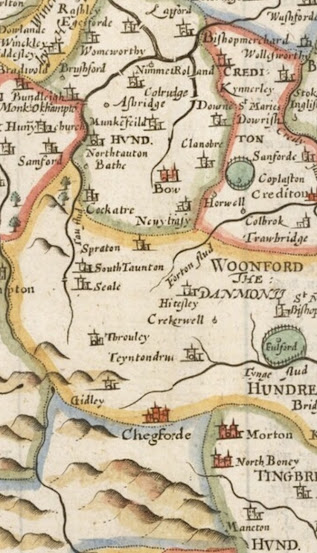
Old map showing 'Coldrudge', 'Afbridge'  and 'North Tauton' 

Part Two    
(See Part One - Setting the Scene/s)   
 
Through the Gateways

        ... Following the visit to  Coldridge I became distracted, the demands of writing new poems for a new sequence about 'Gateway' ancestors taken over by the more rigorous demands of research - snippets of information and names from the Coldridge mystery also fed into the peopled labyrinths of Devon’s late medieval early Tudor families, from whom I was sampling snippets about women's lives into my new sequence of poems. One of the women was Katherine de Affeton, who by now, following aeons of research, I had reason to believe may well have been one of our Sampson family's gateway many many times great grandmothers - through the lineage of Bartholomew Earland - whose marriage with Nan Cann had enticed me to visit Coldridge in the beginning. (See Post One). In my last draft I'd left Katherine peering from her tower at Affeton, Rapunzel-like, waiting for me to return and unite her with a princely spouse:


Looking towards Affeton Castle

 'You
Mistress of all surveyed from the tower -
the deer parks, fishponds, the warrens, and
beyond to the moor’s violet horizon -
it is said wild lynx yet roamed the valley’s wooded groves,
beavers on the little river were hunted by your men for pelts and at dusk wild-cats stirred
 from their dens in old tree stumps.
(From Gateway sequence  - unpublished)


    Reluctantly I had to let the poems go, leave them hanging in the medieval wilds of mid Devon, at least temporarily, and instead try to make sense of all the stuff bombarding me. I’d go with the new flow. Lots of googling. Lots of dreaming. Lots of searching via A2A Discovery. This post started up completely at a tangent to that which I’d planned.

    NO, with a PhD in literature I’m not a trained historian, but literature inevitably spills into, and draws into its orbit the historical events, people and contexts from which it has been inspired. So if this piece occasionally strays out and away from the boundaries of strict literary comment to offer opinion about the historical backgrounds that gave it life, then so be it. Coldridge’s proximity to nearby North Tawton and Ashridge, places of my birth, whose landscapes and lost female histories have fascinated me for years, and from where a number of fascinating and literary-linked possibilities have emerged, spurs me to begin a reflection about some of the families who were connected with these parts and documents linked with them. This may turn out a self satisfying diversion, a chance for me to burrow away, an Alice in the lost rabbit warrens of my childhood lands. Perhaps it’ll turn out to be a prose version of the gateway poetry sequence. But I hope there may be something useful for someone else out there. Whilst not necessarily leading to any bright discoveries re the Coldridge mystery (See Part One) perhaps something here might help to fill in contexts. Any research around the people and places which may be of interest re Coldridge needs to be open-minded, a thinking out of the box, going with an alternative flow,

The Area and its Aura

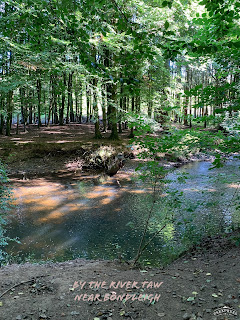
By the river Taw, near Bondleigh
just south west of Coldridge

  A recent feature in a national paper about the recent return of the Dartmoor Railway noted: ‘Many are the legends of lost walkers tricked by swirling mists, pixies or ghosts on the northern edge of Dartmoor, one of Devon’s more isolated corners.’ (Apologies - lost the reference). For those of us who know the lands bordering the moors round here the notion that mid Devon - the places nestled around the northern boundaries of our famous moors - is an area with an aura, a unique liminal landscape harbouring mystery and reverence, is unsurprising. For, not only is contemporary Mid-Devon emerging as an inspirational location for new experiments reinvigorating closed railway lines and introducing eco-environmental reinvention of farming through several of its farms’ engagement with Silvopasture, but for several decades the ancient pasts of mid Devon’s locality have also been attracting attention from various quarters (including historians and archaeologists) because of these lands’ long/standing association with ancient ways of spiritualism. See for example, Michael Wood's In Search of England Journeys into the English Past and Roger Deakin's Wildwood; A Journey through Trees, both of which take great interest in the landscape in these parts as focal site of 'nemetons', once sacred groves and woods. Wood suggests that the important Roman fort at North Tawton may be the location of the important strategic ‘station in the ancient forest’, whilst the nemeton's ‘sacred-core’ could be the recently discovered Broadnymet, or 'Bow' henge -a major focus of ceremonial activity comparable with others up on Dartmoor (or further east on Salisbury Plain’)- which is just a couple of miles east of the Roman plot.


Tudor lady inverted carving in Coldridge Church.
Image taken from Guide Book.

    Like the moors which are focus of its central heart this central part of Devon doubly embodies beauty and scenic attractions; but as well, it's a landscape often linked with danger and darkness. Nothing strange then that several features at local churches, including at Coldridge, appear odd, sinister even. At Coldridge for example, regardless of the identity of the carving in the Barton Chapel of the 'upside down head of a Tudor lady with an enormous tongue!' (Devon Churchland) (or whether she was a joke) the image's very existence is sinister whilst the cryptic inscriptions on the shield in the Chantry, which one writer suggests may be 'mediaeval graffiti' (see A Medieval PotPourri) hints at malevolence - or, alternatively  could be redolent of the esotericism at the sacred heart of these territories. 


Such is the same with the ubiquitous green men, and revolving three hares of nearby churches like South Tawton and Sampford Courtenay and of quirky fixtures in other churches such as Nymet Rowland just up the lanes from Coldridge.

The people and parishes nearby who /which should be considered - North Tawton & Ashridge
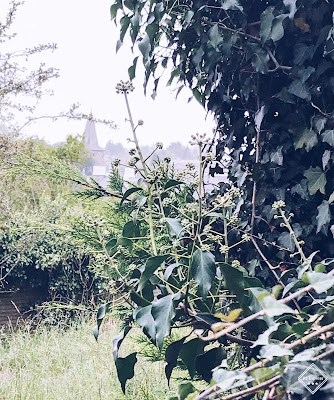
     It’s important to be aware that much of this area in mid Devon was once a royal demesne, so  churches in the vicinity were often created and built by order of powerful patrons, individuals who were one step away from the monarch. Coldridge is one of them and so is North Tawton, whose church has stained glass with ‘sunburst of York badge of Edward IV and Tudor Rose in top of window’ [see The Book of North Tawton] thought to be medieval), and also four angels with shields, thought to be arms of the Valletort and possibly Stapledon and Butler families - all of which were families one step removed from the Crown who feed into the familial circles of those associated with the Coldridge mystery.

Looking towards North Tawton church from Bourchier's Hill

Looking over North Tawton from north of the town
 

Indeed, North Tawton’s and the estate of Ashridge Court’s forgotten history is peopled with a cluster of these then prestigious families. 


I was immediately struck when I came across the following lines from the Richard III blog group (of which I'm not a member, but generously you can read the brilliant discussions).
'What is striking about the Devon group is a number of interconnected families in a small area, who ultimately link up with Arthur Plantagenet, Dorset and Cecily Bonville, people who would have an interest in protecting. Edward V. If John Evans was EV, his identity may remained such a closely guarded secret because of these families' desire to provide a relative who needed to escape his past. (Richard III blog group)
    From genealogical study so far I’d endorse this statement. I see these medieval – C16 aristocratic/noble families as a closed circle of intricately (and more or less 'incestually') connected individuals, people woven together, hooked up over and over again with various degrees of blood kinship, an intimacy which I'd imagine provided situations conducive for conspiracy. (Please note provisos henceforth in this piece - the family networks are mind-boggling, errors easily made and complexities frequently missed! Thank goodness  I’m not writing a peer-reviewed paper!). I can’t pretend to sort out the complex details of who and when and where these families fitted into the manorship and church patronage of North Tawton and nearby Ashridge; others far more qualified to do so have not yet managed it; but there are grounds for suggesting that from these family networks there were individuals who due to close kinship with them may have been linked with key figures at nearby Coldridge - and therefore connected with some of the people involved in the Buckingham Rebellion 1483 and in the events around Perkin Warbeck's Rebellion, in 1497. And if John Evans was Edward V (Medieval PotPourri) perhaps there were people from these families who were in on the secret plot to disguise and bring him to Devon. The North Tawton associated families include several who were closely associated with those whose names feature in the Coldridge affair.
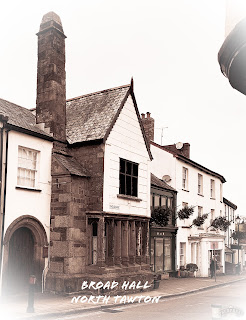
At different times these families - including St Leger’s; Valletorts, Champernownes, Dynhams, Bouchiers, Butlers, Attewoods (Woods) and Hankforths - owned and probably inhabited at least two of North Tawton's most important ancient parish sites - Court Green (now of course famous as home of Ted Hughes and Sylvia Plath) and Broad Hall – which probably dates from about the final decades of the C15) - although it’s not possible to discern which of these families were patrons of the split living/ or/ and manorial owners at any one time. This tangle of families make up the mystery of North Tawton’s/Ashridge's manor-ship and church patronage history; suffice to say here that these families' legal and church association with the parish implies their probable, at least occasional physical presence there ...

    
Ann St Leger Wood of Ashridge, other related  Anns & their families

    A while ago, as part of my imagined reinventions of some women erased from Devon’s recognised past, I drafted a fragment of fiction about a certain Ann St Leger, visualising her as an individual woman from a lost literary network. Ann was a real woman, named in various genealogical charts. As a child Ann may have lived at Court Green and after marriage to Alexander Wood (another leading North Tawton/Ashridge family) - must surely have lived just up the lanes north east from North Tawton, at Ashridge Court the ancient estate just short of 5 miles southwest of Coldridge. (See map heading this post).


     Ann was daughter of Bartholomew St Leger and Blanche Bourchier St Leger, and her husband Alexander Wood or Atwood, was one of the judges who helped to quell the Sampford Courtenay Rebellion, in 1549. In my fictional fragment I  had in mind that Ann was from a circle of literary inclined women. It is entirely feasible that the real women appearing in this fictional fragment did have literary interests, for at these times noble women close to the royal courts were educated and literate. Ann St Leger’s ancestral background took in Eleanor de Bohun, Duchess of Gloucester, her great grandmother x 3, whose 1399 will listed fourteen books, including ‘a book of vices and virtues and another in rhyme of the history of the knight of the swan, all in french.’ (See Women of the Engish Nobility). In my fiction close connections are hinted at between Ann St Leger Wood, Katherine Courtenay, Countess of Devon and Margaret Beaufort, Countess of Richmond (who may during this period have been staying at her South Peverell home - see more about her below). And the women are preparing to enjoy a feast. Here's a snippet from the start: 

    .. You’ll never really know how it was or what really happened here, but I’ll try to tell you, or at least tell you as much as I know. You must cast your mind back a long time – no, further than that.
Concentrate now. We’re in the C15, late C15. It takes time to readjust to the new light of old history,
and don’t forget, we weavers of the re-invented writing have also to realign our creative mode to that of the imagined space. 
    Try to imagine the clothes. It might help. Start at the top. Our lady’s head was adorned with a coif - a kind of net - stiffened with gold threads and to fix it in place she wore a chaplet - a crown like band;
it sparkled with gems of garnet that she’d been presented with during travels in France.
(From unpublished fiction sequence).

    More recently, as I took in the intricacies of the Coldridge mystery it occurred to me how Ann St Leger Wood must have been closely related to some of the elite individuals involved. A glance at Ann’s kinship chart quickly forks out to encompass people closely embroiled with those at Coleridge. The St Leger’s family’s main Devon estate was at Annery near Monkleigh, but by the C14/15, the family had also inherited the manor of North Tawton (see The Book of North Tawton) through dispersal of the chain of descent of ownership amongst several co heiresses, whilst the Wood/Attewood family became holders of Ashridge, a mile and a half or so north-east.

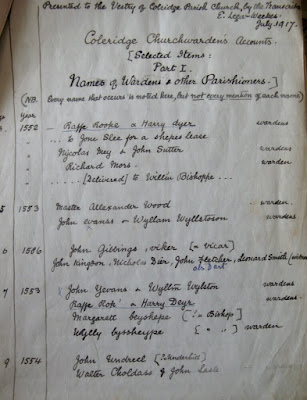
Churchwardens at Coldridge in C16.

    At least one document suggests that the Wood family were also closely associated with Coldridge during the time an individual named ‘John Evans’ (perhaps Evans' son) was there; it is a list of church wardens at Coldridge, which for 1553 names Master Alexander Wood (perhaps the son/grandson? of Ann St Leger and her husband)  as well as 'John Yevans'. (See photo)


Ann's father Bartholomew St Leger was one of the leading rebels implicated in Buckingham’s Rebellion in 1483; he was indicted following that event and his daughter Ann was apparently born the same year. 

    As far as I’m aware although she must have known all about the fate of her father amid the turmoil of this period, Ann St Leger-Wood of Ashridge did not leave a  shred of documentation for us to find in an archive; but other women also named Ann St Leger in her family did. For, there are quite a few 'Ann St Legers' dotted round the networks of interconnected families during this late medieval period. It’s easy to confuse them! A cursory glance at various records in Discovery archives suggests that there are a cluster of documents relating to women of that name from Ann’s extended kin group, who could be useful for those seeking contextual information relevant to research around the Coldridge matter. Any of them could have had close links with the family clusters around North Tawton and or Ashridge, and nearby Coldridge. For example, Ann of Ashridge was first cousin of Anne St Leger Manners, Baroness de Ros, daughter of Thomas St Leger 1440-1483, Ann St Leger Wood's s uncle (her father Bartholomew’s brother), who was also indicted following Richard III’s accession, in 1483, and executed at Exeter castle in 1483. This branch of the St Leger family were at the very heart of the political intrigue which may have impinged on the events around John Evans’s/Edward V's presence in nearby Coldridge. Thomas St Leger had married (as her second husband) Anne Duchess of Exeter 1474 Kent, eldest sister of Edward IV and Richard III, so he was uncle to the lost princes by marriage (whilst through her uncle’s marriage Ann St Leger Wood of Ashridge was Anne Duchess of Exeter's niece). Anne’s first husband was Henry Holland Duke of Exeter of Dartington. Anne of Exeter died (probably) during or shortly after the birth of her daughter Anne St Leger Manners, in 1476. One A2A document references Thomas' daughter  'Anne St Leger 's inheritance following his death; but I've not had a chance to read it because of the cost of access. Anne is Plaintiff, whilst defendants are the two brothers (Ann of Ashridge’s father and uncle) - main players, in Buckingham’s Rebellion - Bartholomew Leger and James St Leger:

C1 109 18 Seyntleger v Seynteleger. Plaintiffs: Anne Seyntleger [St Leger], daughter of Sir Thomas Seyntleger, knight, deceased Defendants: James and Bartholomew Seynteleger, and others, administrators of the goods of the said Sir Thomas. Subject: Jewels and plate of the said Sir Thomas. Annexed is an account by the said James of jewels and plate coming to his hands.

    James St Leger was another of Ann St Leger Wood of Ashridge’s uncles, who married (as her 2nd husband), Lady Ann Butler, whose father was Thomas Butler 7 Earl Ormonde (1424-1515).  I’ve noted above that the Butlers were another in the maze of interrelated families associated with North Tawton manor /and or /church patrons. Said to be a close friend of Henry VII and holding over 72 manors, and one of the wealthiest men in the country, Thomas was captured by the Yorkists at the Battle of Tewkesbury and partially attainted. Following Henry VII’s accession, he was pardoned and became a Privy Councillor. 

    Another document in what I call the A2A 'Ann St Leger' ‘collection’ is the 1520 will of James’s daughter in law Anne Kynvett St Leger of Monkleigh (who married his son George St Leger). Anne Kynvett I believe must have been cousin (in-law) of Ann St Leger of Ashridge. Anne St Leger-Kynbett’s uncle (her mother’s brother) was the infamous James Tyrell, who under the duress of torture is said to have confessed to the murder of the princes in the tower.... 

    Again and again as I write this I find myself naming people from the circle of individuals whose names keep resurfacing in the discussions around the disappearance of the two princes. I ask myself why. 

Extending out the Family Circle Wheel- St Leger – Bourchier – Dynham - North Tawton and beyond

Ann St Leger Wood of Ashridge
was also related to several of the main Coldridge players (See Part One) through her mother Blanche and the extended Bourchier family. As with the St Legers many of these people hook not only into the network of families who were linked with North Tawton manorial and church patronage, but also with other nearby parishes such as Affeton and their associated medieval Tudor families - all of which ought to be considered in light of the Coldridge mystery. (See Part One) We can open out the family circle from North Tawton and Ashridge into other Devon places such as Sampford Peverell, Tiverton, Shute, Bampton, Nutwell, Colebrook and Umberleigh, which were all important sites where others from this cluster of noble families held estates, I can't include them all here as this is a blog post not a thesis! And to be honest the possible Devon-based networks within and across these families which may connect back to Coldridge are mind-boggling and nowadays well-nigh beyond my brain power.  

    But I'll reference a few in such a way as to point the way to a possible link with Coldridge, beginning with the Bourchiers of Bampton (and later Tawstock). Blanche Bourchier, Ann St Leger Woods' mother died in 1483, the same year as her husband Bartholomew St Leger was indicted; perhaps she died giving birth to Ann rather than through the trauma of Bartholomew’s alleged crime. Blanche was a sister of Fulk Bourchier 10th Baron Fitzwarren. They were children of William Bourchier and Thomasina Hankforth, (the Bourchiers’ main seat was at Bampton castle and both William and Thomasina are buried at Bampton church). I understand that at this period it was William Bourchier's family who held the then castle. '1457 William Bourghchier acquired Bampton via marriage to Thomasine Hankeford' . (See REED website about Patrons and Performers. This source suggests that in the C15 dramas may have been performed at Bampton castle). 

At Bampton Castle Motte

    It was in the midst of  this cluster of Devon based families that I stumbled on our 'gateway ancestor' Katherine Affeton Stuceley (mentioned at the head of this post) who I discovered married (as his second wife) William Bourchier; Katherine was thus Blanche's step-mother. Perhaps part of her life was spent at Bampton. It was an eye-opener to trace other branches of Katherine’s history, especially in light of the alleged Coldridge conspiracies - and as inspiration toward the development of my own 'gateway' poetry sequence. Intriguingly, there is also suggestion of a link between the Stuceleys of Affeton, the St Legers, the Woods of Ashridge/North Tawton, and Coldridge, though as yet I have not been able to fathom exact kinships. There is a record of a birth of a Thomas Stuceley son of Thomas Stuceley Sheriff and his wife Anne Wood, baptised 1498 in Coldridge. It seems this family is descended from Katherine of Affeton's son Nicholas Stuceley, and possibly Anne Wood is connected to the Woods of Ashridge, but I have not been able to confirm the latter supposition. As yet all I can find is that Anne's father, another Thomas, is recorded as having been Chief Justice of the Common Pleas, of Childrey, co. Berks. Was he related to the Devon Ashridge Woods? 

    Another significant Bourchier was Archbishop of Canterbury, Thomas Bourchierwho was Blanche and Fulk Bourchier's uncle. Thomas was their father William’s brother; as Archbishop of Canterbury Thomas was closely embroiled in the events leading up to the kerfuffle around the time of the young princes’ disappearance: Archbishop Thomas Bourchier crowned Edward IV and persuaded Elizabeth Woodville to let her younger son Richard go to the Tower with his brother Edward V; Archbishop Thomas Bourchier also crowned Richard III, in 1483. 

   While Blanche Bourchier, Archbishop Thomas’s niece, married into the St Leger family, her brother Fulk Bourchier  (Ann St Leger Wood’s uncle) married into another of the ‘interconnected families [of the leading Devon nobility/gentry] in a small area’ referred to (somewhere) in the Richard III blog. His wife was Elizabeth Dynham, one of four wealthy sisters and co-heirs of Lord High Treasurer, John Dynham, of Nutwood, (in Woodbury; by marriage Elizabeth was an aunt of Ann St Leger Wood). Their son was John Bourchier 1st Earl of Bath). John Dynham was one of the few men who supported all three kings Edward IV Richard III and Henry VII and was one of the judges who tried rebels following the Cornish Rebellion of 1497. Extend out this family cluster a little and we get to John Dynham’s other sisters/co-heirs, whose marriages also hook them into the ever growing number of people whose names and lives can be drawn into any debate about what may or may not have happened at Coldridge. For instance, his sister Katherine Dynham married Thomas Arundell, from Lanherne, in Cornwall; he had been loyal supporter of both Edward IV and Richard III but apparently changed loyalties and was another of the men in this kinship network who was attainted in 1483 following Buckingham’s Rebellion, when his estates passed to his half-sister’s Anne Arundell’s husband Sir James Tyrell (who allegedly eventually later under torture confessed to the murder of the young princes):
The reasons behind Arundell’s involvement are unclear, as he was among a number of rebels who had received grants from Richard III only shortly before the rebellion, as Rosemary Horrox has shown. A possible explanation offered by Dr Horrox, that of family ties, is questionable in the case of Sir Thomas, as he had close relatives on both sides. Quite possibly he was simply prompted by the loyalty he felt for his former lord Edward IV and his young son, and outraged by the actions of Richard (‘The Reburial of Expenses of Sir Thomas Arundell’, Hannes Kleineke)

     Following Henry VII’s accession Thomas Arundell was forgiven and his estates restored, but he died shortly after Bosworth. There were others in the Arundell/Dynham family involved in Buckingham’s Rebellion, including Thomas’ brother in law Charles Dynham, who fled to Brittany following the rebellion. However it is Thomas’ mother in law Dame, or Lady Joan Dynham of Nutwell near Lympstone whose life has attracted recent attention from historians.

Nutwell Court from the Exe
cc-by-sa/2.0 - © Sarah Charlesworth - geograph.org.uk/p/1285689

    An apparently formidable woman who had fingers in many pies - political and other – it is not unreasonable to suppose Joan was interested and involved in literary pursuits. As a start, her early life links her with the medieval times’ most iconic poet and author Geoffrey Chaucer. Joan Arches (birth name) had lost her father at the age of 7; he’d arranged for her to be in the wardship of the then influential royal servant Thomas Chaucer, who was Chaucer’s son. (Joan’s marriage to the wealthy Westcountry Dynham landowner was probably arranged for the profit with which it would supply the said Thomas). According to one source – (Social Attitudes and Political Structures in the Fifteenth Century, edited by Tim Thornton) Lady Joan – who kept Nutwell as her main home base - was an exceedingly proactive medieval noblewoman. Not only did she maintain close control of her extensive land holdings round the country, she also gathered together a household of female attendants; her reeve was a woman and in her will she left a bequest of clothes to her female servants. Lady Dynham also seems to have taken an active role in some of the key dramas and political machinations of her time. In 1459, for example. following the battle at Ludford when Edward, the future Edward IV, had to flee, it is thought she took a pivotal role in the support of her son John in aiding the duke’s escape to Calais - which involved travel through Devon and along Dartmoor tracks known to her servants and then acquisition of a boat. One document held in A2A shows us that following her son in law Thomas Arundell’s death it was Lady Dynham who sent out the order to fetch home his body across the Westcountry landscapes: ‘Costs of Richard Wagot for Lady Dynham, in fetching home the body ('bonys') of Sir Thomas Arondell knight, from Odysdon (also as 'Wodysdon') to Dorchester (via Harbyngdon, Hungerford, Amysbury and Blanford)’. The order includes ‘Black cloth and its tailoring’; ‘wax and tapers left at various places on route and Chideock and Nutwyll’; ‘Timber and ironwork for the horse-litter, and equipment for the 2 horses; Carrying the horse-litter from Exeter to Nottewyll’; ‘Torches, etc., from Nutwyll to Dorchester; Fodder for horses and other expenses’. According to the record’s notes the order ‘is written in a late fifteenth centu'ry hand and can be dated to between October 1485, the date of Sir John Arundell’s death, and the death of Lady Joan Dinham’. 

    A few years later in 1492 another document of ‘Dame Joan Dynham’ (widow of Sir John Dynham) is a complex marriage settlement, jointure, for her granddaughter Elianor, one of the daughters of the now deceased Thomas Arundell and his wife Katherine. Here is an excerpt:  

J.S. to provide all wedding requirements except bride's garments which are to be provided by Dame J.D., C.D. and Sir J.B. John, Lord Dynham, Sir Walter Denys, John Arundell and Charles Dynham esqs., Sir John Biconyll, John Choke and John Hymford, esqs. and John Pole to hold the premises to the use of J.S. till N.S. comes of age, then to N.S. and Elianore for their lives, then to the heirs of their bodies, then to J.S. and his heirs. If N.S. die before he is of age and "Elianore then of the age of 17 years", she to have a life estate in the premises.

    Remaining in favour with all three kings, Edward IV Richard III and Henry VII, perhaps to allow her to steer her path and family according to the prevailing political winds, Lady Joan Dynham apparently managed to steer a judicious way through the turmoil of the last decades of the C15. I’m not sure whether it occurred before or after Perkin Warbeck’s Rebellion, but her death was in 1497 the same year as that event.

    Unlike many women of her time and ilk Joan Dynham’s life has been quite well-documented. For me she is exemplary as a reminder that other women of her kin and circle may well have been actively involved in all kinds of events and  happenings of their time; we can’t assume that just because they now only exist as names in a family tree the women were always passively silent, their lives the background stage-set against which their husbands, brothers, sons and uncles played out the  star-roles on the main stage of conspiracies of the times. It was probably not only the still famous women, such as Margaret Beaufort or Elizabeth Woodville, who became notorious for their various involvements in affairs of state. There may have been other noblewomen, such as Lady Joan Dynham, who were ‘She-Wolves’, some even living out their life-journeys deep in the Devon landscape folds. It seems to me that if a redoubtable woman such as Joan could scheme and organise the get-away of a prospective king then it is quite feasible that others could do the same...

… Ok if you’re still with me you might think I’m ‘scatter-gunning’, straying far from my intended objective to comment on interesting material relevant to the Coldridge Lost Princes theories, and so it might seem, but I’m trying to gather up bits and pieces which are round the edges, begin a kind of cross-section-of-women of the time linked with the mid-Devon vicinity who were linked 1. with the geographical area around Coldridge and 2. closely linked with men who were 'key players', and 3. (in some cases) women whose interests may well have included some kind of literary pursuits. 

Lane to Southmoor Cross
(between Coldridge & Ashridge)
cc-by-sa/2.0 - © Derek Harper - geograph.org.uk/p/2329791
These women were at the heart of the turmoil during the Wars of the Roses with all the political and familial dramas of the time and must have gathered together to discuss with the female kin in their close familial circles and taken keen interest in proceedings as they unfolded around them. Their loyalties must so often have been split.

    And although it might seem as if I am straying from the woman whose name inspired my fictional piece, Ann St Leger Wood of Ashridge, who began my reflection into the connected lives of apparently disparate women only distantly linked with her, I’m not! Ann was connected by blood or/ and marriage with all of these individuals; they were all part of the genealogical jungle of Devon nobility of that time, and even more interesting, they were all in one way or other closely linked with various events or and people that occurred about the time that John Evans was supposedly living in Coldridge. (See Portrait).

Copplestones hooking into Others

    Another local branch of the extensive and intricate genealogical network who had close links with Ann St Leger Wood’s close family circle was the Copplestone family, the site of whose medieval house was once in wooded hills near the main road from Exeter to Barnstaple. Through his second wife (identity unknown) Ann of Ashridge’s father Bartholomew St Leger was also father of Margaret Copplestone who was wife of John Copleston, (1475–1550). John was son of Ralph Copplestone (called ‘The Great’ because of the family’s immense wealth) and his wife Ellen, who was a sister of the Thomas Arundell (whose marriage to Katherine Dynham I’ve commented on above). The two women, Ann from Ashridge and Margaret were therefore half-sisters. John Copplestone, Ann’s ‘half’ brother-in-law was co-heir of his great-grandfather John Bonville.). One writer speculating about the Coldridge affair suggests that it was probably one of the Copplestones whose wealth enabled them to arrange for Coldridge’s screen to be brought over from Brittany. (Chris Brooks and Martin Cherry The Prince and the Parker in The Journal of Stained GlassVol. XXVI). The theory is that the glorious screens at Coldridge and Colebrooke are similar and probably were brought back from Brittany late in the late 1480s by one of those who’d accompanied Henry there, in 1483. 


However, it is not known whether any of the Copplestones were in exile with Henry. If not, then for sure several also wealthy men in Ralph Copplestone’s kinship network did go to Brittany with Henry, including Ralph’s brother in law Thomas Arundell - who was son and heir of Sir John Arundell of Lanheme, said to be the richest landowner in Cornwall and through whom Copplestones link up with the Dynhams of Nutwell (including the evidently indefatigable Joan Arches/Dynham). According to Kleineke Thomas had joined Henry Tudor in Brittany and was quickly an ‘integral part of the inner circle around the pretender’; he provided a ‘supply of money’ to the campaign but was himself accumulating debt. And of course as I've shown, the Copplestones also link up with the St Leger family members who were so closely bound up with all the events at this time. 

   It is interesting that the wonderful Coldridge screen is linked with those who supported Henry Tudor when he was in exile in Brittany because for the most part it is considered that Henry (and therefore his supporters) would not have been in favour of helping the young prince and indeed it is often Henry's mother Margaret Beaufort who is accused of being the main instigator of the children's murder. However, Coldridge's possible link with Brittany through the screen also indicates that there could be another interpretation. Perhaps it was Henry who aided the boy, as suggested in the following comment on one of the posts about Coldridge:

'... On the other hand it’s possible it could even have been HT himself who agreed Edward could be left alone and in peace as long as he stayed incognito. After all he, Henry, intended to marry his sister. Was that perhaps part of the marriage negotiations?'(See Medieval PotPourri)

Margaret and Cecily

....But I find myself drifting from the focus of my literary focused blog and Devon women who wrote in the landscape taken and carried away in this reflection which came about because of the stream of genealogy and its link with lost church history. It's time to try and gather threads together a little. The more I have tried to research some of the family webs who were concentrated in Devon during the years when the country was going through the tumult of the late Wars of the Roses, including the events around the disappearance of the two princes, the more I've realised that the possible scenarios were and are endless. My meditations on the Devon family webs here are just the tip of the genealogical iceberg. I do not have enough detailed knowledge about the timings of specific events nor in particular about the comings and goings of various individuals around the events under discussion, but the theories which are swirling around Edward V and Coldridge are so incredibly plausible, whilst the scenarios involving the possible agency of several of the women seem equally important to consider. There could have been several other Joan Dynhams, women who became actively involved in protecting the young prince; or, for sake of argument, active participants in pursuing his demise. For instance, considering the latter, I have only mentioned Margaret Beaufort, Henry VII's mother in passing so far, in connection with the fictional piece I wrote about Ann St Leger - and the comment above but I must now amend that lack as because of her close associations with Sampford Peverell and Great Torrington, Beaufort was very much linked with Devon. 


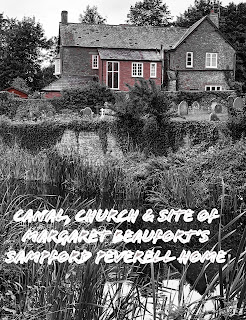
    I've already written a post about Margaret Beaufort and Sampford Peverell in which I mentioned that the historical narrative assessment of this important royal woman tends to stress her political involvements - especially with regard to the focus of this post, as one of the main instigators of Buckingham's Rebellion -  and work as patron of  literary texts, but Margaret Beaufort is an important literary woman in her own right. It is perhaps not generally known that she had close connections with the south west and in particular with Devon. (In my previous post I also reflected on the likely Devon network of other women who may have been active during the time Beaufort spent time in the county). 

    As far as I'm aware  it is not known exactly how many times, or for how long Margaret Beaufort stayed in Devon.  In 1487, a couple of years after plans to get her son on the throne finally succeeded for example, in 1485, the countess was definitely down in Devon staying at her important manor in Sampford Peverell.

    By now, with popular consent she was called 'My Lady, the King's Mother'. During this time, as a keen and avid reader and translator, Margaret may have been reading a then popular chivalric French romance, called Blanchardine and Eglantine. (The moste pleasaunt historye of Blanchardine, sonne to the King of Friz; & the faire lady Eglantine Queene of Tormaday, (surnamed) the proud ladye in loue). Around this period she is said to have purchased a copy of the text from Caxton, then commissioned him to print and publish it in the vernacular, which he did, in 1489.

    According to various sources at the time of its first printing in the vernacular, in 1489, Blanchardine and Eglantine was read as a political roman à clef. During the years approaching the text's first appearance, but presumably before the countess had tasked Caxton to work on it, Margaret was plotting for her son's success in taking the throne; this goal turned on the uniting of the rival factions of Lancastrians and Yorks, which depended on a marriage between Lancastrian Henry and Yorkist Elizabeth, eldest daughter of Edward IV. Some believe that the C13 courtly tale of the 'exiled knight returning to claim his amour' (Thomas Penn, Winter King: Henry VII and the Dawn of Tudor England), might have paralleled the couple's own relationship. Like Blanchardine, Henry was exiled from his intended bride Eglantine, who in the romance, described as a 'proude pucelle in love', is being besieged by her enemies.
    Other researchers believe that when Margaret was scheming the doomed rebellion, in 1483, she drew Elizabeth Woodville into the plot (See for example Margaret Beaufort, The Moving Word, Cambridge University Library exhibition). Elizabeth, having fled to sanctuary inside Westminster Abbey with her five daughters (her two young sons in the tower), went into an alliance with her future mother-in-law; their common goal was the union of one of the daughters, probably Elizabeth, the eldest, who was seventeen, with Margaret's son, Henry Tudor. Another source suggests that part of the plan may have included literary persuasion. Elizabeth Woodville, with the support of Margaret Beaufort could have encouraged her daughter's and her younger sisters' reading of Blanchardine and other similar texts in the cloistered intimacy of Westminster Abbey, hoping a moment of quiet female opposition within a culture of male authority might just sway the young girl. (See Women, the Book, and the Godly). In the prologue to his romance, which is dedicated to the countess, Caxton notes that 'Lady Margaret considered this romantic and chivalric tale appropriate reading for young women'. In the face of other temptations the scheming literary-bent mothers may have intended to urge Elizabeth to keep steady in her commitment to marry Henry. The tale stresses that Eglantine must maintain her strength of will, as men from rival factions bid for her favour. In the fairy, or courtly-tale ending, as you might expect, she is rescued by the right faction, in order that she can be reunited with her rightful suitor.

    Considering the harsh realities of late medieval life, the situation may have been darker. Rumours were rife of an incestuous relationship between Richard III and his niece. Whatever the truth of that theory, it does suggest that Elizabeth was fond of her uncle and would have been easily persuaded to fit in with his plans for her, rather than to keep a promise to remain loyal to a man she had not yet met. Her mother and mother-in-law's reading plan in Westminster Abbey may have helped the course of history. (Women, the Book, and the Godly)Perhaps, following the success of her son's crowning, Blanchardine and Eglantine could have become a special literary keepsake for the king's mother. Could that have been part of the reason she asked for a special translation of the original text, a copy of which she may have had with her when she visited Devon, in 1487?

    I suppose what I'm trying to get at is that these kinds of interconnective interpretations concerning the literary texts of the time can be useful methods of research into the past's mysteries.  The texts that originate from women as patrons, translators, even creators, might be another avenue of approach for new research into mysteries such as those around the Coldridge theories. Along with as yet unstudied contemporary wills, documents of litigation and land disputes etc.,  - which feature some of the women from the family circles of the extended Devon aristocracy at the time of the final turmoils of the last years of the Wars of the Roses and a little beyond - contemporary literature should be brought into the equation as a valid source of more research.

    Well, I don't think I can extend this piece, Part Two, much more, as I need to move on to Part Three and consider one of the early C20 literary texts written by a Devon woman, which adds yet another level of interpretation connected with the ongoing and perhaps unsolvable Coldridge mystery. It is Beatrix Cresswell's White Rose and Golden Broom.

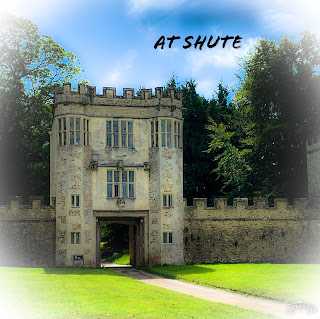
    But just before I move on, with regard to the Coldridge mystery, I just want to add a few comments about  my own views as to who might have been behind any plan to bring the young prince down to the south west to safety in the deer park of the remote village on the Devon ridge. As I've written and researched and googled this I've thought about how the obvious candidate for having both motivation to help and the sources to do so would have been Devon heiress Cecily Bonville (whose family home was Shute) - who was in any case, as with almost all the individuals named in this post, connected via kinship with the major families under consideration. 


S
o when I came upon this comment on Medieval PotPourri  I thought, ah yes this is it! It was surely her!
.... perhaps we should look no further than Cecily Bonville! Devon lands would have been Bonville lands and Dorset acquired them through his marriage. No doubt Cicely was left in charge of the estates in the absence of her husband. Did she receive a request from her mother-in-law, Elizabeth Wydeville, immediately after Bosworth and prior to Elizabeth being sent to Bermondsey to give a safe haven to her young brother in law? Had Richard advised Elizabeth where her son/s was prior to his defeat at Bosworth – and did EW get him safely to Devon in the days following Bosworth terrified that if Edward fell into the hands of Tudor that would be the end of him? More questions eh? (A Portrait of Edward V)
    Judging from a quick glimpse on A2A Discovery Cecily Bonville evidently was active in various litigations and lawsuits linked with a number of individuals in her family network, especially with regard to her son, so (perhaps similarly to her near contemporary Joan Arches Dynham), must have been a  sparky person capable of intrigue and could well have taken centre stage in any conspiracy around her husband' s half-brother, the young Edward. She may well have felt obligated to step in and help when Thomas Grey her husband fled the country following Buckingham's Rebellion. Perhaps she sheltered the young prince in her childhood home at Shute near Axminster, before moving him on, incognito, to Coldridge, the place of his final refuge. 

        ... I 'm just left wondering if somewhere out there there may be a document in a record office or similar, linked with Cecily Bonville. which makes a passing reference to somebody or something that might help to provide yet another clue ...


Links
Ian Churchward's songs inspired by Philippa Langley’s missing Princes project

Coldridge Church; Conspiracy; the Canns, Connections and Beatrix Cresswell Part One


Coincidentally, and to my delight and surprise - a week after I posted this trio of pieces inspired by Coldridge and the unsolved Edward V affair the mystery has made national news, I believe for the first time, Here is a link to the version published in The Mail. I've not read the first account in The Telegraph as I don't subscribe to that paper but see Edward V The Coldridge Mystery and it's also available on Yahoo

Part 1

Setting the Scene/s

‘And finally did Elizabeth Wydville who died in 1492 in Bermondsey Abbey go to her grave with the knowledge that at least one of her sons was safe and living in rural Devon on his half-brother’s property?’ MedievalPotporri

‘When the princes’ mother, Elizabeth Woodville, sent her daughters out of sanctuary and into Richard III’s care in spring 1484, can she really have believed he had killed his nephews months earlier? Her daughters were a threat to Richard; the eldest, Elizabeth of York, was to marry Henry Tudor if he could win Richard’s throne. Yet they all survived. The simplest explanation for all this is that she knew her sons were safe’. The simplest explanation for all this is that she knew her sons were safe’.(Princes in the Tower)
         It began with a mid Devon church ...

        It is not often that apparently disparate passions and projects come together in and from an unexpected source - in such a way that they demand that one stop everything else and step off at a tangent from a schedule to explore a different journey than originally planned - then lead unexpectedly to a new project interweaving all of them. Such happened to me back in the late summer during and after a mini day trip back to explore a couple of churches in Devon.

 
     We all love a conspiracy! Such I found out of the blue in the second church of my tour. (The first church, Nymet Rowland, just up the rolling Devon hills from Lapford, with its porch entrance carvings of ancient spirals, sun-circle iconography and mysterious Roman letters spelling EMER was equally fascinating). 
Photo Nymet Rowland church
But when I reached Coldridge Church,


where, just as with neighbouring St Bartholomew’s at Nymet Rowland, the door was not locked - and not only that, but the church was beckoning me inside with the seasonal visual and scented arrangements of its recently arranged glories of local harvest fruits and flowers still displayed on the window sills and tables. The porch displayed a dazzle of golden sunflowers and inside, gracing one of Coldridge’s ancient Chantry Chapels, when I saw the green apples circling the base of a vase of sunshine whose light cascaded upon the bowl of the season’s last yellow roses, I knew something special was in store; and not just harvest’s feast of apples.

Photo Harvest display Coldridge
Happily taken back to various nostalgias of my own childhood in other not far away Devon churches quickly it felt as if I was being pulled back, firstly to childhood where, every year in North Tawton and Cheldon, two other nearby churches, I’d spent many childhood and teenage autumnal hours decades ago, along with my mother and other local women, decorating ancient brass paraphernalia with garden and nature’s glories, ready for the forthcoming Harvest service spectacular. (Sadly in my case the splendid floral arrays didn’t ever materialise; my artistic talents did not, and still do not lie in the realms of flower arranging – much I’m sure to my mother’s disappointment).


       (A small digression here. A moan! How different here the church’s fate from that of Cheldon, the tiny church - which I still visit fairly regularly to place flowers on my parents’ grave). Here, at Coldridge and Nymet Rowland, the churches are obviously cherished; whether out of religious fervour or commitment, or purely because they are places of deep beauty and historical fascination, as soon as the visitor steps inside he or she is aware of a local community taking care to reach out care for and preserve their parish church, to celebrate it as unique fount of historical knowledge. In contrast, at Cheldon, lately neglected and (though arguably in accordance with the demands of rewilding) left to the attention of nesting swallows, prolific weeds, and general deterioration, there’s a sense of abandonment - which almost veers towards contempt for the Old and old-fashioned; even an aggressive security alarm sounding out to anyone who dares to venture to the nearby gate to contemplate at the beauty of the wooded Little Dart valley down there below the meadows).

***

     In the fifties, from fields near our home on the ridge north of nearby North Tawton we could see Coldridge on the sky line; it’s only four miles away and my friends and I, child sleuths, would sometimes decide to have an ‘adventure’ (mode of Lone Pine Club or Famous Five), take our duffle bags stuffed with sweets and drinks and wander through the fields and along paths and into nearby Ashridge woods. We’d get the occasional glance of the village on the far ridge. There'd be a mystery to solve. We were certain. We must wander along the lanes over the fields until we reached the place. But no, we didn’t ever quite make Coldridge. Usually our need to get back for dinner or for my friends to go back down to their own home at the bottom of our town called us back before we’d reached the end of the back lane out of Ashridge. Anyway, even if we had trekked that far, in those days the treasures of Coldridge church would have eluded us, although I’m sure we realised that the place was another of our special local landscape sites. We were daughters of the ridge and longed to become as familiar with the village on the other ridge as we were with our Wildridge … and Ashridge

    In the present day, I wandered round the nave at Coldridge investigating the church’s obvious and astounding historical treasures – the stunning pulpit with its grape-frieze; its C15 oak rood-screen with carved oak leaves and floral bosses; the barrel-vaulted roof with Tudor rose bosses and fantastic creatures - DevonChurchland calls the overall effect a ‘bobby-dazzler’. 


    Then I turned my attention to why I’d travelled here in the first place. My original reason for wanting to explore Coldridge church was to see first-hand where one of my grandmothers x three was married, in November 1826, nearly two hundred years ago. Having been baptised and I believe born in the nearby parish of Bondleigh, the woman in question, twenty years old Nan Passmore, apparently had no direct connection with this village. Just like so many others of our family's foremothers Nan was just a scribble of a name (actually a series of names depending which record you looked at – Nan, Nann, Ann, and Nancy) - had no real identity other than her connection with the places that the archives listed as places of baptism and marriage and the facts of her links with the menfolk in her life. Nan’s married life had been spent in Broadwoodkelly, another parish within a crow-throw from Coldridge.

    Also, excitedly, Nan had married a man whose own ancestry I’d recently discovered led me as amateur genealogist into the exciting new territory of ‘Gateway’ ancestors - a lines of predecessors which when the amateur genealogist stumbles upon it means that an individual in your family tree links you to already known genealogies, usually from history’s great and good, thus allowing you as researcher to add a bounty of fascinating personages to their previously - at least superficially - nondescript family tree. As I understand it, a Gateway ancestor is invariably from a landed family with money and land, mostly just one degree from then royalty, which makes tracing this family-branch path through life pre-1837 much easier – and more or less without exception, means you will be linked up in a direct line to someone of real ‘status’ from the deep past, ie royalty or aristocracy. As a bonus, a Gateway ancestor also inevitably takes the family researcher back to fascinating places of history, such as large manorial estates and old castles!

    So, I’d wanted to follow Nan Cann, see where her wedding journey led me; step inside the church, stroll up the aisle, conjure the young bride, my great great great grandmother tying the knot with Bartholomew Earland, the bridegroom - who, baptised in another of the mid to north Devon parishes, at Iddesleigh - may have been linked with nearby Nymet Rowland. I wanted to rekindle Nan’s life-journey. I hoped to stumble upon something, a clue which might suggest why the couple were married here, hoped also to find a few gravestones outside that might open up new avenues for genealogical research. (I did note several stones with a family name, which may eventually lead something more productive about my quest after Nan. But hey, that’s another story)!

    Well, there you have it, one of my own personal passions - family history. Not directly connected to writing blogs or poetry or texts about neglected women writers from Devon you might think, or generally with the life-journey of a poet – one of my ‘other’ main creative passions - though in actuality during the long solitudes of lockdown the disparate interests had already begun to draw closer. As I began to trace some of the so-called Gateway ancestors ideas following the discovery of Bartholomew Earland, I’d started drafts of a sequence of poems whose focus was and is a kind of poetry ‘mapping’, an evocation of some of these long lost 'gateway' women, many of whom, even though their names and complicated kinships appear on archival records, have left not even a recorded snippet or trace of their own unique life-journey; and in this respect they are nigh identical to the other 'commoners' in one’s family history, whose names in the listings occur with the bare fact of an accompanying baptism, or and marriage or, and if you’re lucky, a burial date. In common, all these women, aristocratic, or poor as church mice, are history’s invisibles. Here is the beginning of one gateway poem in the as yet (unpublished) sequence: 


***

Before leaving Coldridge church I returned to sit in one of the pews to have another more careful read through the guide book. Make sure I’d not missed anything of importance. Well, I had! In behind the rood-screen (and not easily reached as its now used as vestry) there is an effigy, not your common-or-garden memorial of a once Lord of the local manor, but a late C15/early C16 mystery man. (Didn't get a photo when I was there but here is a link to the amazing image on the out of this world website Devon Churchland). 


That’s when it began to dawn on me why this old church is so uniquely intriguing; where the mystery, the conspiracy come in. I couldn’t believe I’d not heard of it all before. You can read a variety of comments about Coldridge’s possible connection with Edward V, the young ‘disappeared’ Prince who was briefly King, on various websites - especially this piece; but the general gist is that the young Prince may have turned up and spent his life in Coldridge in the guise of a certain Sir John Evans - whose monument it turns out is in the church behind the screen, behind the organ, in what was once the Evans Chantry originally built in about 1511. Then, in the Evans Chantry there's the rare portrait of Edward V. And it turns out the church contains other equally unique features. Here’s the companion account of the Coldridge conspiracy theory, taken from A Medieval Pot-porri:

‘The effigy is wearing chainmail under his robe and the story goes that John turned up in Coldridge in 1485 after the battle of Bosworth. IF he had been Edward he would have been around 15 at that time. There is however reason to believe that he had arrived earlier in 1484. His mother Elizabeth Wydeville had emerged from sanctuary at Westminster accompanied by her daughters on the 1st March of that year. She had reached an agreement with Richard III and wrote to her son Thomas Grey, Marquess of Dorset, who had owned Coldridge prior to it being confiscated by Richard, but was now in France with Henry Tudor, to return home as Richard would pardon him. Two days later on the 3 March a trusted follower of the king, Robert Markenfield was sent from Yorkshire to Coldridge. Was this to keep an eye on the young lad who had been king for such a short time, Edward V, and who had been secreted away at the former property of his half brother, Dorset, a property which was about to returned to him if it had not already been done so?’ 

     Currently, I understand Philippa Langley, whose determination was responsible for the discovery Richard III at Leicester, is leading an investigation into the intriguing Mystery of the Princes and that one avenue of exploration is that centred on Coldridge. 

***

    And it is in the spaces of credulous unknowing that the second project I mentioned above comes in. My drafts of a manuscript about the lost history of Devon’ s women writers includes sections in which I try to re-imagine the lost lives of women of the higher classes from the deep past of our local history through non-fictional re-castings and fictional imaginings. For example, in Heliodora; an Excerpt I’ve tried to evoke two women of high status during Roman times, at the site of the large Roman fort, 'Nemetostatio' at North Tawton. I’ve researched and written about the mysterious medieval poet Marie De France, (whose identity is as yet un-established) and have concluded that it is possible that she may have been brought up in an aristocratic family in mid Devon. (See Excerpt How Do You Solve a Problem like Maria?). I wrote a poem and then fragment of fiction about Margaret Beaufort, Countess of Richmond, who'd often stayed at her various manors in Devon. 

    I’ve also investigated and found records of names and fragments of writing that seem suggestive of networks of literary communication threading between women from various families of high status. When I came across papers written by Micheline White about some Devon based C16 literary ‘power couples’ I decided my theory was vindicated. ("See Power Couples and Women Writers in Elizabethan England: The Public Voices of Dorcas and Richard Martin and Anne and Hugh Dowriche.” In Framing the Family: Narrative and Representation in the Medieval and Early Modern Periods, edited by Rosalyn Voaden and Diane Wolfthal). 

    I’d come to believe that many of the forgotten noblewomen, chunks of whose lives were spent in and around their Devon estates, left traces of significant contributions to our lost literary history, which if known about might help challenge the norms of the canonical understanding of the county’s literary history. However, gradually I’ve almost reconciled myself to seeing that I was on to a lost cause. A non-starter. To begin with, as a background and by default Devon is often considered as a county on the side-lines of important history. Too many historical reports cast aside comments which denigrate Devon as a county of rural 'yokels’, a backwater of the country where people who mattered did not congregate or live and certainly did not feature in events of national significance. For example, apropos the Coldridge church, as the writer of the brilliant blog DevonChurchland, comments: ‘why would a small church ‘in a gritty little village lost in the boondocks of Devon’ have such a wonderful royal and extremely rare window?’ If Devon per se is not important in the unfolding of history's narratives, then the lives and writings of long lost and forgotten women whose secrets - literary and other - are squirreled away in the archival deposits of various Record Offices/Heritage Centres etc., might as well be denigrated and abandoned to their desolate fate. In actuality, this default belief is so far from the facts that it is ridiculous. Just as a start, as far back as the notorious murder of Thomas a Beckett, Archbishop of Canterbury several of the murderers were Devon men. Then there’s the Sampford Courtenay or Prayer Book Rebellion of 1549; there’s the Spanish Armada 1588; connected to Coldridge's mystery there’s the Perkin Warbeck Rebellion (more of which later). Through the centuries intricate networks of powerful people of both sexes planted firmly on Devon’s soil contributed to the unfolding of history’s national happenings.  When it comes to the women, who frequently inherited lands and title and through marriage passed them onto add to the wealth of their often previously less well-off spouses, they are everywhere in archives, between lines in small print, often cast aside in favour of often detailed information about their husbands, fathers, brothers, uncles or cousins.

    And here is where the Coldridge mystery comes in. 

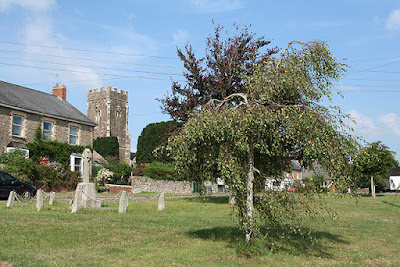
                      Coldridge: village green cc-by-sa/2.0

            © Martin Bodman - geograph.org.uk/p/216476

    What fascinates – but, in light of consideration of the real import of Devon in our national history, doesn’t surprise me about Coldridge is that events from an unsolved puzzle of the past, which is implicitly of national importance, may have had their heart in Devon, too often, as noted, debunked as a county on the sidelines of history. Coldridge is one of a cluster of parishes in the vicinity of mid Devon which in medieval and Tudor times were controlled by and often inhabited by a tangled kin network of the most powerful in the land, many of whose genealogical charts linked them closely to the Crown. Key individuals who had links with Coldridge during the period when John Evans was in the parish included Robert Markenfield, Sir John Speke and Thomas Grey. And then there were a handful of important women linked with Coldridge (whose lives were to some extent documented) such as Anne Duchess of Exeter and Cecily Bonville, All of these immediately link up with extensive networks of other Devon-rooted and powerful people.

    Ok, you may now be thinking, how could the beliefs about the lost networks of possibly literary linked medieval and Tudor women be relevant in any exploration of the Coldridge Edward V mystery? Well they may not be, but during my research I’ve uncovered various names of intriguing women whose direct connections with other parishes/places very near Coldridge -including North Tawton and Ashridge - could help lead to new threads of discovery about some of the important players involved in the dramas of the time. I’ll explore this idea further below.

***
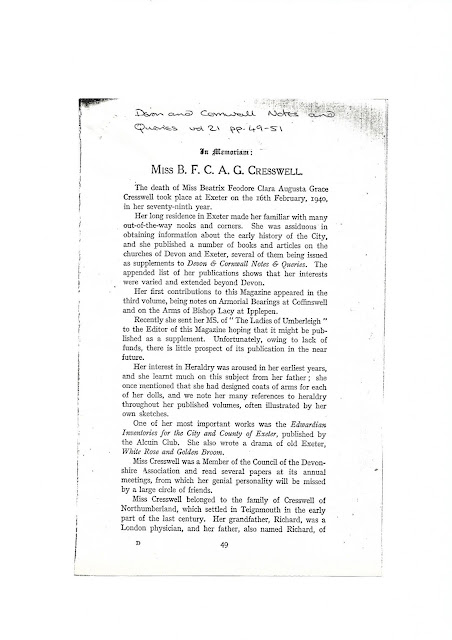
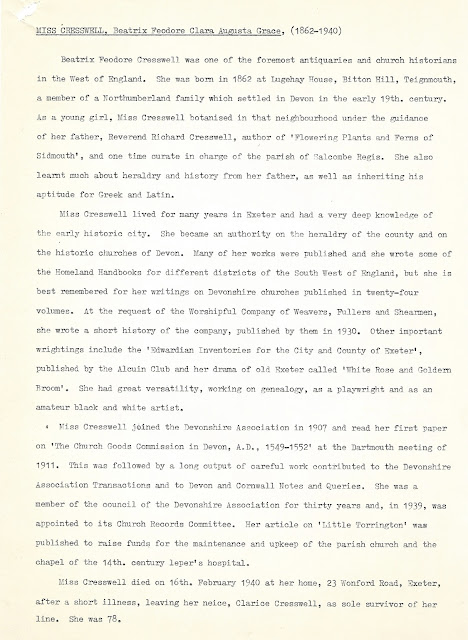
    First though I want to return to where I began this post and introduce the next on my list of current what I thought were disparate projects which the visit to Coldridge launched - the next, ie this post of my Blog. During a time when we've all been preoccupied by pandemic issues I’ve been mulling over scraps of archival material about Devon historian/author Beatrix Cresswell; I wanted to write a post featuring Cresswell and her writings but didn’t know where to start as she was an extremely generous, prolific writer about all things Devonian. Then, out of the blue Holly Morgenroth FLS | Collections Officer at Exeter Museum, another generous researcher and reader of my blog sent me during one of the lockdowns in 2020 asking if I was interested in archival material about Beatrix, which Exeter Museum held, along with other documents about the Cresswell family. Holly then sent me some papers pertaining to Beatrix, They included a copy of an article/obituary, In Memorian; Miss B FC A G Cresswell. (published in Devon and Cornwall Notes and Queries vol 21 - see image of first page above); and a typed page of a brief account of her life. It may be rather faint but here is the image of that page:

 Holly also sent me a link to information held in the Collections at ramm Exeter concerning Beatrix' father Richard Cresswell. All of these inevitably stirred me to look via Google into other related papers and information. 


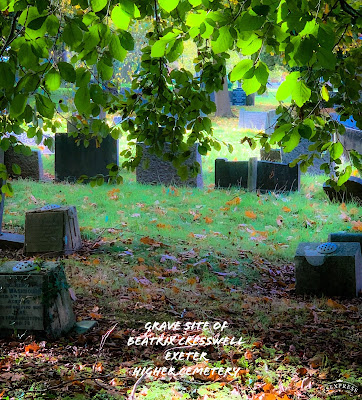
    Any serious local historian studying Devon history will soon stumble upon a feature about a place or person which has been written by Cresswell. Amongst a wide variety of writings her most extensive work is the multivolume typescript account of every parish church in Devon arranged by deanery, which is held by the Westcountry Studies Library. Many of the sites which focus on the past of a church, parish or place take their information directly from the previous work of this significant author, And yet, other than the fragments and files held about and by her at Exeter Museum and Devon West Heritage Trust (mostly a series of her Diaries which may well be richly informative, but which as yet I've not had opportunity to view) and  The Cresswells of Winchmore Hill: A Gifted Victorian Family, the book about the  Cresswell family written by Peter Hodge, and little features such as the one linked with Crediton Museum, there does not appear to be any special paper or indeed book about Beatrix’ life and remarkable individual contribution - an amazing body of work - about Devon’s history and antiquities. Indeed, on a recent trip to locate Cresswell’s grave at Exeter's Higher Cemetery I found the site unmarked (except in cemetery records); there is no memorial). Perhaps one day that will be remedied.

    I wanted to begin some kind of write-up about Beatrix, but couldn’t decide how to focus it, so yet again I put off doing so. That changed following my visit to Coldridge. Reading the church guide book I smiled when I read that Beatrix Cresswell had been one of the first ‘experts’ to remark upon and verify the stained glass image in the chantry as being that of Edward V. Of course, it had to be her. Who else? Then, as I read about the people involved in the Edward V enigma and the events of the time within their historical context I stumbled across a reference to Perkin Warbeck’s wife and widow Katherine, or Catherine Gordon, and remembered I’d noticed several times that Beatrix Cresswell had written a short drama based on a fictionalised reinvention of an episode in Gordon’s life, which had been performed at Exeter at the beginning of the C20, I believe in 1910. Why would Beatrix choose to write about a medieval woman whose connections with Devon were minimal I’d wondered?

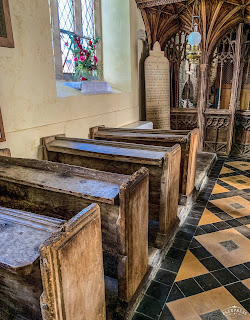
In Coldridge Church looking towards Rood Screen
    Yet, now, sitting in the atmospheric nave beneath one of the ornamental brass lamps which hang from Coldridge church's Rood Screen, I understood. 

Of course, when she visited the church and researched its strange links with Edward V,  Cresswell was probably reminded of the famous events during the Second Cornish Rebellion in 1497, when Perkin Warbeck travelled through the Westcountry with his wife and son. One of the spin-off theories from the Coldridge and Edward V mystery is that Perkin Warbeck was indeed Richard of Shrewsbury, the younger brother of Edward and that the two brothers might have met up when Warbeck was on the way to Exeter and his brother alias John Evans was at Coldridge. (See for example (Medieval Potpourri). I wondered what Cresswell's take on the Perkin Warbeck affair might have been and especially why she had chosen Perkin Warbeck’s widow as the focus for her pageant/play.

  I had to get a copy of the play and find out for myself ...

Acknowledgements 

I'm grateful for the generous help given by Holly Morgenroth of Exeter Museum. 

Links

Ian Churchward's songs inspired by Philippa Langley’s missing Princes project  

A Ricardian Argosy

 See Part Two - Through the Gateways


Featured post

  Finding a Forgotten Devon Author's Grandmother; Who was Edith Dart’s Granny Jane Sampson? Lanes, distant moor and ‘Lydcott’, a farm (o...