Followers

Remembering Edith Dart, Crediton’s Edwardian Novelist and Poet; 'As a novelist in “Miriam,” in “Likeness,” in “Rebecca Drew,” and especially in “Sareel,” Devon lives again':

  Remembering Edith Dart, Crediton’s Edwardian Novelist and Poet; As a novelist in “Miriam,” in “Likeness,” in “Rebecca Drew,” and especially in “Sareel,” Devon lives again'

(Quotation from Obituary for Edith Dart by Mary Patricia Willcocks)


The Grand Affair

General Buller's Return to Crediton 1900
I am grateful to staff at Crediton Museum for locating the image.
‘Miss Edith Dart, attired in a costume of purple tweed with longer black picture hat presented Lady Audrey Buller with a magnificent shower bouquet with red, white and blue favours’. (The Scotsman 2 November 1900).

General Buller's Return to Crediton 1900
I am grateful to staff at Crediton Museum for locating this image.

     As far as I’m aware the vivid depiction in the passage above picturing  the young writer and  Crediton born woman who, at the time the article from which this quote was written and published in The Scotsman, 2nd November 1900, was about 27, is the only extant description of her. (And it is possible that Edith is in the photo). The passage conjures a vibrant picture, such as, for me, suggests a woman who intends to stand out from the crowd, not someone who prefers seclusion and isolation.  For, the occasion about which this feature was written, was by all accounts a grand affair: the return of Crediton’s most renowned hero General Sir Redvers Buller to his home town following a long-standing military career. Buller’s carriage had just come to a standstill outside the railed-off enclosure at Crediton’s then Town Hall steps, bands were striking out 'The Boys of the Old Brigade', and hundreds of local citizens, a thousand children and a detachment of Yeomanry, must have made an arresting greeting-party. 

    Edith Dart, the young woman who was presenting the bouquet to Buller’s wife, was youngest daughter of one of the town’s leading townsmen, renowned and prosperous builder William Dart:

‘The Dart family is deeply rooted in the soil of Crediton, where her father founded the well-known firm of woodworkers and carvers.’ (From M.P. Willcocks, Appreciation/Obituary for Edith)

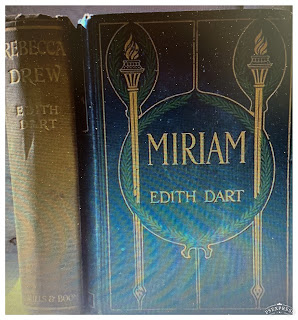
    Edith was already an author who had short stories and poems published in a variety of contemporary magazines and anthologies. A years later considerable success was to come her way with publication of a poetry collection, Earth with her Bars and Other Poems and several then acclaimed novels, including MiriamLikeness,and Rebecca Drew, The Loom of Life and Sareel - which was made into a film. You can find and read Sareel and Earth with her Bars on Play Books App. The other books I'm afraid are very hard to come by. There are copies of them at Devon Record Office, but if like me it's not easy to get there, it's a matter of luck finding a old book still in print (and invariably at a great cost) via the internet.

  I'll post about Edith's writing in a second post. Here I'm going to concentrate on her life.

   Until I came across the account of Buller’s return to Crediton I’d assumed that Edith, who now. in the C21, is just another of the female authors of her time who many years ago disappeared under the cultural radar, had a fragile disposition and perhaps reclusive personality; someone who retired to her attic to pen her books away from the crowd. And for a while when I sent out tentative feelers this assumption was credible because one of the few facts you can glean about Edith - repeated in the few available sources (apparently originally provided by a niece) - is that she was, or at some point became, an invalid, who for many years was virtually bedridden in her own room. 

    I think now that Edith's life story was more subtle and complicated than this…  

    My interest in Edith is twofold.  She's an intriguing novelist/poet whose stories and poems predominantly featured Devon landscapes and people - yet another to add to the list of long forgotten female writers. But also as a keen family historian, when I found that her paternal grandmother’s name twinned that of my own – (though Edith's 'Jane Sampson' was a maiden name and mine my paternal grandmother’s married name), I felt immediately drawn to find more about her; perhaps we met somewhere along her grandmother’s/my grandfather’s family lineages. 

    Also, whilst browsing various archives and internet sources in search of background information about Edith I’d been staggered to discover that, with a couple of exceptions, including her near neighbour Margaret Pedler, rather than being the only mid-Devon woman who wrote during these early decades of the C20, as initially I believed, Edith Dart was one among a crowd of women from Devon who wrote poetry or and fiction during this era. Many of the women I believe were probably linked with one another through a friendship network. Names of others, some of whom I mentioned in my previous post will I hope one day feature on this blog. I don’t know if Edith knew Margaret Pedler, but she was definitely a close friend of Devon’s ‘forgotten feminist’ writer Mary Patricia Willcocks, who wrote the obituary (quoted from above) for her younger friend following Edith’s death in 1922.  I found out about MP Willcocks some years ago. Until some of the other contemporary Devon who wrote begin to receive much more long neglected attention M.P.W., Margaret Pedler and Edith Dart almost stand as sole representatives of a cluster of writers who for the most part have disappeared under the radar, although some of their names are beginning to resurface.

Finding her

… So who was the once acclaimed Crediton writer Edith Charlotte Maria Dart, whose family were evidently closely linked socially with the town’s then foremost family, the Bullers? Presumably it was the achievements of her father, respected builder whose many projects in and around Crediton brought local attention to the family; especially his notable contributions to Crediton’s church. In 1865, seven years before his youngest daughter was born, William Dart had been appointed carpenter to Crediton church corporation and as such was responsible for much of the church furnishings during that time. (Following William’s death the business was taken over by his son in law Sidney Francis (husband of Edith's sister Alice) and family and major church improvements continued, including the Buller memorial and a WW1 memorial plaque in the nave). According to a descendant of the Dart family the firm later became called The Ecclesiastical Art Works. 

    Edith’s paternal ancestral family had deep roots in mid Devon. William’s father John, born in 1792, had married Jane Sampson (born 1788), who was from another intricate family maze, linked with nearby parishes such as South and North Tawton. (I am attempting to follow the Dart Sampson line to see if/when and where they might have connected with our Sampson family). 

    Charlotte, Edith’s mother’s family on the other hand were apparently from Kent. I’ve not yet had too much chance to find out very much about their background, but I wonder if Edith's literary interests in part derived from her mother's side of the family. A pamphlet about the Dart family written by one of the descendants includes a photo of  Charlotte at a writing desk, holding a pen. 

According to various family history records, born in 1830 in Foots Cray, Kent, Charlotte Elizabeth Mead, one of about seven siblings, was daughter of John Mead, a blacksmith; her mother’s name was Mary (born Mumford), whose ancestors were possibly well-established in the parish. By the time she was 22, in 1851, Charlotte was a servant for a family in Lambeth. Within another four years, in November 1855, far away from Kent and London, she was married and living in Crediton, but I don’t know how, where, or when she met William Dart, Edith’s father. In 1861, the couple with their first two children and William’s widowed mother Jane, were living in Fountain Court in Crediton’s High Street. By 1871, the year before Edith’s birth, the Darts with two more children had moved across the road and were living in a house called Bank Court, which I believe is now 18 High Street. Perhaps Edith, the Dart’s youngest child, was born there, the following year. By the time she was eight, in 1881, the family were living at 128 High Street (near what is now Boots). 


128 High Street Crediton showing archway to Dart and Francis.

     Catherine and Alice are named along with Edith, their youngest sibling; the two other children, William, the Dart ‘s son and Frances/Fanny, middle daughter, are not named in the census; perhaps they are married or living elsewhere. William Dart, father and Head of the House is also absent but there are a couple of visitors (Robert Tule and Anne T?) and a servant called Susan Lott. 

    Just two years later in April 1883 a local tragedy which happened near the town must have severely affected the Dart family. William’s older brother John was killed in a terrible accident whilst out at Kenford Hookway gathering wood for the firm; rolling an elm tree to move it to a timber carriage the chain had broken and John was killed outright by the falling tree. 

    I'm not sure if another accident involving one of the Dart sisters was Edith herself. Bill Jerman of Crediton found that in 1899 one of the sisters out walking her dog near Crediton station narrowly escaped being trampled by a train:

Mon 2 Sept 1889 Express and Echo

Narrow escape. A serious if not fatal accident had been promptly averted by the presence of mind of Mr Banks the worthy station master at Crediton station. It appears on a Saturday afternoon Miss Dart daughter of Mr William Dart builder was at the railway station awaiting the arrival of the 4.23 from Exeter. She was accompanied by a pet dog and just as the train approached at a smart speed the dog sprang from the platform onto the wooden crossing. Miss Dart very unwisely got on the step between the platform and the line to rescue the dog. Luckily for her Mr Banks who was on the platform instantly grabbed her arm and pulled her on to the platform, the engine at that moment being only about eight yards from her. Great praise is due to Mr Banks in effecting a rescue from a serious if not fatal accident. Ladies having pet dogs should take a warning from the above.

    At the next census, aged eighteen, in 1891 Edith was still at 128 High Street with her father, mother and eldest sister Catherine (Kate). Others in the house the day the census was taken were a sister in law, Frances Mead, Charlotte’s sister, ‘living on her own means’; George Cooper, a grandson, aged three; and a servant called Ada Connall, from nearby Chulmleigh. This house in the middle of Crediton High Street remained the Dart’s home for at least another ten years. 

    Said to be educated at home (I’m not sure if at the end of the C19 home education was typical for young women of her middle-class status), Edith did attend at least one locally held course and a follow-up examination in 1896, when she was 24. The course in Greek Art and Social Life was held at Exeter Technical College and organised by The University of Cambridge. Edith gained a distinction (Exeter Flying Post, 1 February 1896). 

    At the time of the next census in 1901 (not long after the celebrations described above commemorating General Buller’s return to his hometown) the eldest and youngest daughters, Catherine and Edith were still with their parents, now both in their late sixties. William, listed as ‘Contractor’ was now 67 and Charlotte two years older; their daughters were 43 and 28. Gerald, another grandson, is also with the family and a different servant, called Anne (Sether?). 

    During this period of her life (perhaps before she succumbed to the restrictions caused by her heart condition), the young writer was actively involved in a variety of local enterprises. There are glimpses of her comings and goings in contemporary newspapers. In 1895, when she was 23, she may well be the ‘Miss Dart’, one of five local women who applied for the post of Assistant Nurse and/or Industrial Trainer, (Crediton Board of Guardians). In 1899, the year before the occasion I described at the opening of this piece when Crediton welcomed Redvers Buller back to Crediton, she was bridesmaid at a friends’s wedding. In 1902, not long after the class in Exeter, Edith was Treasurer of Crediton’s Packer Fund (a charity organised by the town’s Board of Guardians, who were the overseers for Crediton's Poor Law Union). I haven’t yet had opportunity to find more but I believe she may also have been active with the Crediton suffragette group, one of whose leading figures was Amy Montague, a Crediton woman of Edith's generation who must have known and may have been another of the author's friends. 

    By the time of the next census, in 1911, everything had changed for the family. Most significantly, Edith’s father had died in 1904, and she, along with her widowed mother and eldest sister, who the family called Kate, had moved north of the High Street into a house called ‘The Orchard’, which I understand had been built by William for his retirement; but sadly that was not to be. 

The Orchard Crediton 

The Orchard is one of a row of four houses he built (sited along the bottom edge of what is now People’s Park). By now Edith was 37. There are additions to the family: a niece, Phyllis Dart aged 19 is with them, as well as a visitor called Mary Lundy and Anne (Satton?), the servant is still with the family.This may have been the house in which Edith’s niece (probably Phyllis) describes her aunt as invalid writer who was ‘exempt from all domestic or garden chores [and] seemed to spend all her time in her oak-panelled “den”, where she had quite a respectable library’.


Looking down at The Orchard from People's Park in Crediton
          Certainly by now Edith was, or considered herself as author, for the 1911 census’ qualifier of her is someone undertaking ‘literary work’. The next census, 1921, which was to be the last for Edith, lists her sister Catherine/Kate as doing ‘House Duties’. Edith is ‘Novelist’. 

            Edith Dart died in 1924. She was 50. 

            There was an account of her funeral in the local paper.

    Edith was probably still writing in the early 1920's, or so it appears from publication dates of a few short stories which appeared around the time of or just after her death. For example on the 9th of June 1922 Shipley Times and Express carried a story called Shipley the Duchess and on the 19th of August 1922, The Westminster Gazette featured another of Dart's stories, called Wooing.

    An obituary was written by Edith’s friend, MP Willcocks  and published in The Western Morning News on Thursday 17th of July 1924. It is perhaps the most succinct summing up of the Crediton writer, reminding us here looking back that our past’s writers need to be kept in our local communal memory. 

I’ve added a picture of the obituary taken from archives but as it’s not easy to read here is an extract: 

There has recently passed away at her home in Crediton at the early age of 50 one of the truest poets the Westcountry has produced. To the general reader Edith Dart was probably best known as the author of the beautiful novel Sareel, and to the few of us who appreciate delicate inspiration in poetry as the writer of a collection of poems entitled Earth and Her Bars. Edith Dart was in many ways an example of the prophet (?) who is,  comparatively speaking, without honour in his own country. 

For while her songs were set to music and touched hearts away as far as America, and the Colonies, while her novels and poems gained recognition for her in literary London, only a few people in her own county seem to have known that from little “Kirton” [Crediton] there had come a native singer of fine inspiration. For Edith Dart had pre-eminently the “singing gift” in her verse. The title “Earth and Her Bars” is aptly descriptive of the temperament shown in her poems, for she had a strong sense of the joy of earth, especially of the Devon earth, with its woods and meadows and its great moor. As a novelist in “Miriam,” in “Likeness,” in “Rebecca Drew,” and especially in “Sareel,” Devon lives again. (Mary Patricia Willcocks, Obituary for Edith Dart)

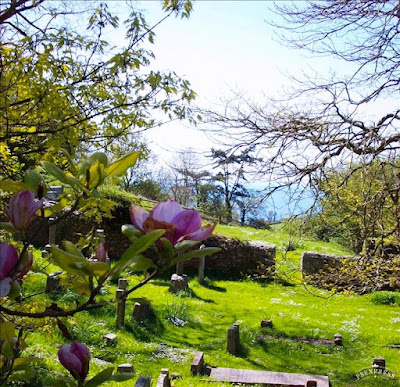
Edith Dart's Grave in Crediton Church Cemetery 
    Edith's grave is with the Dart family plot in the corner of Crediton Church graveyard (beside the road which leads to the car-park). All her sisters are also buried in Crediton, Alice, Catherine(Kate) in the churchyard and Frances in the local authority cemetery at the top of Old Tiverton Road. Her only brother William John Dart is buried in Orpington Kent.

Dart family grave and memorial Crediton Church

A memorial prayer-desk for Edith was later placed in Crediton Church, a fitting tribute from the community to this once acclaimed local writer.


     I'm pausing this post here as it may become too unwieldy. I'll post a second piece about Edith Dart’s journey toward proper publication, as well as contemporary reviews about her work. Watch this space!

Acknowledgements 
 I am so grateful to the following for their generous help as I began to search for Edith Dart: 
Keith Parsons (Researcher Crediton Museum); William (Bill) Jerman (Crediton Church); John Heal (Crediton Museum); Emma Farmer (Reading Rooms Assistant, Reading University); and Jason Nargis (McCormick Special Collections and Archives).


Devon Edwardian Women Who Wrote: Edith Dart, Zack, Beatrice Whitby and Others


     Recently, whilst working on various documents and research leads sparked off by looking at catalogues of A2A and Devon Heritage Centre for as yet unnoticed unpublished writings by women, I've stumbled upon a group of authors at one time or other were closely associated with Devon, who wrote and published novels and fiction that previously I'd not known of. I'm rather excited about this discovery and have decided to take a bit of a break from searching into the archives and am instead currently doing the rounds of various search resources to find out more about each of the 'new' 'lost' authors for a future, probably next post on this blog. The original source was The Oxford Guide to Edwardian Fiction, a recently published compendium, and wonderful source book.

    Although at this stage it is only a summary, I thought I'd make a preliminary start and share some of what I've found so far about the writers with a few links to such of the books that in my preliminary search are available, as and where I can locate them. The women were all more or less contemporaries and in several cases friends of Mary Patricia Willcocks, who is named in The Edwardian Guide and has already featured in this or my other blog several times. Until these latest discoveries I'd assumed MPW to have been the stand out Devon female writer from her time - and indeed in the sense of literary quality it may be that the quality of her writings will stand the literary test of time. But as yet I'm not had a chance to read any of the other's novels to compare their work with hers. Their combined oeuvre is quite extensive and will provide lots of extra reading material to keep me busy for the rest of this year. That's if I can locate the books in the first place.

I'll begin with Edith Dart, from Crediton (1871 - 1924), said to be a great friend of M P Willcocks, who published 5 novels between 1908 and 1920, including Miriam (1908); Rebecca Drew; Likeness (1911); Sareel  (1922 - perhaps her last?), which according to one source was  made into a film, although as yet I've not been able to verify this. 

Dart also wrote short stories, which are collected in The Darts of Cupid; two volumes of verse, including Earth with her Bars and other Poems. She was a regular contributor to periodicals such as Country Life, English Review and The Pall Mall magazine. The consensus online seems to classify her novels as set within the conventions of the standard Mills and Boon genre, but I'm not sure yet whether Dart's writing, like her near contemporary Margaret Pedler (whose home was just along the road near Bow), might stray away from the expectations set by that genre.
    As yet all I've managed to find space to read are a few pages from Sareel; our Edith Dart from Crediton was clearly a passionate lover of the nearby moor:

 'It was a hot summer on the moor that year, hotter than even the oldest moor dweller could remember. Sun blazed down fiercely so that the short grass was shrivelled brown early in July, and the gorse blooms burnt and withered as soon as their yellow flowers appeared.' (From Edith Dart, Sareel)

****

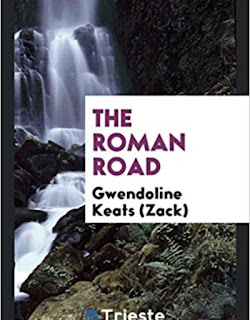
     Next in this list there's Zack (pseudonym of Gwendoline Keats 1865-1919), who, like Edith Dart, was author of at least 5 novels, the first published in 1898. Titles included On Trial (1899); The Roman Road (1903); Tales of Dunstable Weir (1901); and The White Cottage (1901).  Zack/Keats also apparently wrote plays. She was born at Porthill near Northam in north Devon. I'm not sure yet if, like Edith Dart, Zack was a friend of Mary Patricia Willcocks, but I'd not be surprised if so as from the very preliminary moments of browsing through one or two of her novels her style seems similar in approach, especially in the way they introduce Devon places, (with the real name disguised using another fabricated name which is obviously derived from another Devon place)  in the midst of a vivid atmospheric landscape setting often symbolic of the tempo and mood of the related narrative. I am wondering if perhaps if  a few of these women formed some kind of writing group or circle. 


      Zack also features in a biography/literary appraisal by Carl Well, By Noble Things She Stands,  available to read at Google Play Books.

'Halfway between two headlands lay the fishing village of Bere-Upton, a handful of cottages, some crushed in between the cliffs, others struggling upwards, following the hill's incline. Far out on the horizon's edge the November sun glowed dully across the water and then sank out of sight as if overwhelmed by the rising sea'. (Beginning of The White Cottage, By Zack).

**** 

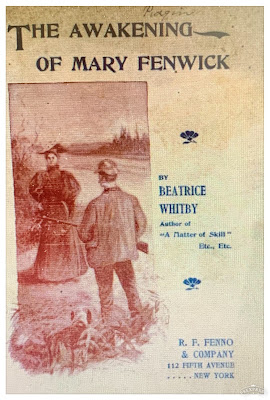
Another writer who is named in The Edwardian Guide is Beatrice Whitby (d.1931) who was born and brought up in Ottery St Mary and between 1899 and 1911 (by which time I understand she'd married and moved away from Devon with her husband Philip Hicks), wrote at least 15 'mildly feminist' (New Woman?) novels. Both Beatrice's husband and father were doctors and she was educated at home. Her first novel The Awakening of Mary Fenwick was apparently a success and other titles included The Result of an Accident (1908); Foggy Fancies and Other Stories (1903); Part of the Property and The Whirligig of Time (1906) 


'Each morning I have looked from my window over the thatched cottages in the valley across to the high-piled hills, until I know every field and hedgerow, every tree and turn of the familiar landscape. I know every flower and shrub in the garden; I know the me and women living in the neighbouring hamlet a stone's throw from our door; I know their bright-eyed children who roam the lanes and woods; I know our batchelor Vicar, who, old in fashion as in years, croaks through our single Sunday service in the damp barn which serves for a church; I know the samart mistress of the smart Board School, a lady who sets the mode in Fairmile ...' (from Part of the Property).


Alan St Aubyn (whose real name was Frances L Bridges) was daughter of a playwright and solicitor from Surrey and Essex who presumably moved down to Devon after she married Matthew Marshall of St Aubyn, in Tiverton. (Place from where she acquired her pseudonym). Quite a prolific writer Bridges studied at Cambridge and worked as a journalist. When she was over forty (presumably in Devon) she began a series of 'flimsy novels of Cambridge social life, interspersed with the odd Wessex idyll' (See Oxford Guide). Another novel Purple Heather; A Story of Exmoor, fictionalised the Devon hunting set. Bridges/St Aubyn died in 1920. Other titles included Broken Lights (1893); In the Face of the World (1894) and May Silver (1901).


'The curate preached on Wednesday evenings in the parish church and on Sunday afternoons in the little mission-church at Rose-Ash, unimportant services as far as numbers went. The week-day services were usually very thinly attended but when Pilkington preached the church could hardly hold the congregation. The record thought this sudden popularity would soon wear itself out; but it didn't. a deputation reached him one day after Pilkington had been in the parish about two months, from the Working Men's Club, asking him to allow his curate to preach to them more frequently, to take the Sunday sermon in fact...' (From The Quiver 1895, Alan St Aubyn)

****


Mrs Cudlip Pender/ pen name of Annie Hall Thomas (1836/8-1901) - or was it the other way around ? - brought up in Suffolk, was another writer who moved to Devon after marriage. Her husband, a High Church clergyman was Pender Hodge Cudlip whose livings for the most part were in Devon and Cornwall. He was vicar of Sparkwell, near Plymouth from 1884-1911. Mrs Pender Hall Cudlip became one of the most prolific romantic fiction writers of the Victorian era. The only daughter of George Thomas, a gentleman officer from County Cork and lieutenant in the British Royal Navy she took to writing at the age of 24, once her family moved to Morston, Norfolk. Her first novel, ‘The Cross of Honour’ was published in 1863 and she followed this with her first three-volume novel ‘Sir Victor’s Choice’ and ‘Barry O’Byrne’ three months later. Annie wrote and published over 100 novels I believe in the Romance ie Mills and Boon ? mode. She also wrote many short stories, articles and verses....
    However, it seems that Cudlip/Thomas  began experiencing financial problems and applied to the Royal Literary Fund in 1907 and 1908. According to one source Cudlip Pender lived in Marychurch in Torquay but I'm not sure when. 


'Very little has been heard lately about Mrs Templeton's difficulties, for it is well known that the Bishop has taken his wife's liabilities on himself and has proclaimed a system of retrenchment whereby he intends to free himself from them ...' (Opening of Allerton Towers, Annie Hall Thomas).

**** 


Then, and for now lastly, there's Frances Bancroft - pseudonym of Frances Charlotte Slater, born 1870), who was a farmer's daughter from South Africa and moved to England at some point. Bancroft published 18 novels between 1806 and 1958 some of which were successful, especially Of Like Passions, her third novel. I don't know when she moved to Devon but according to a letter written to the Literary Fund by MP Willcocks (who was presumably a friend) Bancroft's last years were spent in Paignton, where she was reduced to living on bread and rice, so her writing career can't have provided her with substantial income. I'm not sure if any of her novels were set in Devon, possibly now, but will hope to find out more anon.

'Steeped in the white light of a tropical sunshine and facing the re-bricked front of the Outspan - part farmhouse, part hostel, part country-store - with its single row of outhouses thrust like giant arms to right and left of the main building, ran the broad trail of the high-road - the sign and seal of an invisible civilisation, the link that bound the back-veldt dorps and farms of the Northern Transvaal to the life an stir of the great mining centres of the south ...' (from The Veldt Dwellers, Francis Bancroft, 1912)

    ****
So ... now I'm off to delve into the fictional worlds of at least a few of these writers and to see what else I can find out about their Devon connections. Tune in again when you can as I hope to have some kind of commentary about Edith Dart first on this list.

Centennials, Bicentennials and Other Celebratory years - Devon Texts and Dates 2022


Churchyard at Salcombe Regis Church 

    Ten years ago I posted a piece A Handful of 2012 Anniversaries: Devon Women Writers; Names and Texts in commemoration of the anniversary dates of several women writers whose births or deaths or written texts were occurring that year. Then I posted a follow-up Devon Celebration 2016. So what follows here is another celebratory catch-up piece featuring a handful of writers with special events coming up during 2022. 
****
'Believe me, nothing except a battle lost can be half so melancholy as a battle won'.

Cover of Lady de Lancey at Waterloo

   I'll begin  200 years ago in 1822, when Madeleine De Lancey died, on 22nd July. 

            There's a post about Madeleine de Lancey on my earlier blog, Woman at Waterloo; Lady de Lancey; a Quiet Grave at Salcombe Regis. As I noted in that post Madeleine did not spend her life in Devon; in fact she was only briefly in Devon.


Photo of first page of A Week in Waterloo
The first page of Madeleine de Lancey's
A Week at Waterloo

     Lady de Lancey’s visit to Devon was short-lived as she'd been taken to the village to convalesce, after giving birth to a third child after her second marriage, but had sadly and poignantly died, on 12th July 1822, at the age of 28. The burial entry in Salcombe Regis registers states that Magdalene was 'Wife of Captain Harvey - formerly the widow of St William Howe de Lancey Quarter Master General of the Army under the Duke of Wellington'. As yet I've not been able to locate her grave in the churchyard at Salcombe Regis, although in principle I have had information which should help to find it (See the previous Lancey post). But the church and village is still an idyllic place to have an excuse to visit, so perhaps others out there will follow the quest to Madeleine De Lancey's Salcombe Regis grave.

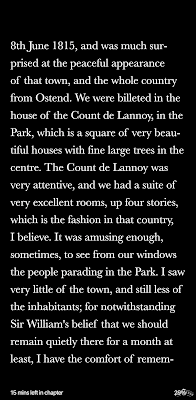
     It is important to commemorate Madeleine's connection with Devon because of the one text that she wrote seven years before, A Week in Waterloo in 1815 , a personal diary/account of her own experience nursing her first husband following the Battle of Waterloo. The text can be read at The Project Gutenberg. The opening of the narrative can be seen in the photo next to this.

    Since I last researched Madeleine's life I've found that she was the sister of the writer Basil Hall a noted author on the subject of early American travel and that it was through him that she met her first husband. William Howe de LanceyA Week at Waterloo was also apparently written at Hall's request and the introductory material to the narrative tells us that Sir Walter Scott and Charles Dickens were both impressed by it. Did De Lancey's account influence Scott's own poem of the same name? That's a question I can't answer but it seems that Madelaine herself must have impressed him as she was said to be a model for a character in in novel The Bride of Lammermoor. There's an interesting comment on the diary and the fate of the de Lancey couple and the response of these other writers on  this All Saints' Church Belgium website:

In 1816, “Lady DeLancey’s Narrative,” an edited version of her diary, was published and stayed in print until 1906. The tragic tale of the beautiful, doomed newlyweds, set amidst the carnage of Waterloo, became one of the 19th century’s most compelling and iconic love stories. Charles Dickens sobbed when he read Magdalen’s story 5 , and Sir Walter Scott wrote not only an epic poem, “The Field of Waterloo,” but is believed to have Lady Magdalen as his inspiration for the character, “Lucy Ashton” in his 1819 novel, The Bride of Lammermoor.

 The same piece also provides a poignant postscript about Madeleine and her journal.

Crocuses in graveyard at Salcombe Regis Church photo JES
'In 1999, in a corner of an attic, Lady Magdalene’s great, great, great grandson made a startling discovery. Inside a dust-covered trunk, he found the widowed bride’s original diary, two portraits of young Magdalen and forty hand-signed letters.'
 Evidently there is more to be discovered about Madeleine, both concerning her brief stay in Devon in the context of her second marriage and with respect to her literary links and its wider inter-textualities. Something to muse on for later research, for me, or perhaps someone else out there ...


**** 


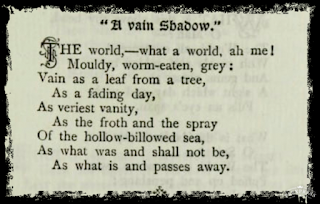
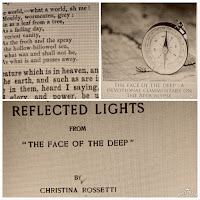
'A Vain Shadow' Christina Rossetti

135 years ago, during the winter of 1887, poet Christina Rossetti left London in search of the sun in Devon's Torbay.  As I begin to write this piece shortly after the Christmas celebrations, with carols still ringing at the back of my mind, I can't put aside Rossetti's most famous - and now iconic - lyric In the Bleak Mid-Winter (which she wrote and published before this period). Our present day worries about how to heat our winter/wintry homes with increasing fuel bills is probably nothing when compared to the problems that people in her time must have had to endure. I wonder how much of that poem came directly from the poet's response to the cold living conditions of her time.

    I wrote about Rossetti's stay in Devon in the context of the poet's life in the Scrapblog post Poets in Winter so won't repeat that here. Unfortunately for Rossetti Torbay that winter turned out to be cold and chilly and to top this inclement weather an earthquake shook the Riviera where her brother was staying whilst she was in Devon, which may have increased her anxiety about being away from her London home. 

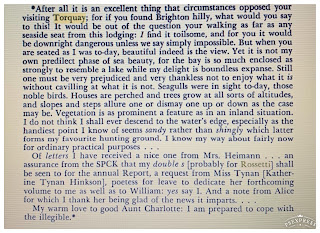
 The image of one of the writers letters, alongside this, taken from the biography Christina Rossetti by Lona Packer, tells us a little about Rossetti's experience of Torquay.
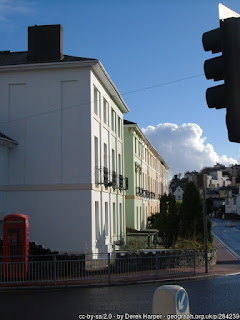
Abbey Road looking in the opposite direction
from the junction with Tor Church Road,
beside the Central Church.
On the right is Waldon Hill.
This photo is copyrighted but also licensed for further reuse.


I've not had a chance to find Abbey Road yet but I imagine the house where Rossetti stayed, in letters as 'Beechwood' might have been one of the terraced properties that appear in the photo, from Geograph:


I noted on the previous post about Rossetti in Torquay that I hadn't found any information about writing she may have been working on whilst in Devon, but I also surmised that it is possible she was mulling over her meditations and supplementary poems that were to be published in 1892 in the text Face of the Deep, A Devotional Commentary on the Apocalypse, (which according to the Palgrave Encyclopedia of Victorian Women's Writing, was Rossetti's last original text for the SPCK (Society for Promoting Christian Knowledge). The text was the poet's devotional responses to the  Book of the Apocalypse. There's a useful introduction to Face of the Deep on the Palgrave Encyclopedia of Victorian Women's Writing, reminding fans of Rossetti as poet that her intellectual and creative skills took on a wider remit; as well as poet, she was also 'theologian and contemplative': 
'These devotional practices take the form of anecdote, prayer, or poem, exposing tensions between theological interpretation and devotional response that Rossetti then interweaves.' (Palgrave Encyclopedia)


Images from Rossetti's Face of the Deep
Just as often happens with modern poetry some of the poems that the poet wrote for inclusion in Face of the Deep - such as 'A Vain Shadow', one image from which I've headed this short feature about Rossetti - were also printed and published in other collections of the writer's poetry. 'A Vain Shadow' appeared in Verses a collection of Rossetti's which came out in 1893. One commentary about that poem and about Face of the Deep suggests that a modern reader's interpretation of the poem should take into account the context in which it appears. (An observation that I'm sure is relevant to all poets and readers given that often poems re-appear in other and later collections). 

                              ****

'There is a little village in North Devon, sheltered from the sea by a low range of sand-hills that stretches for miles on each side of it. The coast turns westward here, and no cliff breaks that line of billowy sand; northward and southward it goes, with the rhythmic monotony of the sea. The sand-hills are dotted with tufts of the long star-grass, where the rabbits sit; inland they are covered with fine blades bitten short by the sheep. Seaward lies the hard ribbed sand, glistening with salt, and fringed with the white surf of the Atlantic'. (From Audrey Craven, by May Sinclair, first published 1897 - 125 years ago).


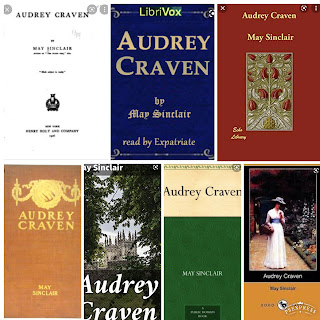
125 years ago, in 1897 May Sinclair - whose real name was Mary Amelia St Clair -  at the time an unknown woman writer whose links with Devon are generally not known about, published her first novel, Audrey Craven. One researcher labels the book a 'New Woman' novel (See The Creator); another publisher summarises the novel thus:
'Audrey Craven 'centres on a beautiful young woman, the eponymous Audrey Craven, who has managed to cultivate an entirely undeserved reputation for originality. Rather than being unique or original she is in fact a shallow self-centred and solipsistic heroine, whose only desire is to become a great muse to a great artist or thinker.' (See Delphi Complete Works of May Sinclair).
    Audrey Craven was published when May Sinclair was 33. Critical reception of the novel was agreeably positive considering that Sinclair was as yet an unknown writer. For instance George Gissing said of it that 

Had you not told me it was your first novel, I should have thought it came from a hand already practised ... For the work - if you will let me say so - it is very well written, in sound, careful, often polished English, assuredly such as one does not meet with every day. Moreover, the characterisation and construction seem to be decidedly good... I hope the critics will give it the attention it deserves.
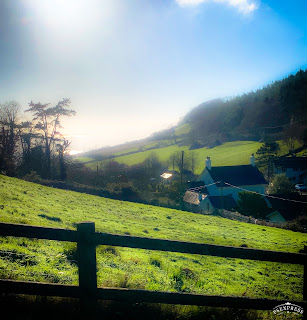
    Sinclair's life is linked with that of Madeleine de Lancey's in that Salcombe Regis was the village where they both stayed when in Devon, although Sinclair's stay there was many years after De Lancey's. Also, both women only spent a little time in Devon, although Sinclair did live in Salcombe for  a decade, whilst Madeleine's time there was very brief - and poor lady, given her state of health it is unlikely that she had a chance to appreciate her surroundings. Both women have left me with unfinished research as I have not been able to find the places where they stayed (or indeed Lancey's  grave and also I've now realised, the location of the graves of May Sinclair's mother and brother in Salcombe graveyard). As noted in A Novelist at Salcombe Regis (a previous post in  my other blog) I wrote about the St Clair family's stay at The Quest on Brook Hill, a place said to be high above the village. 

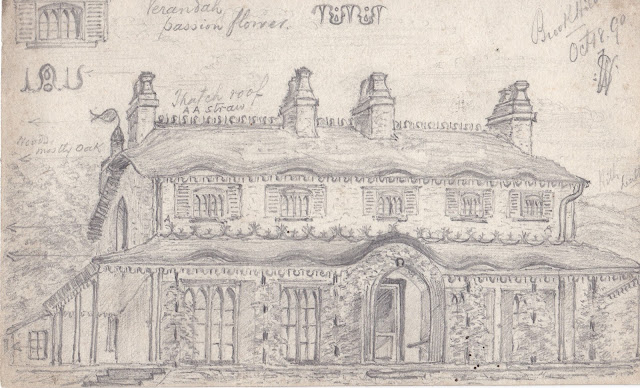
      As yet I've not located Brook Hill, but a helpful reader and distant relation of May Sinclair, who came across A Novelist at Salcombe Regis on my former blog recently got in touch and sent a fascinating sketch of the cottage/house where the Sinclair family lived, which it is thought was drawn by May's brother William.  My contact further commented,

 'The 1891 Census shows Mary Amelia Sinclair and her mother living at Brook Hill, Salcombe Regis (no mention of The Quest). By viewing the neighbouring houses on the Census, we believe the property was sited around the junction of Fortescue Road and Sid Road. The house may no longer exist as details of it finish around 1964. We have found another poorer but similar sketch of Brook Hill signed WS which strongly suggests that is William Sinclair, May’s brother (1851-1896)'. (See also note below)

Sketch of 'Brook Hill', the house May Sinclair lived in Salcombe Regis.
Drawing attributed to author's  brother William Sinclair 

A Novelist at Salcombe Regis makes a tentative exploration about May Sinclair's connection with the village. Audrey Craven was apparently published around the same time as the author left Devon with her mother and returned to  London, so I'm assuming that she well have been working on it whilst living in Salcombe Regis. One source I came across suggested that the novel had been completed at least two years before publication, which again confirms that it was probably a manuscript the novelist was working on whilst in Devon. Devon does make an appearance in Audrey Craven, albeit briefly, as the quotation heading this piece indicates. 


May Sinclair's first novel is a precursor of the author's later fiction in that it suggests a writer whose characters are preoccupied with the nature of philosophical thought and the aesthetics of creativity, just as is suggested in biographies about her:

'She primarily wrote novels of ideas, as her precocious female protagonists grappled with Greek philosophy, Spinoza, and Christian mysticism'. (Campus Press Biography

Perhaps, in some ways prefiguring the later novel Mary Oliver, I read Audrey Craven as a semi-disguised - and somewhat loosely defined Bildungsroman - (perhaps it could also be considered a Roman à clef in that it is likely that several of its characters were modelled on individuals Sinclair knew).

      It is the chapter in which Devon's coastal landscape appears as a place of retreat from the whirl of London life for Audrey, the novel's main character, which for me left a clue that the narrative may conceal events and places taken from the author's own life, but that these personal similarities themselves may be masked. Rather than taking her character/heroine to the climes of south Devon - the location where she lived for several years -  Sinclair describes a north Devon coast landscape: 'There is a little village in North Devon, sheltered from the sea by a low range of sand-hills that stretches for miles on each side of it.' And yet, the place (a bungalow) where 'Audrey' stays whilst she takes her very brief break in Devon fits neatly into the author's description of the actual place that the St Clairs stayed at in Salcombe Regis, 'a long-low house high above the sea on the coast'. (See Novelist at Salcombe Regis). In the novel the location is described as 'On the coast, about a mile from the village ... a long one-storyed bungalow, built on the sand-hills. The sand is in the garden, where no flowers grow but sea-pinks and the wild horn-poppy'. In other words, the novel's location is transposed (from north to south) but at the same time seems to represent the actual place where the author stayed. 

    I think, in keeping with Oliver's stated disinclination to have her own life put on public show (see A Novelist at Salcombe Regis), that the author may have concealed herself within the character Katherine - who though not the leading female protagonist in Audrey Craven - is a kind of alter-ego, a foil, or mirroring character to that of the main 'heroine',  femme fatale Audrey. Instead of Audrey's selfish narcissism Katherine, gives us empathy, and self-awareness; instead of Audrey's vacuous 'constantly shifting' capricious personality, Katherine give us loyalty, a strong sense of self; instead of Audrey's projective dependence on others' opinions and creativity, Katherine gives us the dedication of a true artist who shapes her own opinions and creative projects. In today's terminology, unlike Audrey, the novel's main character, she has reams of  emotional intelligence. I think a reader looking to get a sense of the real May Sinclair at this stage of her writer life, could benefit from seeking her in her first published novel.

    I could, but must not continue here, or this celebratory feature will take me through too much of this year; but for anyone who enjoys reading early fiction by female novelists exploring the rapidly changing lives and roles of women during the period of early Modernism, then this early May Sinclair novel should be on this year's reading list.

                                                                         ****

'He opened the door with a crash, lurched about on the broken brick flooring of the place and finally came to anchor on a cane-bottom chair.' Wings of Desire

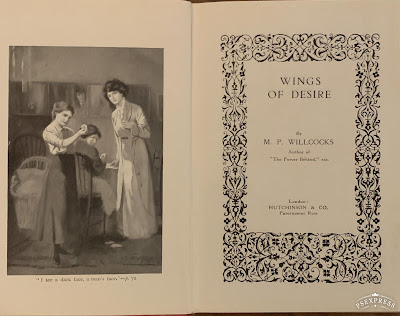
So, 110 years ago, in 1912  Wings of Desire, a novel by the important and long forgotten Devon author Mary Patricia Willcocks was published. I've written about Mary Patricia Willcocks in a previous Scrapblog post, M.P. Willcocks was a Writer from the West  and mentioned how I'd found about her through the writer/journalist Bob Mann of Longmarsh Press. There's also a brief commentary about Wings of Desire in A Handful of 2021 Anniversaries, 100 years after the novel's publication. 

Page from  M.P. Willcocks' Wings of Desire

 Although now, well into the second decade of the C21 most books are obtainable one way or other, when I first tried to find M.P. Willcocks’ novels they were not easy to get hold of. Many years out of print, they were languishing in a dusty corner of one or other basement archive, in such repositories as that of the Exeter City Library, or a local Devon town library store. I was elated when I eventually located copies of both Wings of Desire and Widdicombe - which now you can read online. I began to understand the symbiosis between landscape and literary texts in a new way. Here was a woman from my home country who wrote about the local landscape and about the types of rural Devon women who could easily have been my own foremothers. Walking through the landscape of her stories, which often figure a local Devonshire woman herself wandering through typical county territories - crossing bridges, in damp woods, under trees, or on the moor - usually very aware of and susceptible to the vistas spread before her, I found myself re-living the days of my female Devonshire ancestors. 

    Ranging across the spectrum of the county’s topographies Willcocks' novels offer snapshots of Devon's lost corners. Reading her novels I was reminded of Mary Webb, whose fictional writings capturing the geni-loci of her home county seem synonymous with Shropshire’s essence; Willcocks’ fiction is to Devon as Webb’s is to Shropshire. I imagine that Willcocks was influenced by her near contemporary D.H, Lawrence (though given the dates of their respective fiction publications perhaps the potential influence was the other way around);  but just like Webb, who was also her contemporary, Mary Patricia Willcocks was born and spent most of her life in her home county; both women’s fiction focuses around the distinctive features of their respective home county’s landscapes. Willcocks’ work often has a backdrop of moor and sea, whilst her stories are awash with local (late C19/early C20), mostly rural characters. Preciously old-fashioned, but providing nostalgic, secure representation of an ordered world, her fiction resonates with a sense of place in which generations of ancestors lived and worked; her books are replete with what her fan Bob Mann calls ‘a mystical sense of the inseparability of past, present and future’. (Bob Mann, 'In Search of Devon's Forgotten Feminist', The Dart, June-July 1996, Number 95).


    Willcocks’ female characters project inner warmth, integrity and strength; the ethos of their very being crucially depends on an interior awareness of the longstanding rootedness of their own female ancestral inheritance within the county’s wildest landscapes, over which during the course of each novel, the women roam freely, frequently breaking free of societal expectations:
On the landing Anne paused, bright-eyed and mis-chievous. Leaning over the rail, she contemplated the hall below. It was as silent as the ancestors on the walls. Only the clattering of plates came from behind the baize-covered door that led to the older part of the house ... "Dare I?" said Anne to her sister, putting her head on one side like a bird when he raises a song to the god of raspberries. The next moment there came a slithering noise of skirts followed by a thud; Anne had slid down the ban- isters. Demurely Sara followed, wondering why Anne retained the jolly ways of a child or a man. But she knew, for Anne had been out in the world where one does things. She had not stayed at home listening to the wind in the trees, to the noise made by the footsteps of the future. It was the best thing that Sara had ever done, that sending of Anne into action. Very warm at heart, she followed the girl into the drawing-room, where Mr. Knyvett was still acting as a conduit. ' ' Harmony, ' Mr. Hereford was saying with his fingers neatly fitted in the shape of a pointed arch, "harmony is the thing we neglect in modern life. We must not jar, we must vibrate in unison. (M.P. Willcocks, Wings of Desire (John Lane, 1919). 30.

     As I read the novels I kept wondering how many of my unknown Devon female foremothers were made up of the same stock as the tough and resilient female characters to which Willcocks gave voice and presence.

    Wings of Desire's settings extend from Devon’s coasts (including Brixham) to the Magellan Straits. 
The novel relates the story of  and is focused around its heroine Sara, a concert pianist, whose marriage is wrecked by the controlling influence of her husband, writer Archer Bellew. The narrative follows Sarah's eventual rise to fame and then escape into the freeing arms of engineer Billy Kynvett, Sarah's sympathetic lover. A key speech of Sarah debates the female struggle around relationship and work:
'Year by year we are taught, we women, to live by love—that it is our highest work. I believed it till I was shaken out of the belief. He, my lover, had his work, the thing he was made to do. He put it first before me. . . . He would not take me. There would have been fuss, lawyers, letter-writing. He would not have been left with a mind free to his task. I saw for the first time my place in the scheme of things. I am only a light woman until I can do my work.' 
Molly Woodruffe, a political organiser and object of Archer's latest infatuation, is the other main female character in the novel;that pair's relationship is explored using the background landscape to reflect the unfolding emotional turmoil. The crux of the emotional encounter between Archer and Molly happens in the vicinity of what is now Meldon reservoir and beneath what was, in the early C20, the atmospheric gorge under Longstone Hill. The valley, running along the West Okement river, is known locally as Dartmoor’s 'valley of the rocks'; semi-fictionalised by Willcocks as the ‘Enchanted Valley’, the site becomes both a place of ‘quietude’ for Molly, (who, in today’s terminology is 'burnt out'), as well as a place that is used to mirror the fluctuating emotions of the impending lovers. The preliminary scene is summery, enticing the reader to jump in the car and drive straight to the sunny moor, with the river's ubiquitous background murmurations:

Sun warmed and sweet, over granite boulders where hang tufts of gorse that send golden lights across the deep brown pools, the river slips down the Enchanted Valley. Hills, grassy, patched with young bracken and scarred with grey stones, enfold it; only its swaying murmur, rising and falling like a pulse, can be heard to the summits where the sun beats down in dizzying splendour. ... Into this radiance stepped Molly and Bellew; here they sat on the rocks while the brown waters sparkled over patches of sand or gloomed across the weedy boulders (Wings of Desire, 140).

As the meeting between the couple becomes more angst-ridden, so does the description of the valley take on darker, sinister tones. A storm brews and Archer and Molly have to shelter from the moor’s dark mood:
Then she felt a physical chill fall on her and following her glance, Bellew looked up and exclaimed. Over the shoulder of the Longstone Hill, gathering across the wastes deep in on the moor, was coming a procession of clouds, inky black at the edges. The wind was shaking the trees. Low growls of thunder came from the left; it was of ill omen, thunder from the left, thought Molly. “Come,” said he, “we must hurry.” (Wings, 143).
    Wings of Desire’s last scenes between Sarah and Kynvett are set in an exotic fictional moorland wood, which it is not hard to identify as the real Black-a-Tor copse:

Photo from the last chapter of Wings of Desire
Near the ending of Wings of /Desire
"Between large slabs of granite overgrown with moss and fern grew stunted oaks, their gnarled and knotted trunks half hidden with carpeting of whort-bushes. In the warm, scented wind the tree branches waved above the woodland gloom that was dappled with point of gold. Everywhere was light and movement, thrilling upwards from the breast of earth towards the sun’s caress .. At the head is the wild moor toward Great Kneeset with its dun stretches of ling, a mantle of brown fur, broken here and there by solitary thorn bushes white with bloom and odorous with heavy scent"(Wings).

It is here that Sarah and Billy exchange their final love tryst: 'And she bowed her head for like a wonderful tree of life, their mutual trust in each other's honour bore but their love and passion as a flower' 

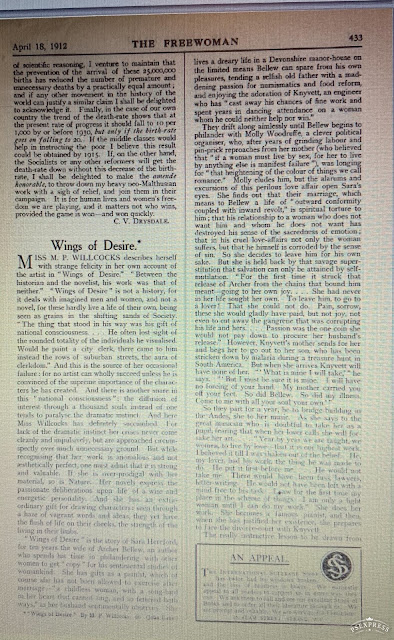
    In April 1912 The Freewoman Weekly Feminist Review carried what might be read as an ambivalent, perhaps even condescending, review of Wings of Desire, written by no other than writer Rebecca West who was - and is - one of the major writers of her time. West is somewhat critical of Willcocks' 'lack of dramatic instinct ... 'for her crisis never come cleanly and impulsively but are approached circumspectly over much unnecessary ground'. (Could there have been an element of envy/jealousy?) But West has plenty of complements for her fellow novelist. Willcocks' writing is 'strong and valuable'... 'Her novels express the passionate deliberations upon life of a wise and energetic personality ... she has an extraordinary ability for drawing characters ... they [yet] have the flush of life on their cheeks, the strength of the living in their limbs'. 

West describes the character of Sarah Bellow thus:


'She has gifts as a pianist, which of course she has not been allowed to exercise after marriage—" a childless woman, with a song-bird in her heart that cannot sing, and so fettered both ways, " as her husband sentimentally observes.' (See The Freewoman)


West concludes her review of Wings of Desire thus:

"In the panoply of our newly-found emancipation we women are as serious as a little girl in a new pelisse : we dare not unbend in so much as a smile. Perhaps that is why Miss Willcocks, having written a rattling good yarn about a reckless buccaneer of to-day who leads some fine gentlemen across the tumbling; tropic seas to the black snow-capped cliffs and yellow coves of South America in search of phantom gold, felt shy about publishing such a frivolous production, and weaved it into "Wing s of Desire " with the slenderest thread. It adds the last touch of riotous confusion to a book that almost faints under the weight of its own luxuriance. But what a magnificent fault!" (See The Freewoman)


    For another commentary about the novel Wings of Desire see The Oxford Companion to Edwardian Literature Given several other reviews of Willcock's fiction in The Freewoman and other similar respected journals, it is clear that she was a well-known and acclaimed author among the literary circles of the time. Perhaps then, it is about time that her books should be reestablished, given due respective attention by those now active in the C21 publishing and academic world.

****
My dear, go to your room. This is not right, You are acting in defiance of my known wishes, although, no doubt, thoughtlessly. Bid your sister goodnight and go.”
Val did not even wait to carry out the first half of the Canon’s injunction. She caught up her brush and comb and left the room. (The Optimist - Great War Fiction Plus)

Now, Centennial Literary Celebrations 100 years ago several books authored by Devon women writers were published. At the time several of - if not all - of these women were beginning to establish a reputation as writers of considerable status. The writers and texts were:  M.P.Willcocks' The Wicker Women, E.M. Delafield's The Optimist;and Margaret Pedler's The Vision of Desire.

    Published in 1922 The Wicker-Work Woman; a Chronicle of our Own Times (read on Project Gutenburgwas a novel by French author Anatole France, which I understand M P Willcocks translated into English. (Willcocks also translated France's The Elm on the Mall - possibly it was published two years later, in 1924). The Wicker Work Woman is probably easily available on the internet as searches bring up many links. However as yet I have not had a chance to read it nor have I found much about the novel and its background. One or two reviews mention that telling the story of a wife who ends her marriage the novel's subject is marriage breakdown, so maybe Willcocks' work translating France's novels influenced her writing of Wings of Desire.  
 __________

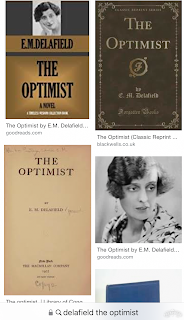
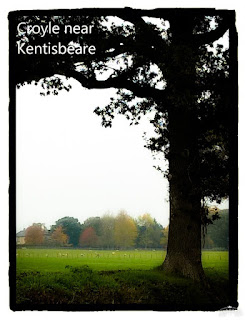
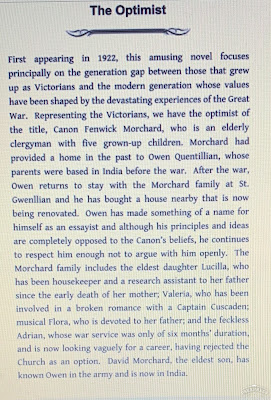
The Optimist by E M Delafield , was the first novel published by the author just after she returned to England following a couple of years when, newly married, she'd lived in Singapore with her husband and young son. (There's an earlier feature about Delafield at Sad December in Kentisbeare on my previous blog). According to her biographer Violet Powell in The Life of a Provincial Lady, The Optimist was written between August 1921 and March 1922; the family sailed back to England in the spring of 1922. Following their return to the UK and again according to her biographer Delafield and her family settled 'downalong to Devonshire'. Delafield had often stayed in the county with her mother and had loved watching the spring flowers unfolding there especially primroses which she still picked and saved in boxes every year as gifts for friends and family. The family rented a house called Westcott (I've not been able to locate where this was) before moving in September 1923 to their forever home at Croyle House near Kentisbeare. 


picture of tree with Croyle House at Kentisbeare in the distance
Croyle House across the field

The Optimist is another novel I've not yet had opportunity to read so any comments rely on others' responses to the book. Powell says that the novel was dedicated to C.A Dawson Scott, who had previously written a very encouraging review of Delafield's early novel Zella Sees Herself. 

Powell's view is that The Optimist 'is in some ways the oddest of all her [Delafield's] books'. Her biographer also suggests that the novel includes literary allusions to Charlotte Yonge's The Pillar of the House and Dickens' Bleak House. Charlotte Yonge was another writer whose memories of childhood holidays spent  with her cousins in Devon became encapsulated in her fiction. Delafield had a longstanding interest in Yonge's work which was put to good interest when she contributed the Introduction to Charlotte Mary Yonge the Story of an Uneventful Life,  Georgina Battiscombe's biography of the author, published in 1943. 


Several reviewers of The Optimist also pick up undercurrents of other prior women's texts. According to one source The Optimist, along with F M Mayor's novel The Rectors Daughter, 'offer a modern rewriting of and modern commentaries on Jane Austen's Mansfield Park and Persuasion'. (Janeites: Austen's Disciples and Devotees)

    The plot of The Optimist apparently revolves around the differences between different generations in the family of a certain Canon Morchard just before and following the First World War. A quick glance at Goodreads and Amazon reviews tells me that it has a mixed response from readers, ranging from those who find it engrossing such as this one from Amazon reviews:

'Some may find the character of the Canon just too tiresome, but he was so beautifully rendered in all his sometimes-tedious glory and piety, I couldn't stop reading. The detached and priggish main character is also a bit of a trial sometimes, but again, the uncompromising realness of all of the limited people who populate this novel is the book's great strength.' AmazonReview

But, another Amazon reviewer is not so impressed. 
'I'm afraid I found this very hard going. It just didn't hold my attention, I felt unable to make a connection with any of the characters, and I had to struggle to make it to the end. I do enjoy Delafields books and I feel she was a really talented author, but this was a disappointment to me'. Amazonreview

    Yet another reviewer is extremely complimentary about The Optimist judging it to be 'one of the most thought-provoking novels of the 1920s'; this review concludes that 'It [The Optimist] deserves a reprint'.  I hope to make up my own mind about he novel one day, and will be especially keen to note the intertextual links between The Optimist and Jane Austen. 

Please do get in touch if you've read and have views about this novel.

_______

The Vision of Desire 


Covers of various editions of Vision of Desire

    The title of another novel published in 1922  by a Devon woman writer echoes that of Willcocks' Wings of Desire. Perhaps indeed Pedler's choice of title was influenced by the earlier work. You'll find my extended piece about Margaret Pedler on Scrapblog at A Zeal Monachorum Author who was 'Queen of Romance' so I'm not going to spend too much more time on her today except to reiterate what I said about her in that piece; I assessed that her work goes beyond the generic stereotypes expected with that of 'romance novel', that her fiction 'deserves our attention, especially for what it can inform the C21 reader about the ways in which, during a time when women's place in family and wider circles was rapidly changing, early to mid C20 women novelists depicted issues about female lives and roles in society'. I see Margaret Pedler as an author of 'middlebrow' rather than 'popular' romance novels. 

Review from The Scotsman of Vision of Desire in 1922

 Here, in the accompanying image, is a copy of one contemporary review which mentions The Vision of Desire - a 'good honest romance'. Another book-jacket reviewer calls the novel ' an absorbing romance written with all that sense of feminine tenderness that has given the novels of Margaret Pedler their universal appeal'. (Grosset & Dunlap publishers New York).
                                  

                                                           ****

And now, bringing this celebratory Devon chronology a little closer to us chronologically, and, for now, closing it - another novel by Margaret Pedler,

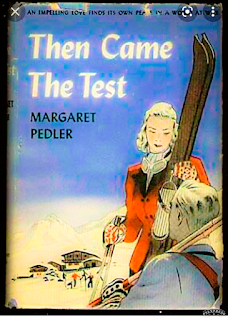
80 years ago, in 1942, another of then acclaimed and popular romance novelist Margaret Pedler's novels, Then Came the Test was published.

Annoyingly thus far a perfunctory search on google has only provided a brief synopsis of that novel. It summarises that plot:

'An English story of the extravagant Sherwoods, geared to horse and hounds, and coming up against sober reality when debt loses them their estate, and war breaks out. Familiar enough triangle pattern, with tribulation getting its tribute, and love eventually winning out'. (Kirkus)

Yes, fair enough there are several copies of the novel - including a scattering of first editions - available on sites such as AbeBooks, but they are few and far between and not cheap. I hope I'll return with more commentary about this long lost novel as soon as opportunity arises... 


Note: Re update following the sketch above of the cottage where the Sinclair family lived. I am very grateful to Jan Wood, archivist at Devon Heritage Centre who kindly assisted in helping to locate the house. Here is part of the email she sent providing details about the whereabouts of the property. '... named as Brookhill - on the 2nd edition Ordnance Survey map [dated to the early 1900s] on the Know Your Place website. It is in Grigg's Lane, which ran at the time from the junction of Sid Road with Fortescue Road (this area is now called Sidford) towards the east, in the direction of Salcombe Regis village. Just past Brookhill/Quest, close to Thornhill Plantation, and before reaching Salcombe Regis village, Grigg's Lane seems to have turned at that time into a narrower track or pathway. Brookhill stood on the south side of the lane towards the village. .. I have just found it on the 2019 basemap as well, named as Quest - so it may still be the same house - if it is not a rebuilt house with the old name still kept. The lane still turns into a trackway just past the house'.


Well there you have it, another year and a selection of the past's celebrated Devon women writers and texts. I hope I'll be here next year to catch up on some more literary anniversaries!

Featured post

  Finding a Forgotten Devon Author's Grandmother; Who was Edith Dart’s Granny Jane Sampson? Lanes, distant moor and ‘Lydcott’, a farm (o...