First page of Barbara Buller's Devon diary circa 1820
Reproduced by kind permission of Devon Archives & Local Studies, DHC 5870M/F/1-5870M/F/2.
The Devon Heritage Centre holds a file of a diary kept by Barbara Isabella Buller, nee Kirkpatrick, its provenance attributed to South Molton (fl 1820). It’s listed on Discovery. When I first
noticed the file something
prompted me to take a second look. A diary kept two hundred years ago by a woman
whose name was unfamiliar sounded intriguing. I assumed Barbara to be a woman from the Devon
locality, but (although aware of Buller family links with Kingsnympton), was
puzzled by the apparent connection of
someone from the family with South Molton. I began to google the diarist’s name, not really expecting to find much information about her. I was surprised to find that
Barbara came from one of the topmost privileged and colorful families of her time, the Kirkpatricks, many
of whose menfolk had prestigious careers in the Colonial Service, in India. My curiosity
grew. What connection did Barbara Buller have with this north Devon town? Why was
she keeping a diary - why indeed, was she there?
Coincidentally, around this time I'd come upon a commentary about another journal centred on north Devon, also written by a woman and featured in the anthology Devon Documents (Ed. Todd Gray). This was The Travel Documents of Elizabeth Ernst North Devon in the 1840's, with commentary by Sue Berry of the Somerset Heritage Trust. Although as yet I have not had a chance to look at Ernst's journals in detail and although there is a difference of some twenty years between the diaries, I now believe there was a social or/and family link between the two 'diarists' (which I'll note below when I comment on the diaries themselves); this suggests to me that travel journals written about and during holidays in Devon, during this period of the early C19, may well have been a popular literary activity for women travelling in the westcountry, especially perhaps those who had connections with the upper, educated class. There may well be other similarly neglected and unpublished journals lurking out there in various archives.
I ordered
some pages from Barbara Buller's journal from the record office and they generously sent me
the full file. This is brilliant, I
thought as I sat down to begin reading. But I hadn’t bargained for a well-nigh illegible
text! Charlotte Buller’s letters (which I’d also recently read) – written during the
same time-span as these diaries, are, in comparison, beautifully neat scripts, and oh so easily transcribed!
I have to confess, initially I quickly gave up with Barbara’s diary. Trying to scan the words quickly to work out a resume of their content
initially proved impossible. Although archivists have managed to get
a sense of their content, I'm not accustomed to dealing with unruly handwriting from the past. I'm not sure that anyone has wrestled with Barbara’s atrocious handwriting to enable
thorough comprehension of the pages’ content (and no, I don’t think that can be
explained away by assuming written letters of the early C19 would be penned in chaotic
script), which may explain why there is no summary of their content on the
archive listing. Anyway, not having
hours of spare time and assuming I’d never be able to make sense of this erratic handwriting, I put the copies aside, in my iPhone Collect app.
More
recently, I decided I must have another go. Specifically, I wanted to find out
if there was a connection between these two Buller family women – Charlotte whose letters I looked at in the previous blog, and Barbara, who, like Charlotte
had married into the Buller family. After all the two women were living within
coexisting time spans, though Barbara lived a little earlier than Charlotte.
I
still struggled to decipher script into words, but very gradually began to
pick out odd words, then phrases, then an occasional sentence. A few minutes
every day, like exercise! As long as I
didn’t spend too long pouring over an intractable word, but just
skipped to the next, I was able to read, my effort gradually began to give dividends. The diary was even getting quite intriguing! Although the pages didn’t appear to contain any
content relating to matters of national historic interest, the diary did - and does - contain references
to a range of diverse topics: these include accounts of C19 jaunts to local
places, as well as personal accounts of the diarist’s attendance at several
local society balls (which take in reference to a number of contemporary individuals. As
I gradually got a sense of some pages of the journal’s content it struck me
that it’s a shame it’s not been noticed, not because the text is a beautifully
crafted new revelation of a lost C19 woman writer - these journals patently
aren’t that - but, given Buller’s family
background, what her diary does is fill in a few gaps in our understanding
of the cultural milieu of her time, especially concerning contemporary social events and well as descriptions of travelling and descriptions of localities in Devon.
Who Was Barbara?
So, who was Barbara Isabella Kirkpatrick Buller? And what was her connection with
South Molton? What indeed was Barbara's connection with Devon? Well, as I said, born in 1788,Barbara came from one of the most exotic families of the time and married into
the labyrinth of the extended Buller family - of Morval in Cornwall and Downes in Devon - and Kirkpatrick family. Both families (especially the Kirkpatricks) - (whose family and interpersonal networks are especially intricate and hard to untangle) - were at the heart of many literary and
intellectual circles of their times. It is useful here to take at least a cursory look at the
Kirkpatrick/Buller family and association networks because as well as touching on their various literary communities and their abundant associations with Devon. both the backstory and
content of Barbara Buller’s journals link into the lives of individuals from within them
Charles
Buller, Barbara’s husband (born 1774),
was MP for Looe in Cornwall. The couple married (I believe, in Calcutta), in 1805
when she was about 17. Barbara and Charles had two sons, Charles and Arthur
Buller, born 1806 and 1808. The genealogy is extremely complex, but I understand that Charles SNR's kinship link to
James Wentworth Buller, husband of Charlotte (who I wrote about in the blog's previous
post), was through their mutual paternal grandfather/great grandfather, also James Buller (1717) of Morval and Kingsnympton, who took over Downes in Devon after his marriage to
Eliza Gould, whose family had held the estate. James Wentworth Buller was (probably) his grandson - or possibly great grandson; whilst Charles Buller was, I believe, James Buller's grandson, through his second wife, Jane Bathurst; thus I assume James W and Charles were (half) cousins once
removed. However, there may be someone out there who finds this post and has a more definitive understanding of the Buller genealogy than I and sees an error in my workings out. If so, please do let me know!

One of four girls, Barbara Isabella (who was just over twenty years older than Charlotte, some of whose letters I discussed in the previous post) was daughter of Major General William Kirkpatrick, the Orientalist, whose career was spent in Calcutta where he worked for the East India Company; Kirkpatrick retired to Exeter in Devon, where in 1805 (when Barbara was about 17 and apparently the same year in which she married), he acquired Southernhay House, which became his home until his death. Now a hotel, Southernhay House, is near the Cathedral Close. According to Wikipedia, other than his connections with a couple of local men, Kirkpatrick’s reasons for settling in Devon are unknown, (but as I've gradually explored his daughter's journals, which frequently mention names of people she knows or is familiar with in the Exeter locality, it seems to me that the family had longstanding and close connections with the place).
Marie Seaton Pawson, Barbara's mother was said to be a daughter of Yorkshire gentry. I was initially unable to discover any more about her, but feeling somewhat irritable, as I often do when someone's maternal ancestry is missing, began to trawl through some of my favourite genealogical websites, digging a little deeper (as they say)! I found a Pandora's Box of genealogical treasure indicating that Barbara's maternal inheritance was far more complicated than is suggested by the label 'Yorkshire Gentry'. Indeed, Barbara's maternal family appear to be just as - if not more - exotic as that of her father. I'll try and lay out the bare bones of Marie Pawson's family, as far I can make it out - anyone reading this out there may decide this is all far-fetched and that I'm wrong in my calculations. If so, do get in touch!
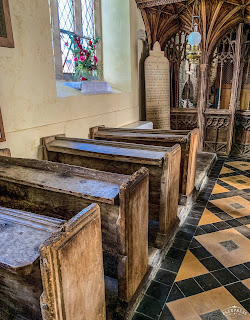
So, Marie Seton Pawson, Barbara's mother, was born in 1766, she was daughter of George Pawson and a woman named Clementina. George Pawson, Marie's father, was listed as wine merchant at his daughter's marriage to William Kirkpatrick, in September 1785, in Calcutta India, and as merchant, at his own marriage to Miss Clementina Smith, at New Kirk in Edinburgh, on 31st July 1763. See the photo which contains the record of this marriage:
I've not yet traced much else about the Pawsons, but Marie's mother's ancestry is fascinating. It leads back into several of the most powerful and historically riveting Scottish families, including the Patersons of Bannockburn and Setons of Touch, and through them, hooks into the complex events that occurred at the time of the second Jacobite Rising, in 1745. There is an intriguing link between Clementina (Barbara the diarist's maternal grandmother) and another woman of the same name (and time) who became mistress of Bonnie Prince Charlie. I believe the two Clementinas were close family members; several of the family's female names thread down through the generations, including Marie, Clementina and Barbara and Seton (which indicates that I am on the right lines in my research into Barbara's maternal ancestry).
I'm more or less certain that Barbara Kirkpatrick's maternal grandmother Clementina Smith was daughter of a rich liqueur merchant, called Charles Smith (probably 1688-1768), who is now recognised as a key undercover agent and Jacobite supporter, who, though based in Bologne, was Scottish and returned to that country to retire. His wife, Elizabeth Paterson (Barbara's great - mitochondrial - grandmother), daughter of Sir Hugh Paterson of Bannockburn, 1st Baronet, was sister of Hugh Paterson 2nd Baronet, (who married, as his second wife, Elizabeth Seton of Touch) and mother of Hugh Smith, who was I understand, - although this information is not always given - became Elizabeth Seton's second husband), taking her surname upon marriage; hence the Seton name that runs through Barbara Kirkpatrick's family. There were apparently also several girls in Charles Smith's/Elizabeth Paterson's family, including I believe 'Clementina', wife of George Pawson and another sister, Catherine, who became mother of the Clementina Walkingshaw who was mistress of Bonnie Prince Charlies and - if all this is correct - aunt of Clementina, Barbara's grandmother (whose life-span interestingly seems more or less to coincide with her apparent namesake, the more infamous 'Clementina') and thus great aunt of Marie Seton Pawson, Barbara's mother. Fair enough, I've not supplied copies of all the records I've looked at in this skeletal genealogy but I wanted to include it just to provide a bit of an outline about Barbara's maternal forebearers, as their colourful lives may have had some kind of influence on her; certainly she makes a few passing comments about her mother's family in the pages of her diary, so was quite likely familiar with its intrigue.
Barbara's early life
Research re genealogy sites shows that Barbara Kirkpatrick and Charles Buller married in Calcutta in 1785, but split up only three years later (when their mother returned to England), in 1788, the year of Barbara’s
birth. The couple finally separated in 1797 (Barbara was 9), and the children were put
into the care of their paternal grandfather, Major General James Kirkpatrick (who
was nicknamed ‘The Handsome Colonel’), who had retired to Kent. It seems
the children had an erratic upbringing; their mother eventually returned to
India with her lover. Presumably the children remained with their grandfather,
who according to various online sources was ‘never one to take the business of
parenthood too seriously’ (erenow.net) Barbara and her sisters also had two
older half-siblings, as their father had a long standing and legalised
relationship with an Indian woman called Dhoolaury Bibi; the couple’s two children were Robert and
Cecilia. Meanwhile, William’s half brother James (also a colonel in the British
East India Company in Hyderabad), who converted to Islam and was a double agent,
became engulfed in a liaison with an Muslim noblewoman called Khair un-Nissa, which
caused widespread scandal. James died suddenly in 1805 and two children from
the relationship followed the other Kirkpatrick children, their half cousins, back
to the UK to be cared for by grandfather
James, ‘The Handsome’. Following a severe accident, the son became a recluse and
died at an early age, but the daughter, KatherineAurora, (Kitty), born 1802, apparently
spent some of her life with her half cousins, 'diarist' Barbara and her younger sister Julia Woodburn Kirpatrick Later on, upon marriage to Captain James Winslow Phillips, Kitty, herself a wealthy
woman, lived at Villa Sorento, in Torquay. She died there, in 1889. Kitty features in several books, including William
Dalrymple’s White Mughals, which relates the story of her parents’
affair and Thomas Carlyle’s Sartor Resartus, in which Kitty is Bluemene,
Rose goddess, the heroine; Carlyle is said to have fallen in love with Kitty. But Kitty
isn’t the only Kirkpatrick to be embodied in literature, for I found somewhere that Barbara Kirkpatrick Buller, writer of
the journals and her son Charles reportedly also feature in Sartor Resartus - he as 'Toughgut' and his mother as 'Grafin Zahdaum'; According to one source, Barbara has also been immortalised in fictional form, as the
model for Thackerary’s Blanche Amory, in Pendennis.
Nor
indeed was Kitty the only member of the family who was acquainted with top literary
figures of their time. For many of the Kirkpatrick– Buller family appear to
have been at the forefront of leading
intellectual and writerly circles. It was, I understand, Barbara’s grandfather James, the ‘Handsome’) who had brought her up when she and her siblings were sent back to England) who authored the poem Sea-Piece
(1750), whilst her father, on retirement to Exeter, translated over 400 letters
of Tipu Sultan (1811). Barbara must have been well acquainted with Thackeray who apparently exchanged letters with her. She also features in some critical texts about him.
Barbara Kirkpatrick Buller’s sons, who were both
educated at Cambridge and both later became M.P.’s in the Westcountry, also authored books and were closely connected and corresponded with several renowned writersand /or patrons from the literary establishment, including Thomas Carlyle,
Monckton Miles, Lady Asburton, John Sterling, John Stuart Mills Thackerary and his daughter Anne
Thackeray (who sometimes stayed in Devon). According to Carlyle, Charles
Buller, a ‘vigorous reformer’, was ‘the genialist radical I ever met’. It is thought that
Charles was father of Theresa Reviss, who entered fiction as Becky Sharp of Vanity
Fair. Theresa (nicknamed Tizzy), was adopted by Barbara, the diarist. (However
other sources suggest that Theresa was Arthur’s child). It is thought that one
of the brothers wrote the verse play Galopades in Revenge (1836).
The foregoing is only a quick resume gleaned from several googling sessions - each one deserving far more research than I've had time to give - noting some of the literary links with which the Kirkpatricks and Bullers were linked. Anyone who’s interested and
googles the family background will find a fascinating trail of interlocking familial and
acquaintance networks, which include various individuals from the extended family
circles, but here, my focus onward is on Barbara Barbara and the journals themselves.
There are portraits of members of Barbara's family online. I don't think that this one at the Portrait Gallery can be her, because of the date, which is after her death (but on the other hand I am unable to find any other Charles Bullers than her husband and son of that name who apparently did not get married); this memorial (with her son at Kensal cemetery also names her, whilst one or two comments that surface on the
web present a cameo or personality profile, albeit a somewhat mixed one.
Thomas Carlyle, who Barbara employed for a while as tutor to her sons,
said of her that she was ‘a capricious cold woman’ (See Carlyle and "Irving's London Circle": Some Unpublished Letters by Thomas Carlyle and Mrs. Edward Strachey, by Grace J. Calder). Carlyle is also reported to have
described the Buller couple as ‘strolling in strenuous idleness to compress their
tinselly enjoyments, conversant alone with the most shallow feelings, aiming at
little higher than dining or being dined.’ Yet, even this assessment is unreliable,
because another source says Carlyle also described Barbara as a ‘once very beautiful graceful, airy and
ingeniously intelligent woman of the gossamer kind’. John Sterling, writing in 1829 (see The Works of Thomas Carlyle) was very complimentary about Barbara. Describing her husband Charles as ‘a
rather clever man of sense, good natured and gentlemanly’, he went on to sum up
Charles’ wife as ‘once a renowned beauty and ‘Queen of Calcutta’, a brilliant
conversationalist who presided over a radical salon centred on her son.’ Yet
another commentator remarks she was ‘a restless itinerant’.
***
The Journal
So, now for a closer look at the journals themselves. As I’ve begun to get to
grips with the chaotic handwriting, one of my immediate impressions of Barbara the diarist is that the pages seem to be written
by a restless spirit, someone always on the go, travelling somewhere/ or/and going out
‘visiting’. So
Sterling’s appraisal of Barbara as ‘restless itinerant’ is probably en pointe. There is also, I notice, a volatility, expressed with mercurial changes of mood, demonstrated in the way she sets down a day's experiences - and several of the entries indicate the writer's prevailing sense of entitlement; Barbara assumes the identity of a woman used to entitlement and superiority - expecting to continue being served by those who are beneath her on the societal ladder (see for example the long account below of the trip to Barricane beach; perhaps Carlyle's assessment of Barbara is about right); although there are also several entries in the diary that suggest a kindness to those who surround her, a willingness to show them understanding and appreciation.
When I initially enquired about Buller's diary helpful staff at
The Devon Heritage Centre informed me that 'The surviving portion of the diary (we do not have it in its entirety) is in two fragments, both a little smaller than A5. The second fragment is just a few pages long but the main fragment is comprised of just over 60 pages'. I now have copies of approximately 35 pages (or 70 double), which may not seem a lot, but believe me, given the difficulty of reading, has taken hours of scrutiny and although I have tried to read them all, there remain passages that are still beyond me! Therefore, any commentary I make will contain a certain amount of guesswork. I have endeavored to get a sense of each page, so there’s an overall idea of the content. (In the passages below I've left question marks after each unidentified word).
Barbara Buller’s ‘journals’ can only loosely be designated as such. For, from the outset, they are presented as letter-diaries addressed to her husband, who is often addressed as ‘My best love’, in which Barbara wrote what we’d understand as a
letter, but in a journal mode; perhaps 'travelogue' might be better designation for them. The diaries were not intended for public consumption, although during the C18/19 journal keeping was becoming a popular activity for women (particularly from the upper class) to engage in; whilst reading it one has the sense of eavesdropping on one side of a
private conversation. I imagine that her
intention was to send the text to Charles, her confidante, or alternatively, to
share it with him when they were together again. I have a sense of invading a personal privacy as I quote and comment on some of the entries, but hope that given the long time span since the time of their writing and the, I believe historical significance of some of the pieces, that if she is hovering in some ethereal after-life Barbara will forgive me!
Given that Barbara was writing two hundred years ago, I find the diaries fascinating; for anyone who’s interested in Devon and its history, it’s women-who-wrote and indeed for anyone who’s curious about the social world of the early C20; as I noted above within the pages you can find a variety of subjects - at least one detailed account of a ball that the diarist attended – as well as comments about others that have taken place; there are frequent references to a variety of individuals, some of whom can be identified; she often expresses an opinion of the person in question, and goes on to update her husband about that person and family ; many of the entries are about Barbara’s social visits to friends and acquaintances in the locality; several entries concern her staff, especially a Grace, who I take to be her ‘lady’s maid’.
The overall tone and content
of the text suggests that the Bullers were a close couple; Barbara evidently
misses Charles; page one of the diary dated 1st August, mentions a previous ‘book’ which she has already
sent him, implying that letter-diary interchange was a regular occurrence:
It is now ten days my ever dearest
husband since I sent you the thin(?) book of my adventures and I have not till
now attempted to resume my daily intercourse with you …’
Emphasising again that communication
between the couple whilst apart was frequent, the diarist continues, ‘this (chasm) in my history has, however been filled up … by the letters I wrote you a few days ago’. My assumption is that Charles was
in India during the time his wife was writing the diary, and that she was on
holiday in Devon. Indeed, there are several references to ‘my ‘holiday’ within
the pages and others soon confirm that she was indeed in Devon.
It
is noted on the archive file that the journal was written during the 1820’s and
although as far as I can yet tell there is no year specified within the pages, from its many references to Barbara’s sons who
are evidently with her on holiday in Devon, I think that 1820 may be about
right; the sons are evidently still children, but probably more teenagers than
young boys. Background reading informs me that the Bullers lived in Kinnaird House
in Perthshire from 1823, after Charles had returned from Bengal and that by
1824 they were down in Woolwich in Kent. So all in all 1820 is a good guess for
the Devon trip. Barbara must have been about 32. (The entries are written during the month of August, but I have not yet followed or noted here their dates of exact chronology).
It soon becomes evident that Barbara Buller was more than a little familiar with Devon places, and especially informed about its local gentry; she frequently intersperses her diary entries with comments alluding to a prior knowledge of the place or/and of its geographical location, suggesting that she has already at some previous time stayed in the county, perhaps when her father lived at Exeter, or/and during the time of her courtship with Charles, who was a westcountry man. The entries often recount travel expeditions, including several trips to Devon places; Barbara occasionally gives a description of the place and her own opinion of it, and as well, writes with obvious knowledge of and familiarity with the people who she encounters during her travels.
Often Barbara seems overly preoccupied with her health and is updating
Charles, not only concerning certain physical ailments but also about her apparently
vulnerable emotional state. Later
comments in the diary suggest to to me that Barbara was recuperating after
undergoing a period of illness and that, perhaps, her holiday in (coastal) Devon was
arranged for her to regain her physical strength; several entries note her food requirements and suggest a preoccupation with her diet and with sleeping patterns. She is also often concerned about her appearance, possibly this is a common womanly trait of her time, or perhaps her apparent vanity is more because she has reason to inform her husband of the improvement in her 'looks'.
As she writes, it’s very clear
that the couple’s relationship is such that she feels quite able to inform Charles about her personal concerns in some detail, including her walking routines and the regimes of her daily food (which often are fascinating and include references to weighed out - not calorie
controlled (!) food; but as the diary develops, the topics open out; it's soon clear that Barbara is not staying at South Molton, but is instead near the
sea: ‘I do not go out again till two o clock when I stroll about on the Beach
for an hour or so.’ Reading on, it’s soon apparent that she is holidaying in Ilfracombe,
has been there three weeks, but that, due to not fully revealed health concerns
(‘I have already mentioned a longer residence would I think be ? to my health’),
including it seems lack of company (‘I should be satisfied … but the ?? of
society for so long … is a trial to my spirits…)’ is making plans to leave the
town and travel on to Exeter, where she believes ‘many of your relations or friends
will invite me’ and that her intention is to remain there ‘till the 19th
when the holiday will be over’.
Although I’d love to do so I cannot here follow the progress of Barbara Buller’s diaries through in detail; if I did rather than blogpost this would become long academic paper, or even dare I suggest thesis! . However I hope that if I trace a few of the journal’s themes and include some longer extracts from it that someone out there will be curious and decide to take a look themselves...
Reproduced by kind permission of Devon Archives & Local Studies, DHC 5870M/F/1-5870M/F/2.
Barbara's day-trip to Barricane Beach
'I must now my best love give you an account of our adventure which occurred to me the day before yesterday from which you may form some idea of my improved strength although I hope never again to experience such a painful trial.' (From F1 4)
Well, before I follow Barbara’s journey from Ilfracombe - a place she was not keen on - on towards Exeter, I'm going to share at length much of her entry about a bizarre day trip, which she took with her sons to a local coastal beauty spot. On the advice of their cook (who’d informed the boys that Barricane beach, ‘a place by the seaside’, ‘famous for its fine beach and beautiful shells’ and was ‘only three miles away’). Barbara decided the ‘distance was so trifling that I thought we could easily accomplish it before breakfast and after spending a few hours in picking shells intended returning to Ilfracombe for dinner’. Little did she know what kind of day was before her.
I doubt that Barbara intended her account of the trip to be hilarious, even farcical - though she does briefly show awareness of the humour of the situation - but I couldn’t stop smiling as I read on, although I'm aware of the pitfalls that accompanied local travel back in the 1820’s - a totally different affair than now - even apparently, for gentry looking for accommodation. I'll include a long section from the journal to give anyone reading this a good idea of how the story of the disastrous outing to Ballicane builds up.
We got three very quiet ponies from the Butcher who lets them out one of them carried Charles and James a very nice boy of about 14 ... who officiates as my footman, the other Arthur rode and I mounted on the third. As (?) is so good ... I didn't like to leave (him)? ... but Grace who liked the idea of the ? volunteered to take charge of him and she accordingly set off on the donkeys. I usually ride with ? before her. The cook understood to be our guide walked (?) with drinks and bread and butter and a couple of mutton chops for me .... (F1 4)
... I found that we had only proceeded three miles and I began to feel very tired. I proposed we go into a Farm House which was luckily close by, in which to to try (?) some breakfast - the people were luckily not unaccustomed to similar applications & we therefore succeeded in getting some very nice comfortable Breakfast. At 12 oclock we proceeded on our journey, but we had by this time (determined)? that the distance from Ilfracombe was by the very shortest road five miles. After we had got to the top of a very steep hill our guide the Cook, was so hot & tired that there seemed little chance of her being able to walk all the way. Therefore I got off from the Donkey, Charles, James & ? rode one horse Arthur the other & Grace took my pony with the Cook mounted behind & found being very fat & the pony small she was literally seated on the tail, nothing could be more ridiculous than the appearance of the whole cavalcade. I think if you could have seen us without anticipating the ? you would have laughed as much as I did. We soon found that our guide was perfectly ignorant of the Road. Every ? lane we were desired to enter but as soon as we came to a House - which was but too rarely the case - we were sure to be directed back again & in this way we proceeded till two o clock. I had frequently got off my donkey to walk as I found it relieved me but by this time I was so fatigued that I was obliged to go into a Hay field, spread my cloak on the ground & lye down (F1-5)...
for half an hour - Having then received ample directions from a man who was mowing in the field, we set out again, but again got out of our road at a place where four roads crossed each other & unfortunately the next person we applied to, although he directed us to the place it was by a circuitous road of at least three miles - I was by this time really quite knocked up but the hopes of reaching at last a decent public house where I might continue to sleep for one night, supported me & gave me strength to get on to Bellicane. When we arrived at 5 o clock ? however my dismay when I saw the place where I had proposed resting after all my fatigue. It was ? dirtier than the worst Ale house in the smallest village in Cornwall without any place to sit in or sleep a miserable room infinitely less comfortable than Mrs Pincombe's (?) kitchen nor had they any thing to give us to eat except Barley bread. Tired as I was, I left it in disgust, but should probably have been driven back to it by necessity had not a woman in a Cottage opposite begged me to come in to her and ? me that her house was frequently revisited by the Gentry who came to Barricane - I looked into it & seeing that it was much cleaner & nicer looking than the public house I accepted her invitation, but when we came to enquiring (?) into her stores we found that she had ?? ? of any kind but salt pork but she proposed killing some chickens & boiling them which was accordingly done & ?? us in getting a Lobster & some eggs. Whilst the Dinner was preparing I went up into a ??? & had a look at the woman's bed, being thankful for any place to rest my wearied limbs but the noise of the children completely prevented ? sleeping. I sent Grace to her to see if it was possible (F1 - 6)
to get a Bed any where, where I could at least could have remained for the night, but she was unable to succeed in getting anything better than the Cottage I was already in which was too c? to give me any hope of being able to sleep in it. We had therefore no alternative but sending someone back James ? ? practicable dispatched to Ilfracombe to desire that a Post Chaise might be sent for us as soon as possible. He went off about 6 o'clock & we sat down to our Dinner ? which turned out to be rather a miserable concern... (from F1 - 7)
... Then, just at the height of her description about her discomfort and angst about the outing - when, objecting to the ‘miserable’ and ‘tough’ ‘fowls’ the cottager had presented the party for a meal - she‘was obliged to make my dinner principally of bread and butter’, Barbara's narrative mode changes abruptly and there follows a passage which focuses on the scenic beauty of her surroundings at Barricane: she ‘strolled out to the top of the hill near the cottage and 'though I wasn't much in the mood to be pleased with anything' ... ‘could not be struck with the extreme beauty of the surrounding scene’. There follows a rapturous description of the scene, perhaps Barbara was influenced by earlier readings of the Romantic poets and their notion of the sublime in nature and landscape. Barbara's beleaguered spirits were evidently soon restored! (I'm still struggling with several words from this passage, but you can get the general gist of it):
... The coast ? at this place forms a beautiful Bay, with the finest sandy beach I have seen in any part of Devonshire an island in the middle of the Channel called Lundy Island seems almost to touch (?) one extremity of the Bay although it is probably some miles distant and & beyond this Island the Welsh Coast was perfectly visible. The character of the Country which Barricane is I think particularly pleasing. The Cliffs if indeed they can be called such are not at all abrupt but ??? places of a easy descent to the the scar (?) & form ?? like Vallies covered with turf and fern - which gives them ? enough to be pleasing to the eye & to admit of this variety of light & shade which is so ? to the Beauty of a Landscape. (f1 - 7)...
I could not have chosen a happier ? for seeing Barricane to advantage than the one I happened to fix upon. The evening was uncommonly mild & the sky almost without a cloud. On one side the sun was just setting with the sea & the moon had just appeared in all her silent splendour on the other - From the hill on which I was standing I had a complete view of the Bay & the Welsh (?) Coast. The sea was scarcely ruffled although there was enough to ? the sails of numbers of little Fishing Boats which added in no slight degree to the beauty of the scene - ?? it was altogether so lovely that it made me forget all I had undergone to view it, & if you had only been with me my dearest Husband to have partaken of my admiration I think I should have been induced to ? it the ? it or at least the most pleasing prospect I have seen since I have been in England. For a watering place the situation & bathing are incomparably superior to any I have seen (f1 - 8).

Reproduced by kind permission of Devon Archives & Local Studies, DHC 5870M/F/1-5870M/F/2.
Then, taking leave of the beautiful vista before her (and it seems her considerably mellowed mood) Barbara returns to the
'miserable cottage which the woman endeavored to make as cheerful as she could by lighting a rush light, & making the hearth blaze with bundles of ferns'. The party waited for their transport back to Ilfracombe, her sons 'amusing themselves with ? out every moment to look for the Carriage', whilst 'Grace was nodding in a corner & I was lying on a bench, half dead with fatigue & impatience'. Even when the carriage arrived the party's troubles were not over; the return journey was as eventful as that of the arrival in Barricane. Barbara's 'joy' at hearing the vehicle outside was short-lived, for
'instead of a Chaise, an Open car (something like a double Gigg) without Springs had been sent for us ... This miserable conveyance was drawn by one Horse & our driver was a boy about Charles' size & age. I had no alternative but going in the wretched thing or sleeping in the same ? with the Cottager's children & so therefore got in the Gig, James following with a Horse & Donkey which was to be taken back to Ilfracombe. The moon had disappeared but there was light enough to show (?) us our road although not sufficient to keep us out of the rucks which were very deep, & jolted us to such a degree that even Grace found it almost insufferable - After we had proceeded a little way we heard James calling to us to stop for he could neither get on the Horse or Donkey - I desired him to let the Donkey go on as it ??? & this proved good? (from f -10).
Unfortunately, I am not able to note here the ups and downs of the party's final arrival back in Ilfracombe; the page which I assume must relate the conclusion of the fated trip is apparently missing files so at present I only have Barbara's self-pitying remarks to her husband on the page (f-12) after this: 'I am sure my dearest husband you will pity me when you read this terrible adventure & ? to yourself the dreadful fatigue I must have experienced' - but she counters her complaints with the awareness that 'if you had been with me it would in all probability never have occurred but at all event your society would have made a most ? difference'. 'As it was' she comments, the 'Party of Pleasure' was 'one of the most miserable days I have spent ... in my life'
On one level, the story of the eventful Barricane outing seems to confirm Carlyle's judgement of Barbara Buller as 'capricious and cold', not only in her stance of social superiority and entitlement, but also, it appears, in her disregard for her sons' welfare during the trip, where she comes across as preoccupied with her own welfare. But I think that assumption may be a bit unfair on the lady, as dotted through the diaries there are occasional indications of a kinder more considerate persona. She takes pity on the poor 'abominable Cook' after her other staff blamed the woman for the disastrous trip to Barricane: it turned out the woman had 'never been near the place herself & trusted solely to our good fortune to discern the way'. But rather than scold her herself Barbara notes in her diary that 'The other servants were so enraged with her ... that I believe she has had reprobation (?) enough to punish her'. Then there are comments which suggest Barbara's maternal concern for her sons; she notes that she has talked to them about her future plans to return to India and that they are happy about the arrangement, whilst she has invited Grace to accompany her, noting that 'it might be to her advantage'.
****
Onwards to South Molton & Beyond to Exeter
Not long after the disastrous beach trip Barbara leaves Ilfracombe and travels through Barnstaple, via Castle Hill towards Exeter, stopping for a few days in South Molton, ('a very nice looking town', where they were staying not far from the church as Barbara says that the nearby church clock woke her early.
On the 6th August she writes about their recent trip out from the town, another extended day's outing, this time to
'New Place' King's Nympton). New Place, nowadays called
King's Nympton Park, had been built by
James Buller (1717 - 65), who was Barbara's husband's grandfather (see above). Barbara evidently had not been there before, but her intense curiosity concerning her husband's forebearers' estate becomes palpable as the diary recounts the visit. It begins by telling Charles that the weather that day was
'unpromising', then notes that 'I accordingly set off with Charles and Arthur in the Carriage, my ? Footman having left before on a Donkey for us or me (?) to ride (?) when I got there'. Grace and 'Reggy' (?) were left behind as Grace's family lived in South Molton and Barbara believed she'd prefer 'spending the day' with them; whilst 'Reggy' would 'only have been in the way'. Barbara bemoans the roads to Kings Nympton, which are 'very hilly'. The party arrived at New Place 'in the midst of wind & rain' and were received warmly by a Grace Beer, who I take to be the then Housekeeper at New Place. Barbara informs her husband that Grace 'could not make out what could bring such unexpected guests'; the diary adds that 'when I told her that I was Mrs Charles Buller - she exclaimed "What Master Charles' wife , god bless him & all that belongs to him" & nothing could exceed her delight & warmth of her welcome." Presumably, Grace was one and the same as the 'old woman' who Barbara showed the
'picture in my pocket that it might see its old favourite place', (ie Charles' picture).

Reproduced by kind permission of Devon Archives & Local Studies, DHC 5870M/F/1-5870M/F/2.
Barbara's vivacity and curiosity (nosiness?) quickly come to the fore. As soon as their introductions to Grace were accomplished,
'we immediately ran all over the house, Grace following & telling us to what use each room had been appropriated - at last we came to a room next to the nursery with two Green beds in it & in this room Grace told us Master Charles & his Brother used to sleep when they came hone for the Holidays. (F1 -20)
I need not tell you, the diary continues 'that the room interested me more than any of the others & before I left the House I went up to it again & kissed both the Curtains although not the very cleanest, thinking that you had slept within one of them.'
The diarist's love and longing for her absent husband is again confirmed; she longs 'for some kind Fairy who could have brought you before my longing eyes'.
The visit continues, the journal next documenting Barbara's forthright views about the state of New Place's house and garden:
The house is in a very good repair in at least only requiring painting to make it so, but there is a still far greater scarity of furniture than at Morval - ? excepting the Library or beautiful Parlour there is no sitting room with anything in it - the Bedrooms were as they were in your time & although old fashioned both very comfortable with the help of a little money the House might be made a very handsome as well as ? one but the addition of a couple of wings as was originally intended would leave nothing to desire - After peeping into every nook & corner, we went in spite of the wind (the rain had ceased) to look at the Gardens which have the remains of very excellent ones, but now they are a perfect wilderness, over grown with grass & weeds & vegetables & fruit trees all growing together in terrible confusion. In spite however of its ? unprepossessing ? appearance a good gardener would I have no doubt soon make it a most excellent Garden (f1 21)
Picture: Entrance to King's Nympton Park
Whilst in 'the garden Barbara's sons 'helped themselves to some Currants ? which was the only fruit ripe', then (I'm not sure if there is a missing page in the journal at this point), the party went inside again, where Grace served them a dinner of 'Cold Fowls', a tart? and some bread' (which 'luckily' the party had brought with them). Grace supplemented these with 'some potatoes & a little fresh butter'. 'We made a very good Dinner' Barbara concludes, 'Grace waiting on us, often talking of Master Charles & hoping he would come some day & live ? at New Place'.
Before leaving the house Barbara felt compelled to take another peep at the kitchen and Charles' old room 'with a fervent hope on my part that I may again revisit it with you' (she notes that New Place is her husband's 'favourite place').
The party were back in South Molton about 7 o'clock. Their outing to King's Nympton was evidently a considerable improvement to the day at Barricane! Before she moves on to other subjects Barbara informs her husband that prior to the visit to Kings Nympton she'd been in touch with Mr & Mrs John Buller to let them know of her intended visit to
New Place and that she'd 'had a very kind letter' in reply,
'appraising me of the degenerative state in which I should find it'. I believe that
John Buller must be the elder brother of Charles, Barbara's husband, born 1771 (who married Harriet Hulse, as his second wife). During the decade of the 1820s, when the journal was written, he was probably the John Buller who held
New Place , or King's Nympton Park. One website comments that
John Buller continued to develop the landscape, constructing in 1769 a picturesque thatched barn, known as Snydles Barn, to be seen as an eyecatcher from the Great Terrace (CRO: DD/BU135). In 1776 John Buller was appointed Commissioner of Excise in London, and New Place or King's Nympton Barton was let; the terms of the lease reserved to Buller the 'great House, the Walled Gardens, the Whole [Home] Close, the park, the little new stable, the Coach House stable, the House & Garden at Jewells & Jewells Marsh', together with rights to the timber on the estate. The lease was renewed in 1795, and by 1818 the farm was let to Robert Tanner, whose son, James, purchased the estate from John Buller in October 1843. (See King's Nympton Park)
In other words, at the time of Barbara Buller's impromptu visit to the house in about 1820, the estate was in a rather deteriorating, in-between state, still at least partly owned by the Buller family, but undergoing the gradual change of ownership to James Tanner, a local yeoman. That might explain the state of disrepair that she emphasises in her diary.
Next page of account of trip to New Place King's Nympton, (f1-21)
Reproduced by kind permission of Devon Archives & Local Studies, DHC 5870M/F/1-5870M/F/2.
The 'stage from South Molton to Crediton is 20 miles', Barbara comments as she journeys onward away from South Molton toward Exeter, adding that it 'was rendered ? doubly tedious by the badness of the weather the rain having ? all day. We reached Exeter about 5 oclock'.
I get the feeling that Barbara thrived during her time in Exeter, enjoying daily rounds of visiting and sightseeing, interspersed with walks in the town, beside the river, or canal and donkey rides. She even enjoys at least one ball whilst there. Her move to Exeter has got her what she told Charles from Ilfracombe she wanted, ie company and various invitations from relations and friends, including chance meetings with people who knew India and could talk with her of 'old Indian friends'; but, in the midst of all the bustle she is still concerned with her ongoing health concerns, which often seem to necessitate rest times. Interestingly, there does not appear to be any mention of Southernhay House, which had been her father's home, or and of her father's close connection with the city, though Barbara does refer to a few local places as though she is already familiar with and has connections with therm.
Her entries are often interspersed with her opinion on the places she's viewing: for instance a 'walk with the children to the Banks of the River' is 'a remarkably pretty walk' which she adds is 'an easy distance from my lodging'. Whilst she's out and about Barbara frequently encounters a whirl of various acquaintances, who then often drop round to see her, or vice versa; it's a melting pot for the 'great and good' of Exeter at that time; there's more than a hint of the kind of world that Jane Austen brings to life in her novels. There are a host of names of people who Barbara encounters, far too many to explore here. However, I must mention one entry, written 11th (August) in which the Bullers of Downes appear. I'm assuming the couple are from Downes as Barbara specifically names the place in connection with them and indeed, is very disgruntled with them, especially with 'Mrs Buller':
'she (Mrs Buller)
'might have shown me greater attention considering how I was situated - I mean that as she was going everywhere to the Play & the Castle & everything that was to be seen she might have asked me if I should like to have gone with her. Instead of this she has never asked me to go anywhere (An I proposed the Ball myself) nor did she call for me till finding that I was going to leave Exeter - but of course this may have been accidental. (f1 30)
The strangest thing' she adds is 'that she has never asked me to go to Downes', - although', Barbara adds, 'when you (ie her husband) were here, we had so many invitations'. (f1 31)
In the companion post to this I have written about the letters of Charlotte Buller, Barbara's kinswoman from Downes, so her reference to the family there is intriguing. I believe the couple she's talking about in this diary entry are likely to be James Buller (1766-1827), and his wife, who was his cousin once removed, Anne Buller, daughter of William Buller, Bishop of Exeter (one of the brothers of James Buller who'd built New Place at King's Nympton). They were the parents of Charlotte's husband
James Wentworth Buller. William Buller was a friend of Jane Austen's father
George Austen, who sources say, educated Anne (of Downes') brother, Richard Buller. (There may well be connections yet to be established between the two families, although by the time of Barbara Buller's holiday in Exeter Jane was deceased). I can't help but wonder why Anne Buller was apparently reluctant to invite her cousin through marriage to Downes; perhaps Barbara's reputation for being snoopy and forthright had been passed along the grapevine!
I have yet to make sense of all of Barbara's encounters with various members of the Buller family during her Exeter visits. She is greeted by one Buller couple shortly after her meeting with the Downes people whilst she is walking in Northernhay with her children, (it may be the next day): 'I was not a little surprised at being recognised by Sir Edw'd & ? Buller who had just arrived in Exeter on their way to Cheltenham'. Then, Barbara says,
after chatting with them for sometime I went to call on Lady Buller who was at ?? in the Circus. She looks as fat & blooming as ever but I believe is again suffering from the complaint in her back ..... Anna Marie Buller' is amazingly ? both in figure & manners & is a ? pretty - she is to come out next winter which will be a grand event for Lady Buller. They were all very much struck with the improvement in my looks, & my apparent (?) strength of ? so that I suspect I was looking even better than I had an idea of ... (f1 -35)
My understanding of this passage is that these Bullers are all from the same family, and that Barbara has gone to call on Lady Buller at the suggestion of Sir Edward and his 'companion' (whose name I can not decipher). This family I believe to be yet another branch of the Morval Bullers, possibly descended from (or a brother of) James Buller of Downes and King's Nympton and thus more distant cousins of Barbara's husband. Sir Edward Buller is probably Edward Vice Admiral Buller (1764-1827). His wife (who Barbara says is suffering from the back problem) is Gertrude Van Cortlandt; their daughter Anna Maria Buller married James Drummond Buller Elphinstone. Perhaps the other person in the party was Edward's son - though I think not as apparently he died as a child
Notwithstanding her busy social life, Barbara does find time to mention quiet times, during which she rests and reads. In one entry she names
'The Antiquary', a novel -
'a remarkably clever one of Walter Scotts, which Mrs Woolacombe lent me'. the novel had been published about six years before, in 1816.
Barbara's boys Charles and Arthur often pepper the diary entries, emphasising her maternal fondness for them - though she does on occasions reprimand them. The day she meets up with Edward Buller at Northernhay, she 'was scolding the children for ? too much a steep bank'. On one visit to 'Mrs Woolacombe' she writes, 'After dinner I took the children into Garden & allowed them to gather some fruit, which they considered a great treat .' On another day Barbara
'went with the children to the Quay & although I am not very fond of water exhorted (?) myself in order to please them'. I called a Boat & we took a row on the Canal for an hour & a half - the day was very fine, the water very smooth & the Banks of the Canal very pretty. I therefore found our expedition less disagreeable than I expected'.
****
Leavetaking & The Last Ball Barbara Buller's Devon diary-letter is comparable with a cluster of letters written by her sister Julia Strachey, circa 1824, which coalesce around the latter's friendship with Thomas Carlyle (who was as mentioned above a tutor for Barbara's sons). In her paper 'Carlyle and "Irving's London Circle"; Some Unpublished Letters by Thomas Carlyle and Mrs Edward Strachey' Grace Calder notes that Julia's letters
'help round out the picture of friendships formed during Carlyle's absence from Scotland ... and are the only extant letters so far as I know from the woman whom Carlyle considered his chief favourite - they show how Carlyle was making his mark on the influential people of the day'. (See Carlyle and "Irving's London Circle": Some Unpublished Letters by Thomas Carlyle and Mrs. Edward Strachey, by Grace J. Calder)
Fair enough, Barbara's journals may not provide rich insights about notable male literary figures of the time, but they are written by a woman who like her sister (who appears in her sibling's diary - see below) happened to live her life in the midst of interlocking circles of influential gentry, and literary, political and intellectual giants of the period; the diaries revivify a period of Devon’s past - its remote rural landscapes, its social etiquette, its travelling modes. Read in this context I believe they are invaluable Devonshire documents. I'm glad that I didn't give up in my battle to make some sense of them! However, having been immersed within their pages for several months off and on, I am left with many questions about Barbara Buller and her journals: for instance I'd like to know the identity of the child (or person) she names 'Peggy' or 'Reggy' who is also with her during her Devon holiday. I'm wondering now if it is possibly Reggy short for Reginald Buller (born 1813), whose name appears as a third son of the couple on one ancestral website and on the Peerage website, but is not mentioned in other sources; if so, he would have been under ten and thus would fit the descriptions of him in the diary. I'd also love to have time to explore the identities of some of the individuals she mentions in the diary and I'm also curious to find more about Barbara's maternal heritage in Scotland.
However, these questions will need to wait, for, having captivated me, and helped to keep me sane during some of the hardest winter weeks of Lockdown during early 2021, Barbara Buller's diary has led me to write up a seriously long post, and although there remain many omissions in my commentary, rather reluctantly - and fondly - I must soon leave the diarist as she writes her last entry; it's an intriguing one chronicling her visit to Ston Easton, the then home of Sir John Hippisley, where she and others in her party have ended up, following their attendance at the last ball she leaves an account of, for us, in the future. (There are pages missing here which confirm the note form the Heritage Centre that 'we do not have it in its entirety'; one or two of these final pages are blotchy, so it is possible that some pages were damaged).
On the page archived as F1 -36 - and following her meeting with Sir Edward Buller and his family, we find Barbara telling her husband that
Seeing (?) as I ? to the end of my Book I must think of finishing & dispatching it which I shall accordingly do tomorrow - when I endeavour to inform you of my plans, as far as they are known to myself (F1 -36)
Then, in a new entry dated August (I think 18 but may be 16th) she continues
Although I had intended to finish my journal (?) on the 13th I have been unable to resume it my dearest husband (?) until today, when as it is Sunday, I expect to be sufficiently free from other plans (?) to be able to devote a few hours to you... (f1-36)
I can not yet quite make sense of the last couple of lines on this page but think Barbara is mentioning visits to a few acquaintances in Exeter. Then on the next page (F2) we are plunged into the story of her arrival 'somewhere' with others in her party (who include her sister Julia Kirkpatrick Strachey - see paper on unpublished letters here).
There is apparently no description of Barbara's journey from Exeter, but the reference to the name Lady Hippisley and later naming of travel to Ston Easton following the ball confirms that greeted with a 'blazing fire in a very pretty draping room', she has just arrived at that house, then the home of her hosts the diplomat Sir John Hippisley and his wife Lady Hippesley (apparently Elizabeth Ann Horner daughter of Thomas Horner, of Mells). Julia Strachey's home at Sutton Court, was only six miles from Ston Easton). (It was incidentally through the Stracheys of Sutton Court, Julia's husband's family, that the other North Devon diarist Elizabeth Ernst, who I mentioned above, was linked to the Kirkpatricks; Elizabeth is said to have been a cousin of Henry Strachey of Sutton Court. I'm not yet certain which Henry, but hope to return to investigate Ernst's life and diary in a later blog post.)
We soon find that everyone is making preparation to go on to a ball, and where they are going:
About ? o'clock the Carriages were all ordered & in the midst of snow & tempest (! - really, it's only August!) we set off to Old Down' ... even Julia, Barbara notes, 'you will be not a little surprised at learning, actually forming one of the party' (f2 -1)
One page from Barbara Buller's account of the Ball (F2 -1)
Reproduced by kind permission of Devon Archives & Local Studies, DHC 5870M/F/1-5870M/F/2.
I'm not sure, but I believe that 'Old Down' must be the same site as that which is now
Old Down Estate, near Bristol. The identity of this site does not help me in identifying the place of the ball however, as from what I can understand so far of Barbara's account the ball was held at
Mells Park, the home of Elizabeth Ann Horner's parents,
Colonel Thomas Strangways Horner and
Margaret Frances (Stuart), and yet Barbara names Old Down, so I probably have not read this correctly yet! I'm hoping that others who come across this post in the future might have more information.
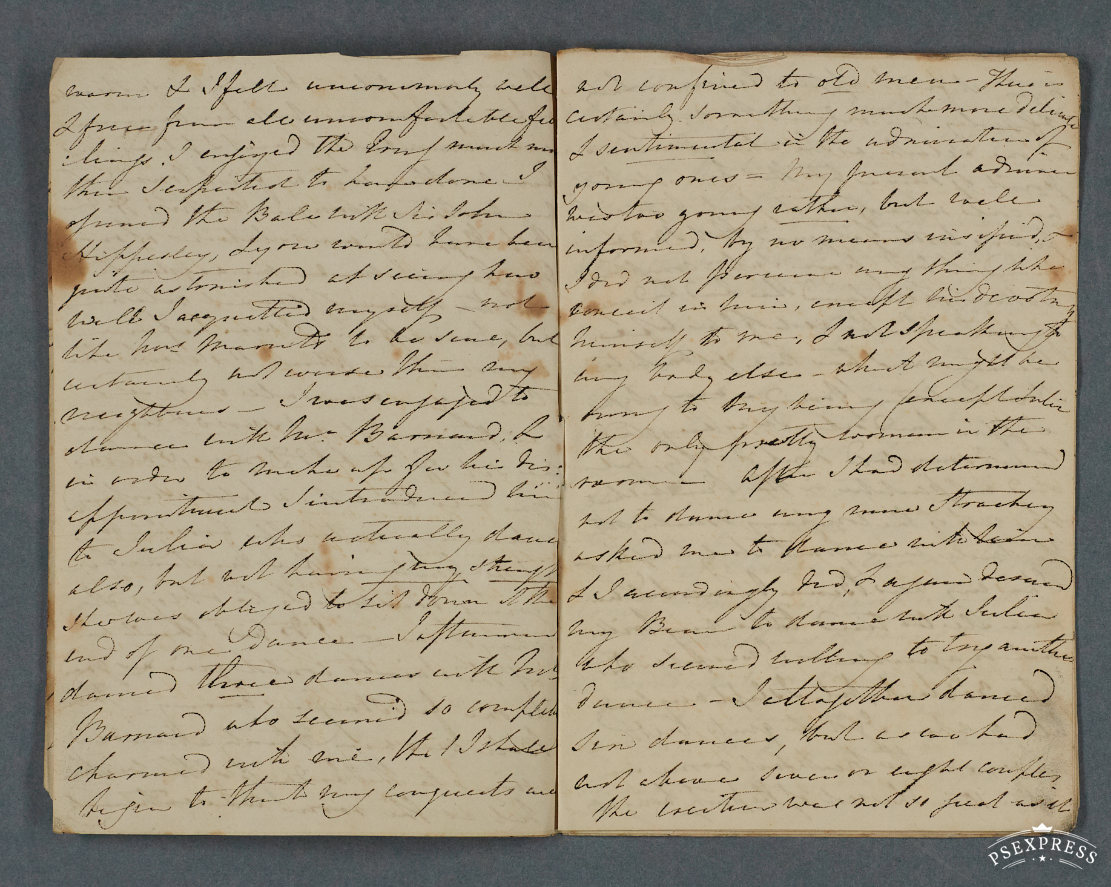
Although apparently a small ball ('only seven or eight couples'), the diarist has left a detailed description, naming and providing cameos of its attendees, of their appearance, of who danced with whom, of the food, surroundings, weather and travel arrangements. I can't do her account justice here so a few extracts, plus copies of relevant pages will have to suffice. This is a set-piece sketch for anyone who's researching the conventions of the time involving societal balls.
With evident pride Barbara declares that 'I opened the Ball with Sir John Hippisley, adding, 'you would have been quite astonished at seeing how well I acquitted myself'.

Page from Barbara Buller's account of the Ball (F2 -2)
Reproduced by kind permission of Devon Archives & Local Studies, DHC 5870M/F/1-5870M/F/2.
Not for the first time in her diary we find that Barbara enjoys boasting (teasing?) her husband with the success of her coquetry skills!
'I danced three dances with Mr Barnard who seemed so completely charmed with me that I shall begin to think my conquests are not confined to Old men'. There is certainly something much more delightful & sentimental in the admiration of young ones. My present admirer was too young rather, but well informed, by no means insipid. I did not perceive any thing ? conceit in him, except his devoting himself to me, & not speaking to anyone else,
'which' she adds, with sisterly rivalry and a degree of vanity, 'might be owing to my being (excepting Julia) the only pretty woman in the room'. Mr Barnard, she has already noted, is 'a 'very interesting young Clergyman, a gentleman of the Cloth & a nephew of the Bishop's - I suppose the Bishop of Bath.' (He may have been Revd. H W Barnard mentioned for the church of Easton, here) Incidentally, we find that Julia does not have sufficient stamina to dance much; she'd danced a little with Mr Barnard, the Austenian hero, but 'not having any strength she was obliged to sit down at the end of the dance'. We get a sense that the two sisters are opposites - though Barbara's words about her younger sister suggest her sororal care; Barbara's vivacity comes across in her diary, whilst according to Scott Lewis (see paper 'A Thousand Things to Say; Unpublished Letters of Thomas Carlyle to Julia Strachey'), Julia was 'impressionable and deeply spiritual'.
Julia is mentioned again in the closing pages of the journal as Barbara tells her husband, and us, two hundred years later, that as the ball ended 'Lady Hippisley had ordered the carriage at one oc'clock ... I felt so little fatigued that I did not mind it but poor Julia complained bitterly & declared she had had enough of Balls for the rest of her life'. 'Between one & two, we got back to Ston Easton, Barbara continues, '& found a very elegant supper had been laid out. I was very glad to eat some cold fowl & jelly, but did not partake in the Punch which the rest of the company drunk, although the smell was particularly tempting.' She is chuffed that 'my Beau' is still 'by me' though 'he was also tired', and concludes her story of the ball noting that 'I was not in bed till 3 o'clock but I slept very soundly till 9 when I got up quite brisk.'
We don't learn where the journalist actually is when she pens this final entry, but it finishes with fascinating descriptions of the interior of Ston Easton house ('a very handsome one') as the hostess Lady Hippesley, who is apparently something of a scientist), takes the party on a tour around the rooms. Just as during her visit to New Place back at King's Nympton, Barbara scrutinizes and is beguiled with everything she sees and is later impelled to share it all with her husband:
.. a comfortably fine drawing-room & dining room, then she took us into a Room containing a very fine collection of shells, curious ?, Corals, marine curiosities & in short something of every thing that is wonderful or rare in Natural History - These were all arranged by Lady H herself in a scientific ? & explained to us in a way equally so. (F2 - 3)
We afterwards went to see her collection of minerals which is considered the best private one in England after Mr Rashleighs - she has also a complete Laboratory, done(?) up with every thing requisite (?) for making all sorts of chemical experiments, which she is in the constant habit of doing herself - About 12 0'clock we left Ston Easton & at Clutter (?) I parted with the Stracheys & went on to Clifton to Sir Edward & Lady Buller, with whom I staid for a couple of days'.
Last page of Barbara Buller's Journal, (F2-4)
Reproduced by kind permission of Devon Archives & Local Studies, DHC 5870M/F/1-5870M/F/2.
That last entry is on the left side of the manuscript; the right side is blank. I'm assuming that Sir Edward and Lady Buller must be the same couple that Barbara talked to a couple of days before her account of the ball.
We may never know where the diarist went after she left her husband's kin in Clifton and from where she has penned this final entry, perhaps shortly before she began her long journey back to be with him, in India ...
Postscript
As I prepare to press return and publish this post, one or two tantalising snippets about Barbara Isabella Buller years after her Devon holiday are beginning to surface. One, from the 1840s, in which she is mentioned by Jane Carlyle, contains indispensible information. Thomas' wife mentions the Buller's youngest son Reginald, thus confirming the probably identity of 'Reggy' in her diaries; he is now a clergyman and his now reunited parents are 'rusticating' in Troston Suffolk. See Letters & Memorials.
There are other letters from the same series providing an even richer portrait of the couple and their sons during this period. Here is one passage:
Mr. and Mrs. Charles Buller, senior, who now led a somewhat nomadic life, in the manner of ex-Indians of distinction, were superior people both; persons of sound judgment, of considerable culture and experience, of thoroughly polite manners (Madam considerably in the Indian style, as ex-'queen of Calcutta,' which she was, with a great deal of sheet-lightning in her ways). Charles, senior, was considerably deaf, a real sorrow to one so fond of listening to people of sense; for the rest, like his wife, a person of perfect probity, politeness, truthfulness, and of a more solid type than she; he read (idly, when he must), rode for exercise, was, above all, fond of chess, in which game he rarely found his superior. Intrinsically these excellent people had from the first, and all along, been very good to me; never boggled at my rustic [Page 154] outside or melancholic dyspeptic ways, but took, with ardent welcome, whatever of best they could discern within - over-estimating all, not under-estimating - especially not 'the benefit,' &c. Charles, junior, was getting of me. Indeed, talent of all real kinds was dear to them (to the lady especially); and at bottom the measure of human worth to both. Nobody in London, accordingly, read sooner what my rural Jeannie intrinsically was; discerned better what graces and social resources might lie under that modest veiling; or took more eagerly to profiting by these capabilities whenever possible. Mrs. Buller was, by maiden name, Kirkpatrick, a scion of the Closeburn (Dumfriesshire) people, which, in its sort, formed another little tie. - T. C.
Then, fittingly, I came across more from The Life of John Sterling and again noticed references to 'Mrs Buller' from 1829, several years after she'd written the diary. It seems at that time she was spending time in Cornwall, near Looe, probably at Polvellan Manor, which was the Buller's Cornwall home. In one letter Sterling says of Barbara: 'her conversation is more pleasant and brilliant than any one I know; and at all events I am bound to admire her for the kindness with which she patronises me. I hope that one day or other, you may be acquainted with her.'
Having stumbled my way through the adventures recounted in her Devon diary - and even one night having dreamt about her - I feel we have indeed 'met'.
_________________________________________________________________________
I'd like to thank the staff at The Devon Heritage Centre - especially Scott Pettitt and James Ward - for their generous help with information about Barbara Buller's diaries and for giving me permission to publish images from the diary on this blog