Followers

On the Ways to the Old Literary Roads around Okehampton


Okehampton Castle
Photo Julie Sampson


Writing Women on the Devon Land
A-Z of Devon Women Writers & Places

On the Ways to the Old Literary Roads around Okehampton

        I could have chosen Offwell, Ogwell, Okeford, Otterton, or Ottery St Mary. But for this Alphabet of Devon Women Writers (up to about 1960), I settled on Okehampton. It's partly nostalgia, the town being a favourite place of my childhood, where I (albeit fairly briefly) and before me, both my parents attended school. I don't know of any individual woman author whose home was in the parish up to circa 1960 - but I do know several who included the place in their writings. Rosalind Northcote, Mary Ward and Sophie Dixon all set down in text their personal responses to the scenic, and/or historical characteristic of the Okehampton locality ...

     ... It is not just the romantic lines of Okehampton castle ruin that call, either when you spot Okehampton castle from the dual carriageway of the A30, or as you negotiate the upward swirls of the road curling up and away from the old town deep in the valley beneath, or through light reflected leaves on the left of the road. It is also the intricate lineage of the genealogical patterning of the past, which suggests that this near empty shell must once have harboured both men and women closely connected to the topmost ruling class, who were likely to be of the then literate fraternity. By the time you see the ruin you have entered the hallowed receptacle of the moor. Before you, are a multitude of enticements.

       For me, the northern doorway to Dartmoor's charm has always been the historical marker of this well-known Devon castle. Rosalind Northcote's travelogue/guide-book/historical survey, Devon; its Moorlands, Streams & Coasts (See on Project Gutenberg) outlined the ruin and its vicinity as it appeared in the rustic environment of the early C20.

   The castle of Okehampton stands about half a mile from the town and looks on one side over fertile hills and valleys, woods, and rich meadows, and the gleaming waters of the West Okement, on the other towards the bold, changeless outlines of the outer barriers of Dartmoor. The castle was once surrounded by its park ... The Okement rippling over a rocky bed – the name ‘uig maenic’ means the ‘stony water’ – hurries past the foot of a knoll on which the castle rises out of a cloud of green leaves that shelter and half hide the walls. Protected by the river and a steeply scarped bank on the south, a natural ravine on the north and a deep notch cut on the western side, the mass of slate rock that it stands on was a point of vantage.[i]
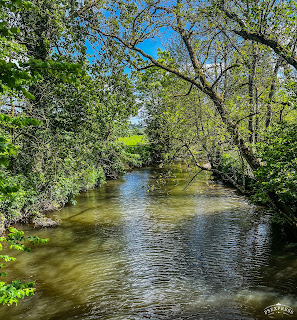
By West Okement, from where you can see glimpses
of ruins of Okehampton Castle glinting through the trees.


Old Town Park
Local Nature Reserve
Okehampton

          There are copies of Northcote's Devon book available from various sites, including Abe Books. I tend to agree with the fairly recent review of the book on the jsbookreader blogThe best feature of Devon; its Moorlands, Streams & Coasts is its inclusion of colour plates of Devon scenes, by acclaimed painter Frederick John Widgery. I feel rather mean saying this about this, but tend to agree with jsbookreader's assessment: Devon; its Moorlands, Streams &Coasts is 'largely built around scraps of learned but much-recycled material'.
Colour Plate of Okehampton Castle, painting by FJ Widgery.
taken from Devon: its Moorlands, Streams & Coasts.

         Devon; its Moorlands, Streams & Coasts is a book which anyone who likes to collect Devon history, or landscape books collectors, would love, and ought to have in their library. Of nostalgic value, the text is in the tradition of and influenced by such canonic male-authored Devon books as Crossing's Guide to Dartmoor; but once you get into the mind-set of the time in which it was written,
Devon; its Moorlands, Streams & Coasts does have a certain time-less appeal and Rosalind Northcote's passion for her home county is evident. There are individual touches which the author most likely obtained from personal visits to many of the places she describes. 
        Daughter of Walter Stafford Northcote, Second Earl of IddesleighLady Rosalind Northcote wasn't the only author in her family. I'm not sure whether she had any literary female relations, but both her father and her brother Stafford Harry Northcote, Viscount St Cyres  also wrote and published books, whilst her grandfather, Stafford Northcote First Earl of Iddesleigh, also had literary interests. For centuries, the Northcote family seat was at Pynes House near Exeter, which, though nowadays known as Devon's Downton Abbey and popular as a local wedding venue, is also known locally for its apparent close association with Jane Austin:
'The second Earl, Walter Stafford Northcote, was a huge admirer of the literary talent of Jane Austen and believed most fervently that his house was indeed the inspiration for Barton Park in Austen’s iconic work, Sense and Sensibility. This tale is still told in the local area and remains as popular as ever' (Pynes House Website) 
       
         I'm not saying the information isn't out there in the archives, but in the limited time I've been able to devote to researching Rosalind Northcote I've not found much about her life; maybe someone out there does know about her, or has come across documentation about her in a record office somewhere. The Pynes archives  at A2A certainly seems promising. There are a couple of tantalising snippets dotted round the web. One concerns Lady Rosalind's next youngest sister, Lady Elizabeth Northcote, who in 1914 married Sir Randolph Bruce in a celebrated wedding held at Pynes. According to one source, there had initially been plans for Bruce to marry author Rosalind, eldest daughter, but she was found 'prickly' and 'unapproachable' (see Lady Windemere) Elizabeth was 38 at the time of her marriage, quite old for her generation. There are various easily accessible online accounts about this couple;  a year after their marriage they travelled to Paris with Rosalind, which suggests the two sisters were probably close. The same description notes that unlike her sister (!) Elizabeth had a 'sweet disposition' and 'was very thoughtful of others' (Lady Windemere). Sadly, Elizabeth died within a year of her marriage, probably of appendicitis.

        Lady Rosalind survived her other siblings and died at Pynes in 1950. A visitor to Pynes during her last years is said to have commented: 'She was a law unto herself quite a formidable woman. She used to spend most of her day in a large sitting room with the windows open, chain smoking.' (Lady Windemere).

      The National Portrait Gallery has a portrait of Lady Rosalind here.www.columbiavalleypioneer.com/news/the-lady-of-lake-windermere/ ....


         But, at this point, though it is tempting to stray further I must not wander away too far from Okehampton, the subject of this blog piece. One hundred years before Northcote's Devon book another local Devon author wrote about Okehampton castle and its surroundings.  Sophie Dixon's C19 journals provide us with another detailed panning shot of the castle and its vicinity in an even more pastoral, pre-technologically dominated landscape than that about which Northcote wrote.


Pages from Sophie Dixon's Journal
which mention Okehampton,
1830
        I get the feeling that unlike Rosalind Northcote, Sophie Dixon had more first hand acquaintance with the places she wrote about. You'll find Dixon's name pops up readily in Google searches, especially linked to various descriptions and accounts of Dartmoor. For instance:

 For sometime Dartmoor was the home of Miss Sophie Dixon, the charming writer, and her acquaintance with it was extensive. She was in the habit of taking long rambles, setting forth at an early hour, and covering as much ground in a day as many would do in three. Sometimes when on a pedestrian tour she would rise at midnight, and start on her journey soon after, in order to avoid walking under a burning summer sun (Quoted in William Crossing's One Hundred Years on Dartmoor). 
          Contemporary writers often refer to Dixon, probably because her writing is striking in its detail and immediacy. In his Garden History of Devon Todd Gray notes that she was 'decisive in her writing'. Along, with Anna Eliza Bray and Rachel Evans, two other contemporary female author/travellers whose homes were in the vicinity of Tavistock, Dixon contributed to the C19 discourse of Dartmoor discovery.
     
      In her book Ten days excursion on the western and northern borders of Dartmoor, you can still sense the immediacy of the rapturous, pseudo-pioneering mode of discovery experienced and then voiced by Dixon after she crosses the C19 wild Dartmoor reaches, in 1830:

… we passed near the source of the Lyd, and then altering the direction of our steps the Sourton Tors rose before us, until again diverging to the right we came in view of the West Okement, winding amid a rocky channel, below a descent almost precipitous ... The valley inclining almost to a ravine, the river enters by a winding channel at the foot of Black Tor, which closes the view in a southerly direction. An extensive range of hill, dark with heath, occupies the opposite side of the valley, while a third mountain meets it below.’

     ... Following a trip to the locality of Fatherford I scribbled a short piece reflecting simultaneously on my own visit and what I re-imagined of Sophie Dixon's ...

         If you're lucky ... on moor's northen slopes, at the, just, still, tranquil site of Fatherford, just east of Okehampton and on the edgelands of the multiplying, mushrooming new housing estates, you can reflect and muse beside west Okement’s mirror river, where the wooden bridge crosses over into the glade the other side, where water’s lyrics, a ‘voice of waves’, will lull you to the beguiling wild haunts that writer Sophie Dixon intuited a hundred or so years ago ... Royal ferns flutter at our feet, taking us, slowly, surely, into their green and empty world, beyond glittering light.
        Sophie knew she felt, she heard, here, where road and river dissect, where dual worlds seem to briefly meet and part, here, where one looks (and moves us to loop unhurriedly, like snails snaking the undergrowth at our feet), back to the past and the other hurtles us onto the future, which can’t wait; this conveyor belt of concrete we cannot get escape.
      As you leave the glade,  spin around to catch a glimpse of your past, and hers, before a covey of orange monbretias in the hedge by the stream flare a signal, we are still here, still here, here, here, find us. Us ...

         Sophie Dixon also wrote poetry. Her Castalian Hours is made up of a sequence of poems; its title poem Stanzas Written on Dartmoor revels in the wildness and solitude of Longaford, and the surrounding moorland. It's with pseudo-Wordsworthian delight that she captures the scenic grandeur of moor's romantic enticements

And these are yours oh Mountains, these around
Your time-bleached summits, mingle in the air
A potent voice, a passion stirring sound ...
        William Crossing praised Dixon’s poems in his Dartmoor travelogue 'Amidst Devonia's Alps' but nowadays, like Rachel Evans and Anna Eliza Bray, although versions of her books are still obtainable, unlike that of their male equivalents, Crossing and Carrington, these women’s published writings are not generally recognised or acclaimed as being significant Dartmoor texts. This is a shame, for between them the trio of C19 Tavistock women fully documented a kaleidoscope of Dartmoor’s richly diverse data. There are, I believe, as yet unexplored interconnections between the three women, Bray, Dixon and Evans, linking both their lives and their texts. All three left a rich legacy of documents, which are testaments to the moor’s unique contribution to Devon’s landscape and heritage and are also encyclopedic in their value to the researcher. If a researcher wants to know something about someone or somewhere concerning Dartmoor’s history, then the likelihood is that they will eventually find the answer in one of the texts of Bray, Dixon or Evans ...

     ... I'm asking myself,  am I straying again from the ostensible main theme of this blog-piece? I hope not. I don't think so. Okehampton is very much enclosed within, or in the dip of the wrap-around protective landscape cloak, so the Dartmoor-linked comments about the women authors I've so far discussed are relevant ...

        ... Some fifty years or so before Dixon's journal was published, in 1807, in her collection Original Poems, a Devon poet called Mary Ward evoked the ruin in a poem titled 'Oakhampton Castle'. Albeit rather laboured in tone, Ward's poem's darkly laboured iambic lines project an appropriate mood of Gothic splendour:
stupendous pile whose mouldering towers/declare the wide uncultured day/when thou couldst boast terrific powers/that sought to make the world obey.      
         Ironically, the considerable historical significance of such an ancient skeletal and now ruined building as Okehampton Castle is emphasised because of the poet's use of overly ornate language. The style may be ornate, as well as foreign to contemporary ears, but the underlying message is authentic and eternal. Such an edifice, sunk into the foundations of solid earth within our land was – and is – forever replete with the stories of those who lived before. Nevertheless, Ward’s poem about the once striking and significant castle makes its own original contribution to the maintenance of the site’s importance in public memory. 'Oakhampton Castle's' flourish of romantic ornamentation can help to preserve reflecting fragments of history as they are wrapped within the sparse shell of a ruined building in the landscape. The poem aims to mirror the reality of what was.

       However, other than her poems in the collection Original Poems, little seems to be known about the poet herself. Mary Ward herself is elusive and attempts to discover anything substantial about her have proved well-nigh fruitless: she is said to have come from Brixham; she dedicated her book to the Countess of Loudon (who might be this Flora Campbell)she was an acquaintance of the owner of Raithby Hall, in Leicestershire, Robert Carr Brackbenbury, who rather intriguingly, was also known as a poet. Yet, that is all I have found... If there is anyone out there who knows anything about this elusive C19 poet, please get in touch, so I can add more information about her ...


          ... Before I leave the lanes and literary losts of Okehampton I'll just mention I've included a short fragment of fiction based on an imagined scenario at Okehampton castle in Part Two of the as yet unpublished Writing Women on the Devon Land. It's based on Hawisia ... a real noblewoman of the C12, whose ancestors from Okehampton were closely connected to the Norman/Plantaganet royal court. Following a lot of detailed and genealogical research, it occurred to me that this Hawisia may well have known the mysterious C12 poet Marie de France ... 'Someone, who in the mind's interior depths, heard a whisper from that long-ago past, telling me that yes indeed, she was Marie and not to leave her (and her circle of kin including Hawisia) out, from my own reinvented (or as I now see it, reinventing) story' ...

Here's a snippet from the opening of the fictional fragment:

Okehampton Castle’s ruins lie like an abandoned fairy-tale
 in a hollow on a spur of shale between two rivers flowing beneath Dartmoor. 

There’s a deep ditch between it and the country around. 

Outside the still quite massive wall of the castle,

above the curling west Okement river,
lie the immense lands of the Chase - 
the hunting-park of the medieval Courtenay family - 
which once sprawled its green-throw beneath the splatterings of C20/21 edifices. 
There’s the army camp, 
the relatively recently constructed A30, the golf-course, 
various other houses and paraphernalia ...


Ma(r)king the Way to Martinhoe


Old Schoolhouse Martinhoe


Writing Women on the Devon Land

A-Z of Devon Women Writers & Places

Marking the Way to Martinhoe

Old Schoolhouse Martinhoe

         The little parish of Martinhoe in north Devon has to represent the 'M' in this A-Z of Devon Women Writers & Places.
I began the journey toward writing a book about women many years ago, long before I researched then embarked on the written study of particular women writers. During the late eighties and early nineties, whilst researching and writing up my PhD, I ventured up to the remoter landscape north of the county to find where author/poet H.D.’s once stayed, in north Devon. She was there For several months in 196, during World War One she lived at Martinhoe then along the road at ParracombeJust as many other women writers associated with the South West, H.D. had significant connections with at least two of its counties, in her case it was with three (Devon, Cornwall and Dorset). 

      What fascinates me about writers whose lives and texts cross county boundaries is the way their experience feeds into a kind of communication with the land space on which they writers lived and wrote, the way it affected their individual and combined selves and the ways in which their textual, literary roots also branch out and extend far beyond the surface, creating and recreating an endless kaleidoscope of inter/intra personal intertextuality.

       Born in the U.S., H.D. (Hilda Doolittle), but much of her life and writing was influenced by our South Western shores and coasts. Without her presence I would not be here writing at all.  


Woodland Cottage Parracombe

I've already written about H.D.'s stay in Devon during 1916 in an earlier blog Scrapblog of the South-West and also in companion pieces on the same blog. and again here. There is also an essay I wrote about H.D. in Devon on the H.D. Web. I have no intention of repeating the same material in this piece. It is more of a marker, a page to mark H.D's importance in my whole project.

       However I will pop in some extracts from a chronology, which details some of the events of the writer's Devon stay. If you want to read more it is taken from Louis Silverstein's H.D. Chronology Part Two 1915-March 1919:
1916 February 22. HD. at The Schoolhouse, Martinhoe, Parracombe, North Devon

writes to Amy Lowell, her book [SEA GARDEN] has been accepted by Constable but will not come out in three months as she had hoped because of paper shortage; tells Lowell that she IS m Devon; discusses poems [Fnedman notes: not seen by LHS (H D. to Amy Lowell, [unpuL letter],

1916 February 24. HD. writes to George Plank; gives new address on envelope: "New address / c/o Mrs Dellbridge / Martinhoe / Parracombe / N. Devon"; says "some of us, no doubt all will turn up Isola Bella on Friday"; sets tune for 7:30; continues "we must be back early as we take mornmg tram' We are movmg our furniture to 44 Mecklenburg Square Fnday PM. Indicates that dinner will include herself, Aldington and John Cournos and perhaps F.S. Flint as they had asked 111m to dme With them that evenmg--they had planned a tea on Monday [for Plank and the wnutalls?] but it has all gone mentions confusion [LHS note: from this letter It seems as If the decrston to move to 44 Mecklenburg Square was a hurrted one]; mststs that dinner must be Dutch—says " we can't ask Flint otherwise & we can't impose on you forever and ever" (HD. to GP, [unpubl. letter]).
1916 March 6. HD. at Woodland Cottage. Martmhoe. Parracombe. North Devon writes to Harriet Monroe (Zllboorg notes).
1916 March 22 (?). HD. in Devonshire: writes to F.S. Flint: describes wanting actX1ttes and domestic life: says they are on their own trout stream (called the Heddon): the place is charming but there is only enough room for them and John Cournos (If he comes): speculates that Pound had expected to get Aldmgton's post on THE EGOIST had writtten a "charmmg Macheavelhan [SIC] note" to them which they had not answered: refers to widening gulf with Amy Lowell (HD. to F.S. Flmt.

1916 March 27. HD. at Woodland Cottage, Martinhoe. Parracombe. North Devon: Richard Aldmgton writes to F S. Flint and comments on her erotic attraction and his desire to sleep with her (Zilboorg introd. [draft)). Richard Aldington writes to Amy Lowell giving above address (Zilboorg notes: Houghton)

      And here is a few extracts taken from a piece written about the journey I took with a friend some years ago down to the far west of  Cornwall, on a follow-up quest to Martinhoe, to find the location of the poet's stay there, a couple of years after her trip to Devon ...

         
    .... This has to be near Lyonesse’, I remind myself, echoing H.D.’s own description some (clock-time) 70 years ago. Sun-slant time is low behind this haze of mist, which envelops us, just as it does twenty clock years later, up on the wild north Devon coast reaches, when I am try to locate H.D.’s temporary home, near Martinhoe. 

       Today we’ve been driving along the snake-like, zigzagging B3306, between Zennor and Cape Cornwall. My friend finds this place creepy and would, I suspect, be content to turn around and make tracks homewards. I decide not to tell her about Alistair Crowley, about witches and other slightly sinister past inhabitants and goings-on in the area. All she knows, after I told her during the journey down from Devon, is that for a while during, World War One, D.H Lawrence lived not far away from here, up at Zennor, and that in 1918, H.D., the poet, (who was a friend of Lawrence) also spent some time (clock) somewhere round here; that she came away from the war turbulence of London to ‘accompany’ the composer Cecil Gray at the house he had rented (with Lawrence’s guidance) near, or at Bosigran; that she first met her lifelong lover/companion Bryher here, when H.D. invited her for tea; that she became pregnant here; that the pregnancy had had a negative impact on her already threatened marriage to Richard Aldington; that whilst here she worked on several significant texts, including the roman-a-clef Bid Me To Live; A Madrigal.[1]

        My friend knows that, for both personal and academic reasons I wish to find the place where H.D. stayed. I want to feel the impact of this moor and sea-scape that forms the west Penwith peninsula, to let it inhabit me, as it had then possessed H.D. 

         I feel a stranger, an impostor. Traditionally, Cornwall, not Devon, is known as the Celtic land. And yet, the spiritual atmospherics of this part of Cornwall correspond with and complement that elemental landscape in north Devon, further east along the coast, which is also associated with writer H.D. For me, this landscape also resonates with that of  Devon’s central mid-Devon region set between the two moorland plateaux, with its subliminal sacred-roots. I can imagine how extended and underground labyrinthine root systems which some call ley-lines, might travel through and along the line of the counties, beneath the palimpsest layers of their mutual prehistory, under the ancient field systems, the archaeological strata, the high moorlands. I understand my home county as a distinct entity, but also view it as part of a more extensive tract of land, which is defined by its common geological, historical, anthropological and social histories.

        I shall absorb the mystic, mysterious aura of the peninsula's territory so as to bind me back into the atmosphere of her book, which, in turn will open perceptions toward re-membering the writer's time/thyme here, in 1918. For, it was H.D.’s affinity with this west Cornwall landscape that prompted my own preoccupation with landscape and text. After serendipitously coming across her writings one day, I began to understand the magical sacred appeal of my child-landscape with fresh eyes and to see why the location of my roots had such an emotional pull. In turn, that enabled me to explore the implications, both for self-identity and for my own writing. 

      That’s why I’m here; I want to breathe in this Penwith air, absorb the intoxicating essence blend of place and poem, the mix of panorama and prose; read the elaborate script set in the exquisite scene:


      ‘The jagged line of cliff, the minute indentations, the blue water that moved far below, soundless from the height, were part of her.[2}


       ....We stop in this car-space beside the old mine-shaft by the road, and after a sip of coffee begin to make our way along the tinners' tracks, which define this strip of coast land reaching out onto the cliffs. Walking along the edge of exhilarating South Western coasts, we should soon be able to see beyond these cliff-paths. But, though seemingly guided by unseen presences, we can not see far A fog-horn's booming in the seaward direction and disembodied voices whisper to us, stealthily as the mist. We do not know the language, yet can follow the trail of hieroglyphs seaward/sea/w/ree/a/ds.


Though mystified, we know which track-fork to take when it splits, as it seems to, every few yards. Hiss-hiss. Here-here. Hiss-hiss. Mist here must represent the spirit/s of the place, I think. And, we have been travelling along the snake-road, genius-loci of Cornwall’s most sacred space. I do not feel threatened by stories of this area as an oppressive ‘spiritual black country’. On the contrary, the mist wraps itself comfortably around us and as we saunter across the grassy sward tracks, begins to trail into ribbons and then to lift, to disperse, so that by the time we reach what is left of the fortifications of Bosigran Castle, the sun is hovering over the Atlantic spread below us. Other than the springy, tangy and lightly scrubby heath at our feet, which is stippled with tiny violets, we are cocooned in a blue shroud. A heaven of Cornish seas; the bliss of springtime South Western skies.

My friend, sun-worshipper, wants immediately to bathe in one of the ‘room’ enclosures that are formed between the castle’s esoteric relics. I wonder if H.D. had occasion to do the same, to remove her garments and lie out in the sun when she visited the ruins. But then, I also wonder if, when she was here, the stone walls of this place were, at least to some degree, still intact. A lot can change in clock-time over seventy years. In its hey-day Bosigran must have been a massive and magnificent castle; it ran across the neck of the headland and may have been a ceremonial site. I remind myself to look out my copy of Bid Me to Live when I get home, so that I can re-visit the place as though from H.D.’s eyes, follow the footsteps of the poet as she trailed around the paths of this coastline.

It is whilst we are doing a recce of the castle that we hear the knockings. They are loud and are echoing over from the next hill of this broken line of headlands that culminates at Cape Cornwall. Instantly, I remember that Cecil Gray – and possibly H.D. herself - spoke of experiencing these phenomena and that the knockings were rumoured to be the ghostly after-echoes of tin miners quarrying in the locality. My friend shrugs, grimaces. I do not know what to think. Although this region is known for its mystical goings-on, both historically, and now, I am not really a believer in ghosts; just interested in the enigmatic possibilities of mysterious cryptic occurrences, which could as easily be interpreted in psychological as in psychic terms. But those knockings are for real; we both hear them. I allow them to melt and merge as soundscape to accompany the inner map of H.D. in Cornwall beginning to form in my mind.

Next question is, where did she stay? Where was this large house that was called ‘Bosigran Castle’ or, in H.D.’s novel BidMe to Live, ‘Rosigran’? Was it purposely named after this ancient ruined castle?[3] We venture down other tracks looking to find the site where a once ‘sizeable’ cottage may have been, may still be. But there are no buildings here and no evidence of any. We realise that we may not be at the exact location, that the site may be a little to the north east and that the house's name may have confused us. Did H.D.'s then lover Cecil Gray and his companions want their friends to think they were living in the castle? It’s also possible that the house may have gone, some years ago.

Today we have no more time to explore. We will return. H.D’s words buzz  around my head:
            I suppose we will come back ... I will never see you again ... I will go on scribbling.’[4]
I shall return to H.D’s South Western sea lands; even if I have to cover, or cross, the same ground.
It seems as though yesterday, though in clock-time is a long time.
In clock-time it’s a long-time; it still seems as though yesterday
.[5]


There is also a sequence of my poems written in commemoration of H.D.'s time in Devon published in Shearsman Magazine 111/112: see a few extracts below.


Shearsman 111/112

Driftwood 
        Breathless, 
at last we are here, 
at the sea-shrine, 
though few seem to venture to this abandoned plot, 
where at the time of the latest tide 
             a twist of drift left 
behind figures 
           for us, 
the gravitational curve, 
a centenary   - the sea's-time.

 'you are useless, O grave, O beautiful' (H.D. 'The Shrine') 
........

At the Fort; The Beacon, Martinhoe
We arrive from the old Roman carriageway
high 
above the sea, next the sky, 

                                    way below 
in coastal chasms, white against white 
gannets and gulls 
              beating,
                   breaking surf -
        at home 
our multimedia screens still on 
flashing in-perpetuum into our comfort-zone rooms,
every opportunity, we whip out phones from pockets or bags, 
photos flash,
burst from our finger-tips - 
we remain alive with interactive possibility, 
yet find it impossible to conjure a picture from the swiftly lit 
spark of a stated fact. 

Here    only flashes, a series of dots and dashes 
cracking along faults of the rocky screes on this north Devon coast
from long-ago beacon fires
intended for those, rudderless, 
tossed in the turbulent sea, 
                            waiting, 
                    in the Channel, 
watching for life or death landings.

'I have stood on your portal/and I know-/you are further than this, still further on another cliff' 
(H.D. 'Cliff-Temple') 

1. In which the name of the heroine, Julia Ashton, an avatar of H.D. herself, always seemed to me to be a close sound-echo of my own name. H.D’s writing sound-effect, or phonotext, is always significant, so this closeness had hooked me into the book.
2. From H.D., Bid Me to Live; A Madrigal.
3. Returning from her solitary walk along the cliff tracks, H.D./Julia in Bid Me To Live, briefly describes the house as it ‘loomed suddenly like a greyship, rising from the sea’ and someone noted it was a ‘big lonely house on the edge on the wildest part of the coast ... with seven rooms and a great view out towards the Scilly Islands out the front’ and that it was ‘near Gurnard’s Head’ (Mark Kinkead-Weekes, D.H. Lawrence Triumph to Exile, vol. 2, 1912-22; The Cambridge Biography of D.H.Lawrence (Cambridge University Press, 2011). Interestingly, H.D. did not refer to the castle itself in her book, which seems strange, given its size and historical importance.
4. Bid Me to Live. I have been down to Penwith several times since, including once with participants of the ‘H.D reading party’, in the early 1990’s, when a group of us manoeuvred the lanes and byways from Trevone Bay toward Cape Cornwall. Again, not one of us could work out where the house in which H.D. lived for several months was sited. I remember some heated discussion; but eventually we gave up our search in return for the delights of a local Cornish cream tea.
5. H.D.

L ... Tracing Tracks towards Lapford ... and Other Literary Lanes, Away, and On the Way ... Newton St Cyres, Crediton ...


Women Writing on the Devon Land

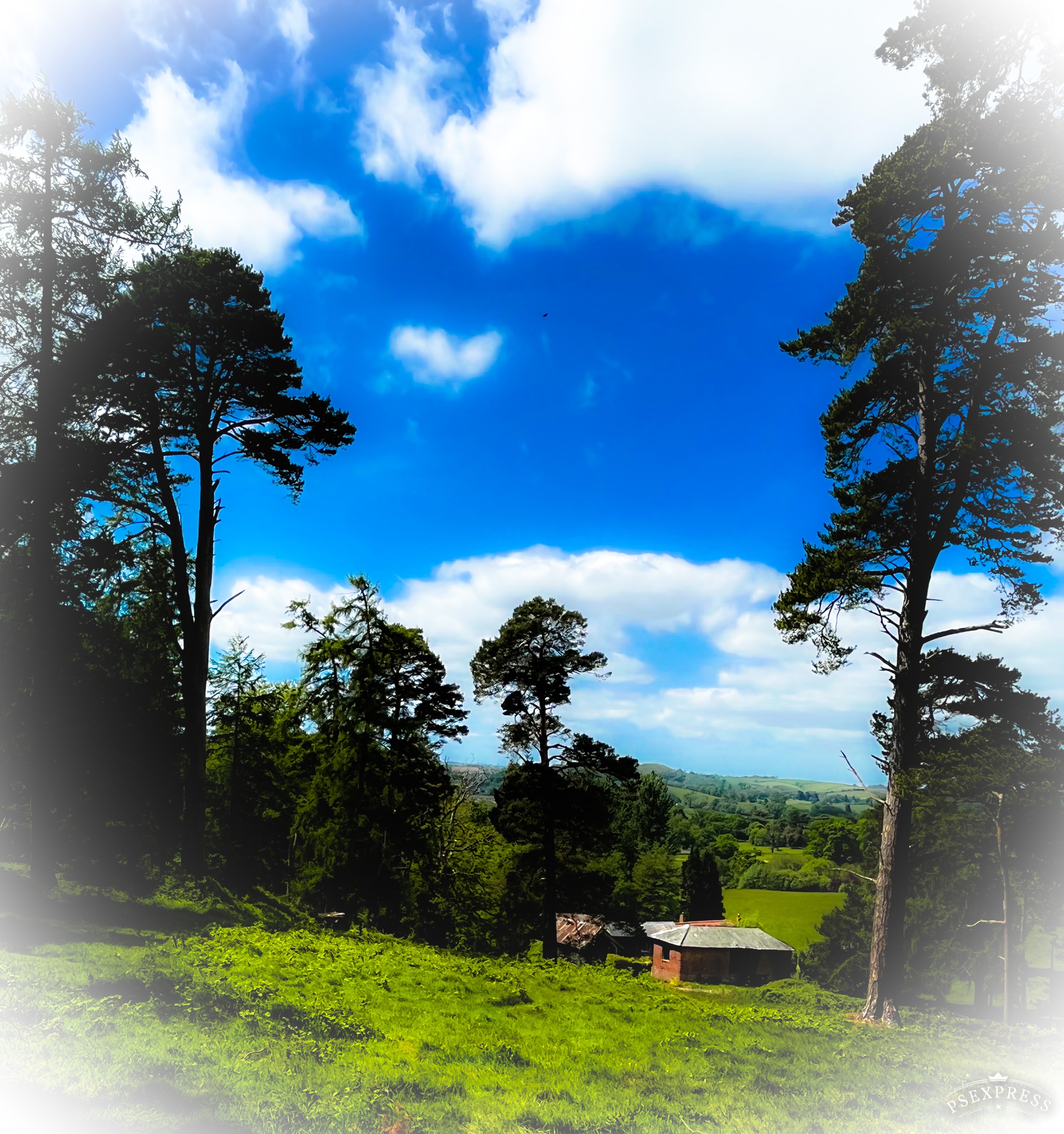
A-Z of Devon Women Writers & Places
Lapford


Around Lapford, possible places
of the site of Dowriche's home in the C16.
Lane and Vie of Parsonage Farm
& Court Barton across the road from the church.
Photo Julie Sampson

      It’s not easy to adjust your field of vision and cut out all the paraphernalia of modern life, even in a small village, or hamlet. The traffic and take-aways, the maze-like housing estates, all the accoutrements of contemporary rural life screen out what is inevitably there somewhere, just below and behind the surface. A wall; a ruin; a high hedge; an eave jutting out from a building; a mound in a field; an old house over there, with turrets.

      See there, the other side of the valley; there's a monument inside the village church (if, that is, you're lucky and the door is not locked). But here I am, late autumn, atop the village, walking up toward Lapford church; the village landmark. I am lucky. Unusually for nowadays, the door is not locked. I go inside, to look at the angels. Lapford is an ancient village set above the river Yeo and the interior of its C12 church has a flourish of ancient carved woodwork: bench-ends, roofs, and the icing on the cake, an especially fine vaulted rood-screen. Most of these were added to the church from the C15 to early C16.

       As I stare up to the nave-roof, the carved angels set in between the vine leaves look down. It’s a mutual gaze and I’m thinking that those six centuries ago Anne Dowriche, newly married wife of the local clergyman, may have similarly stared up at the angels, in reciprocal admiration...


Scenes around Lapford church
Photo Julie Sampson

       In the late 1960’s my journey to school at Crediton from the much smaller parish of Cheldon, a little to the north, following the road’s slope winding around and down past thatched houses and shops to the river Yeo, in the valley below, went through Lapford, passing the high church tower on the right, half-way down. Later, there were nights out at the Malt Scoop Inn. It took several more decades, a renewed interest in local history and Devon’s women writers to tempt me back to the village on the hill...

      I have already written about writer/poet Anne Dowriche, both in the manuscript of Women Writing on the Devon Land, whilst a couple of papers about her and her long epic poem, The French Histoire, have appeared in Transactions of the Devonshire Association, 2009 (see Abstracts). Anne Dowriche also appears several times in my other blog, Scrapblog a writer from the South-west, where, in Anne Dowriche/Edgcumbe's French Historie I noted: 

It had always seemed puzzling that an unknown wife of a clergyman (of Lapford and Honiton) and daughter of a prominent Elizabethan Devonian family should be the author of a 2,400 line poem, a long and inherently gory narrative epic about the long-winded French Wars of Religion during the C16. see Anne Dowriche's French Historie& its Westcounty Connections.

      My research on Anne Dowriche has been noticed and picked up by  Dr. DebapriyaBasu who has written about the C16 poet in her own research. See, for example, Writing History; Anne Dowriche

       This post's focus is to muse a little on this forgotten important C16 writer's links with the parish of Lapford, in the hope of unpacking some of the complex interweavings re the writer's family and social circles, so it is not the place to examine Dowriche's poem in detail; but it's important to stress the strangeness of this unusual text's connections with Devon and if nothing else I hope this blog-post may lead to a few more clues about the background of the whole text and its writer, which may be of use to future researchers and also of interest to more casual readers. If you're one of the latter and you're interested to read about the poem itself, wikipedia is a good place to start and the previous blog-posts, plus the papers in DA Transactions may also be useful. 

    Before it finishes this post may take you, at least in spirit, into the intrigue and mire of the C16. As I write this piece, BBC is broadcasting its series about Elizabeth's Secret Agents, which if you happen to watch it, will provide an excellent background to the Zeitgeist of the times of Anne Dowriche. 

      Every time I take a break from Ms Dowriche and her life and texts I breathe a sigh of relief. Each time I return to take another look, to consider the contextual background of the author's life and poem, I am quickly engulfed in its literary repercussions and am swept, yet again, into the complicated throes of Dowriche's milieus. So many of the people who surrounded the writer had their own fascinating lives, including tantalising links with others; each of them seems to provide yet another clue within the convoluted C16 jigsaw of this important woman writer's life; an endless labyrinth of mirrors within mirrors. All to soon though, exhausted with trying to make sense of them all I have to take-a-break and get away from her and those who surround her. 

       When I first chanced upon Anne Dowriche some years ago now (and I write about this first encounter in Writing Women on the Devon Landscape), it soon became clear that the known facts about the writer's life were apparently sparse. Yet, as I also soon discovered, more and more academics from both sides of the Atlantic were, and are, taking an interest in her life and poem. I kept asking myself the same question; there seemed no sense as to why an apparently unknown gentlewoman living in Honiton in the heart of Devon in the mid C16 would decide to write a macabre epic poem about the complex religious controversies of the period. And, given that it is such a long poem, why had I not heard of it before? Why was The French Histoire not on the agenda of the county’s literary canon and why is Anne Dowriche not included in the lists of its famous – or even infamous, writers?

        From the preliminary information I could find, Anne, one of the earliest of all the Devon women writers I’d ever traced, seemed to have been a decorous gentlewoman. Married in 1580, to a clergyman who during the mid to late C16 was responsible for two of Devonshire’s mid C16 parishes (at Lapford and Honiton), she was from the Edgcumbes, a large and extended family of important Devonian landed gentry; her father, Sir Richard Edgcumbe, from Cotehele in Cornwall, was builder of Mount Edgcumbe. But, superficial study suggested there was little else to find out about his daughter. That changed gradually as I explored various archives and sites that connected with her or others of her family. 

       I had to find out more. That's when I first set off, back along the tracks, here, to the mid Devon village, where the author must have actually spent live (quality) physical time. For, it was at Lapford, where, in or about 1567, Hugh Dowriche, was inducted as rector. Anne Edgcumbe's marriage to Hugh took place in 1580. In 1587, Dowriche became rector of Honiton, so presumably the family moved from Lapford to Honiton at about this time; it was from Honiton that Anne completed and sent her poem out into the world. She addresses her readers directly:


From the Preface of
The French Historie

      Several of  the Dowriche couple's children’s births were registered in Lapford, which suggests that before the move to Honiton the family home may have been in or near Lapford village, rather than the Dowriche family estate, at Dowrich/e manor, in the parish of Sandford (which is not many miles from Lapford). 


      According to other researchers the couple had  five, possibly six, children: William (?); Elizabeth (c 1583); Aleana (1585); Marie (30 Nov 1587); Anne (18 Jan 1589); and Walter. I have not been able to find documentation about all of them, but have located records that show  Marie's christening registered at Lapford in November 1587; and her sister Anne's, registered at Lapford, in January 1590.

     Interestingly, George, another Dowriche child, was registered at Lapford in 1613. His father was William, who may have been one of Anne and Hugh's children; perhaps he remained in the parish.
Records of  Dowriche children
registered at Lapford parish.

        It looks as if poor Walter, the youngest child died at an early age; there is a record of a Wa(l)ter Dowreshe's death in February 1591, which is two years after Anne's poem was published. The record of his death is at Honiton where I assume the family made their home following Hugh's take-up of the post there.


Record of Wa(l)ter Dowreshe's death
in Honiton


       But let's return to Lapford. Where, I kept asking myself, would the C16 clergyman and his family have made their home here in this little village? It is not easy to be certain, for the records, such as they are, suggest different places. I think we can narrow the possibilities down to two however. One of them is Court Barton, (see photo at top of this post) which, sited just across the road from the church, is still prominent in Lapford. One record which I had found suggested that Hugh Dowriche's predecessor as rector in the village,Rev Christopher Saunders had himself lived at Court Manor. I can't place the document at present, but must have located it via Discovery or local archives. This would suggest that the Dowriches took over Court Barton as their home.

        It is interesting to digress for a moment from the main thread at this point just to look in a little more detail at the dates of these clergy's residencies in the parish. I hope the following list of Lapford clergy is sufficiently clear to read; it shows the changeover from Rev. Saunders to Rev. Dowriche taking place in August 1567, a date which, given the assumed birth year of Hugh Dowriche, is itself intriguing. For, according to G.E. Trease, in an article in in Devon and Cornwall Notes and Queries, vol. 33, (1974-1977), Hugh Dowriche (sometimes spelt Hugh Dowrishe) matriculated at Hart Hall, Oxford, in 1572 at the age of 19. (See also The Clergy Database). If I'm correct with my calculations, that makes Hugh Dowriche's birth year about 1553, which fixes his age at the changeover at Lapford as only 14. Even for Elizabethan England, that seems remarkably young. I don't have enough expertise apropos the normal practises of clergy appointments in the C16 to be able to explain the apparent contradiction here but can only think that perhaps the initial appointment, by the owner of the advowson in those years (stated as Thomas Arundel), was in name only and that Hugh took up his official duties in the parish following his matriculation when he was almost 20. Alternatively, there are confusions re the facts of the dates (of birth/of matriculation). Hopefully someone else will be able to clarify this one day. 


       But, to return to the likely location of the Dowriches Lapford home, at least one document suggests that the family were connected not with Court Barton but, instead, with the rectory or parsonage, the site of which, I understand was where Parsonage farm is nowadays, which is a mile or so north east of the village. A path just up the road from the church leads directly to the site. (See the photos at the top of this post). Dowrich versus Kelland available at Discovery, tells us that there was a dispute in 1597 between Hugh Dowriche (of Honiton) and Richard Kelland of Lapford regarding bonds for goods apropos 'the rectory and parsonage of Lapford'. I have not as yet had a chance to study this document; but the more it seems to help us provide new clarity about the everyday life of the Dowriche family, the more it seems, as well, to hinder!     

        The Clergy Database has Hugh Dowriche's year of death as 1599, but my assumption has always been that the couple moved their family over the hills eastward to Honiton and therefore they would have not had any association with Lapford after 1587. This document suggests that the couple still had some links with Lapford parsonage. Could they have split their time between the two parishes, or was the connection with the Lapford rectory an unfinished legal matter from the past when the Dowriches did live in the village?  But beyond that, there are other possibilities. The Kelland Dowriche document may help to provide an answer about this, so when/if I'm able to find about it I'll return and hopefully update this post accordingly.


   ****
 Other Literary Lanes, Away, and On the Way ...

      Well, here I am yet again, having written about Anne and her family in Lapford, mesmerised by the C16 author, and her kin. I did not intend to take the narrative of this post beyond the boundaries of Lapford, the focus of this whole piece in the A-Z. of places. However, I'm going to take a diversion and stroll away from Lapford, along Dowriche family related metaphorical (literary) lanes, kicking up a bit of dust from these tracks. It's an opportunity to reflect a little more about how the geographical situation of this mid Devon village may have affected the important C16 author as she went about developing her long poem. Slotting together and mapping various genealogical charts which concentrated either on Anne, or/and on her and her husband's family, it occurred to me that, in the C16, Lapford's location, more or less in the centre of Devon, could have been an excellent site for the Dowriches as they went about their daily routine; the life of a busy rector would inevitably have included various and probably many social encounters with immediate family, as well as taking in more extensive kinship circles. They may not have had our ultra-sophisticated methods of technological communication, but during the C16 families, friends and neighbours amongst gentry classes who lived perhaps many miles apart apparently easily made up for their lack of physical geographical closeness: 

'The local gentry converse familiarly together, and often visit one another. A Gentleman and his wife will ride to make mery with his next neighbour; and after a day or twayne, these two couples goe to a third; in which progresse they increase like snowballs, till through their burdensome waight, they breake againe'. (quoted in 'Women Writers and Literary-Religious Circles in the Elizabethan West Country'Micheline White )


    For the Dowriches, living in or near Lapford within a 15-20 mile radius there were a number of parishes which included places owned and inhabited by individuals from the extended kin of the couple's (many being the Dowriche's) family; their social rounds could have begun with one or other of these families meeting up with another, then extending out to 'snowball' and add on other family members who lived at a greater distance (say as far as west Devon or perhaps eastern Cornwall).

    As I buzzed around various (mostly online) archives for this blog-post I concentrated on Hugh Dowriche's immediate kin (rather than Anne's father's Edgcumbe, or mother's Tregian family  - who I have already looked at and written about in my other blog, Anne Dowriche/Edgcumbe and The French Historie) and soon realised, something I'd ignored before - that the backgrounds and literary connections of the Dowriches were probably as significant as the author's own birth family of the Edgcumbes. Many of the C16 Dowriches married into other important gentry Devon families, whose manors or estates were frequently in parishes within travelling distance of Lapford. Every which way we look there's someone else from the Dowriche family who hooks up with another, and other families, all from the top rung of then prominent mid Devon families, including the Stuceleys of Affeton; the Northcotes of Hayne, at Newton St Cyres); the Pollards of Kingsnympton; and the Bodleys of Dunscombe, near Crediton.

    These families often included men who as well as filling 'local political offices and ... [being] responsible for defending the coast and maintaining social order' ('Women Writers and Literary-Religious Circles in the Elizabethan West Country'Micheline Whitewere known for their involvement in some kind of literary pursuit or, if not authorship, some kind of lived contact with another man who did write. Reading and researching in the spaces between the written and documentary information about these men can provide snippets of tantalising extra information pertaining to the women in their lives, many if not most of whom have left virtually nothing, at least on the surface level of archival data. A little tentative browsing on such web sources as A2A Discovery brings up a plethora of documents related to these prominent C16 Devon men, especially regarding their respective roles in maintaining the status quo and often related various disputes concerning land, disagreements about ownership etc. Most interestingly though, along with the legal and land-related material, it only take a few clicks and the avid researcher can link to a manuscript, a book, a text say or play, or poem, which thus hooks the individual into the wider C16 social/literary network of Devon.

       The implication of this for me, as researcher seeking information about Anne Dowriche (as well as looking for other forgotten C16 women who may have had significant literary interests during this period), is that somewhere, lurking in the spaces, on the margins, or round the edges, of the extant archival documentation, there may be as yet undiscovered new material which could provide new insights and informative documentation. And, as well, these documents might lead us to other sources, which could help in our understanding of the lost connections between the already identified cluster of literary C16 women from Devon/south-west England.

    In her brilliant paper 'Women Writers and Literary-Religious Circles in the Elizabethan West Country'Micheline White suggests that a research methodology that 'prioritises geographical locality kinship and religious affiliation provides valuable insight into connections between women and into the historical matrices in which they read, thought and wrote'. (See Women Writers) It is in the spirit of White's work that I'm jotting down some of the links and associations that pop up out of the virtual ether.  
 
      It's exciting to locate some of these individuals' once homes and search for their forgotten memorials. I won't pretend it is easy; it is most definitely not! The genealogical interweavings of Devon's C16 gentry and noble families are mind-mindbogglingly confusing and it doesn't always help that present day family history researchers contributing to the charts and facts about various families on a range of online sites don't always agree. Likewise, we will probably never know which of the many people on the extended family trees of the Dowriches/ Edgcumbes and their circuit of associated Devon families Anne Edgcumbe/Dowriche actually knew well, or was even acquainted with; but even if she did not meet or know a person personally, one can imagine her exchanging ideas with her husband and close kin about the lives, exploits and literary accomplishments of individuals in their dual genealogical trees.
     
     So, given the genealogical and historical complexities, where to start on this quest? Well, one of the simplest and (for any one with interest in local history) most pleasant steps on the trail is to start (via web searches) a tour of several of the many monuments or memorials located in Devon churches out and about in the mid county region, starting from here, in Lapford. Doing this, we can begin to follow the trail of a web of women related to prominent C16 men. (Incidentally and suggesting one potential physical obstacle in their otherwise freewheeling social get-togethers,  it may be useful to point out that in the C16 the Coach Road or Highway, the then 'main' road between Exeter and Barnstaple, went north of Crediton through to New Buildings and on to Morchard Bishop; so for local people travelling from Lapford to venture out to meet up with relatives in various outlying villages the journey probably meant  quite a difficult trek north of Lapford to Morchard, and so onwards. According to one source, the roads or tracks round the Sandford area - where Dowriche House is situated, were so 'foundrous and unsafe'  that the inhabitants were allowed to have their own chapel). (See A Parish Patchbook, Daphne Munday), 


View from road between Sandford and New Buildings
Photo Julie Sampson

      ... So for this Dowriche family 'trip', I'm going to begin with a 'sample', of individuals taken from Hugh Dowriche's siblings and their offspring. Each of the following can lead one away into a veritable tangle of intricate family networks, one or two with a literary connection; inevitably I could therefore direct each one along other equally fascinating avenues.

Elizabeth Dowriche and John Northcote; Dowriche - Northcote - Rous - Petre 

  One of Hugh's sisters, Elizabeth Dowriche married John Northcote
Track to Hayne Newton St Cyres
Track to Hayne Farm
cc-by-sa/2.0 - © David Smith - geograph.org.uk/p/2298900
, of Uton, Crediton Hamlets - which is less than ten miles south eastwards from Lapford. I
 understand that both John and Elizabeth's deaths were in 1587 (two years before publication of Dowriche's The French Historie). 

     It is likely that the Dowriche couple in Lapford would have maintained frequent social connections with their sister in law and her family, possibly involving a round of weddings, funerals, and baptisms at local churches such as Crediton and neighbouring Newton St Cyres, where, during the mid to late C16 the Northcote family also held the estate at HayneIn 1570 the Northcote's second son, (also John) was baptised at Crediton. This John married Elizabeth Rous daughter of Anthony Rous of Halton, in Cornwall; she was thus daughter-in-law of Hugh Dowriche's sister, and so niece-in-law of Hugh. 

     In Newton St Cyres church, just along the road between Crediton and Exeter, there is a splendid monument representing five generations of the Northcote family. 


    It stands beside the Lady Chapel altar. I believe it is Elizabeth Dowriche's son, also John Northcote, whose effigy is the focus of the memorial. On top of the monument, to the right,  I think is a medallion portrait of her husband John Northcote, who was a serge merchant of Crediton. (Anyone reading this who can confirm these identifications please do contact me). The inscription round it reads: Ecce Tibi Christi Crux Certa erit mihi lux. (I'm not sure if Elizabeth (née Dowriche), his wife, is also referenced on the memorial, but Elizabeth Rous, their son John Northcote's first wife - just as many others in his family circle - is definitely immortalised on the effigy. 

At Newton St Cyres Church
Photos Julie Sampson

     As far as I am aware (although certainly social or and religious links between the families are inferred) no one has noticed the actual kinship links between the Dowriches, the Northcotes of Newton St Cyres and Elizabeth Rous/Northcote's mother, also named Elizabeth - who was wife of Anthony Rous of Halton, in south-east Cornwall. It is this Elizabeth who White identifies as one of the network of probable 'learned' women who were actively engaged in literary activity during this period. White considers that the 'Halton household placed a premium on devotional reading and writing'; Elizabeth Rous Halton 'might have been the woman involved in a reprinting of Katherine Parr's Prayers or Meditations', in 1587 (White, in the paper women from south-west England and literary authorship). Or, is there a possibility that it was her yet unmarried daughter, Elizabeth Rous (Northcote) who was the instigator of this text? Probably not, as she's likely to have been a teenager in 1587, but given that the respective dates of her and her mother's births/marriages are uncertain, it is not impossible. With regard to Anne Dowriche and the probable local networks of literary-inclined women she may have been part of, it is exciting to posit an individual woman who was quite closely linked into Dowriche family circles and with whom she may have exchanged ideas and texts. 

    As I explore the Northcotes and the Rous families I find that the spider-web of connection spinning out from the Dowriche family soon absorb individuals from other locally based families with equally fascinating literary and social links, who also are strong candidates to be considered as possibly part of the wider intellectual circles around the Dowriches. I'll touch on one of them...

... Elizabeth Rous (Anthony of Halton's wife and mother of the Elizabeth who married Elizabeth Dowrich/Northcott's son) had Devon origins. She was daughter of Thomas Southcote, of Indio, in Bovey Tracey, MP for Tavistock and Sheriff of Devon. Thomas was married several times, and two of his daughters, Elizabeth's half-sisters Frances and Cecily, married men from another important local (one writer labels the family Exeter/Devon's C16 'Oligarchs') family - the Peters/Petres, who because of their connection with a poem that has sparked much controversy amongst recent academics, should be brought into the area of interest re Dowriche and her (possible) extended writerly contacts. Frances Southcote, half-sister of Elizabeth Southcote/Rous, married Otho Peter of Bowhay; that couple's memorial is in Exminster Church. One site notes that Cecily Southcote married William Peter of Torbryan (who was I believe a cousin of Otho;see Meet the Peters). Now, from what I can so far work out, the poem which has sparked off the discussions was written for a son of Frances and Otho, another William Peter. It's beyond the scope of this piece to write in detail about the poem and persons implicated, but I want to note that titled 'A Funeral Elegy for Master William Peter', although I'm not to date with most recent thought about the authorship, the general consensus seems to be that the poem was penned by Shakespeare. That fact has all kinds of implications, particularly in light of the networks of local literary associated people who lived and wrote during the time of Dowriche and her poem. Fair enough the elegy was not written until 1612, so it was another generation on from Dowriche's French Historie whose publication (in 1589) occurred between 1585 and 1592, a period that scholars refer to as Shakespeare's "lost years". But the two writers were not that far apart in age and his plays were in circulation before 1592. 

     Did Shakespeare know William Peter, the man whose murder the poem responds to? If so he may also have known people from the Southcote family and through them others who were linked to them socially. Various people have attempted to work out the links between the Peters/Petres and the famous dramatist; it's fascinating to read about and around the potential family and cultural associations that may have existed between them (see Meet the Peters)... 
 

    ...  Well now I'm going to backtrack to the Northcotes of Newton St Cyres and reflect a little more on the implications of other extended family links that pop up from the introduction of yet another family into the family webs. As noted above, John Northcote (son of Elizabeth Dowriche/Northcott), married Elizabeth Rous from Halton. The couple only had one son; Elizabeth evidently died young, perhaps in childbirth. That sad fact is embedded with her on her curt memorial medallion inscription in Newton St Cyres church:
 'My fruits were small, one sonne was all, that not at all'. Also, above the medallion is the inscription, 'See heer in Christ sleeps shee/From painful labours free/her works hence follow on/To resurrection' .


    I believe there is a further verse beneath the inscription 
Vous qui aymez amitie nuptiale/Vous qui prisez charitie coridale/Et que louez en un corps feminin/un cueur entier gracieux et benin/Arestez vous; c'est la demoiselle/que tout cela and mieux avoit en elle'

      Elizabeth Rous/Northcote's memorial  contrasts with the medallion on the other side of the memorial, which memorialises Northcote's second wife, who he married in 1596. She was Susanna Pollard daughter of Sir Hugh Pollard. of Kings Nympton. Anne Dowriche, poet/writer, was possibly still alive and may, as with previous family marriages, have attended her husband's nephew's second wedding, which may have been held at King's Nympton (the Pollard family's then main estate) - although by this year Anne and her family may have been living in Honiton, not Lapford; or of course, she could have died! 
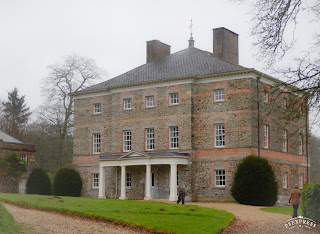
Present day King's Nympton Manor,
photo kindly provided by Michael Sampson

    One of Anne's Edgecumbe family descendants, the Fourth Earl of Edgecumbe considered it was possible that she was still alive in 1614 to compose an epitaph for her great nephew Thomas - which makes me reflect on the possibility that the poet could even have been the writer of the Newton St Cyres Rous/Pollard/Northcote inscriptions!
 
    Susanna Pollard Northcote's medallion and accompanying inscription in Newton St Cyres church is fascinating, but as I said the contrast between the inscriptions to Northcote's two wives stand as a sad reminder of the predominant role/duty of young women in these times (when literary or indeed other interests were low on the agenda), to bare many healthy children. Susanna's medallion, on the other side of her husband, on a black stone tablet is inscribed with a cryptic chronogram:

Susanna Pollard memoiral
on Newton St Cyres 
Memorial (public domain) 


My Jacob[9] had by mee
As many sonnes as hee,
Daughters twice three"

Above her head is a chronogram in verse:

"See heer In ChrIst sLeeps shee,
FroM paInefVLL Labors free,
Her VVorks henCe foLLoVV on,
To resVrreCtIon"

Wikipedia (John Northcote) notes that:

If the capital letters in red are added together as Roman numerals ("VV" being treated as V + V, and the first letters of each line excluded) the sum of 1634 results, Susanna's date of death.[10] The remaining unused letters are SFHT, the initial letters of each line, of uncertain cryptic meaning.

   I find both inscriptions (to the two wives) puzzling and intriguing. I can't help wondering who might have written the French lyric accompanying Elizabeth Rous and (especially) the cryptic verse accompanying Susanna Pollard Northcote. I don't have enough knowledge about memorials of this type and time, but do wonder if there may be more to be teased out from them, especially in light of the Elizabethan habit of favouring poetry and verse which deliberately employed riddle, emblem, puzzle, particular shape etc. The poems were intended to combine their emotional symbolic effect with a representation that could inspire religious meditation. See for example the book Elizabethan Silent Language which discusses the form and provides examples. (It's worth also noting with regard especially to the slight possibility that there was a connection with Anne Dowriche that she authored at least one acrostic poem, on the subject of her husband's name).

     Anyway, as far as I'm aware no one has delved more deeply into the inscriptions at Newton St Cyres; perhaps one day someone will.

    Before leaving the Northcotes I want to jot down a few interesting literary associated reflections which arise from more kinship connections of the late C16/early C17 Pollard family; for me all these might become background material that may eventually be of interest providing material for more discovery about Anne Dowriche and her female literary networks... Susanna Pollard/Northcote is the key person bringing together the various families in this as always complex C16 genealogical networkSusanna's eldest brother, Lewis Pollard, 1st Baronet married Margaret Berkeley, daughter of Sir Henry Berkeley and Margaret Lygon of Bruton, Somersetshire; Margaret Berkeley/Pollard was thus Susanna's sister-in-law. Margaret's mother had married Henry Berkeley after becoming a widow following her first marriage to Sir Thomas Russell of Strensham. (That couples' son, also Thomas Russell, was the Overseer of William Shakespeare's will. As far as I can work out this Thomas was thus half brother-in-law of Lewis Pollard, Susanna's brother. Does that mean that the Pollard family were acquainted with Shakespeare)? 

    Margaret Berkeley/Pollard and Lewis' son Hugh Pollard (2nd Baronet)  married, as his first wife, Bridget de Vere. and the couple had a daughter, who seems to have disappeared from records. Hugh's father Lewis 1st Baronet and his wife also had a daughter, called Elizabeth - who later married Sir John Chichester - (Susanna Northcote Pollard's niece?). Elizabeth's grandmother Margaret Lygon Berkeley Russell, left a will, in 1617, naming the granddaughter and her mother, both of them presumably still living at home in Kings Nympton. The will leaves us evocative first-hand access to the minutiae of a C17 female aristocrat's life; indeed such wills can kindle our imagination about the interior worlds of women living during the Tudor era. Here is the extract naming her daughter and granddaughter, both presumed to be living at their King's Nympton manor: 

I give and bequeath to my daughter, Margaret Pollard, wife of Lewis Pollard of Kings Nympton in the county of Devon, esquire, one hundred pounds’ worth of my plate; Also I give and bequeath to my said daughter Pollard my great gold chain and my great pearl, both which are in her keeping already; Also I give and bequeath to my said daughter Pollard my coach and my coach-horses, and my leading gelding, with all the furniture thereunto belonging, which she shall have presently after my decease, part of which plate before given is in my said daughter Pollard’s keeping. I give and bequeath to my grandchild, Elizabeth Pollard, daughter of the said Lewis and Margaret Pollard, the sum of two hundred pounds of current English money, which said sum of 2 hundred pounds is already in her father’s hands, and my will and intent is that the before-mentioned sum of two hundred pounds shall remain and be in the keeping of her said father for her and to her only use till such time as she shall be married or accomplish the age of one and 20 years, & in the meantime to give her yearly allowance of the use of the said money towards her maintenance; Item, I give and bequeath to my said grandchild, Elizabeth Pollard, presently after my decease my green mockado chest standing at the end of my cupboard in the drawing-chamber at Wells, with all such things as shall be in the said chest at the hour of my death unsight or unseen ...' (Will 1617 Margaret Lygon Berkeley Russell) 


Ann or Jane Dowriche; The Bodleys, Peryams - off to Crediton and its environs

Lower Dunscombe
near Crediton  
© Copyright Derek Harper and licensed for reuse under creativecommons.org/licenses/by-sa/2.0
 

   Another of Hugh Dowriche's sisters married into one of the most famous local families apropos Devon's C16 literary historiography - the Bodleys. Some sources say she was Jane Dowriche, others name Anne. (Some reference also a first marriage to William Weekes but I have not been able to confirm that yet). However, Ann or Jane Dowriche definitely married William Bodley, of Dunscombe, or Higher Dunscombe, once the Bodley family estate, which is I believe, on the A377,  just past Downes between Crediton and Newton St Cyres. As far as I can fathom from various genealogical charts William, son of George Bodley was first cousin once removed of his more famous Bodley contemporary, Thomas Bodley, Elizabethan Diplomat, Antiquarian and founder of The Bodleian Library. Following the extended trails and tracks of the Bodley family's marriages and children through the C16 takes us along yet another endless labyrinth of kinship relations. The Bodley - Dowriche family feedback loop circuits down through the generations and, as it does, hooking into yet another two of Devon's prominent families, draws in the next generation of Hugh Dowriche's siblings: Anne, or Jane Dowriche-Bodley's niece Elizabeth (daughter of Hugh's eldest brother Walter Dowriche and his wife Mary Carew), married George Trowbridge, who (I think - but may need verification again) was the son of William Bodley's aunt's husband. There are various, probably land deed documents held at A2A naming local Crediton Bodley men and Thomas Dowriche, father of Hugh and his siblings, so a close social interaction between the families is implied.
    
    Thomas Bodley's fame as founder of the famous Bodleian Library and his otherwise distinguished career as diplomat and scholar must have made him an exemplary individual for many intellectuals of his time. Others men from his extended family, who were known for their Protestant sympathies, also became renowned during their lives for one or other literary-linked achievement. One of Thomas' Brothers, Lawrence Bodley, a canon of Exeter before 1588, became rector at Shobrooke (near Crediton) and it is said that it was probably mainly through him that the dean and chapter of Exeter gave, in 1602, eighty-one early and valuable manuscripts from the library of their cathedral to the new [Bodleian] library at Oxford, including (amongst other gifts of Bishop Leofric, the founder of the church), the well-known ‘Leofric Missal.'

    The Bodleys are potentially very significant when it comes to considering The French Historie and its author's religious affinities and concerns. It's beyond the scope of this piece to go into the intricacies of the background turmoils of the time and this important text's take up of these, but certainly the Dowriche couple are noticed for their likely allegiance with the non-conformist networks which were springing up in local and national communities. Thomas Bodley's father and family were strongly associated with the Protestant Reformation; they had arrived back in England after being in exile in Geneva for two years and were in contact there with John Knox.

    As I continue to explore and read around more the lives, careers and connections which soon, because of their kinship links with the Dowriche family, show up in connection with the Bodleys, it quickly becomes evident that there are others, also locally based and often close kin of the family, who possibly interacted socially or intellectually with the poet and who should therefore be kept in mind in any more exploration of Dowriche and her local cultural networks.

    I can not write in detail about them all here, but I must mention the Peryam family, whose wonderful memorial is in Crediton church. Sir William Peryam, (first cousin of Thomas Bodley through his mother's family, the Hones, of Ottery St Mary), a known puritan and one of the judges who tried Mary Queen of Scots, was Chief Baron of the Exchequer. Peryam's main manor home during the 1580's was Little Fulford (renamed Shobrooke Park in the early 1800s) which he bought at that time. 


Northern old gateway to Little Fulford, now Shobrooke Park

Little Fulford/Shobroke is easily accessible from nearby Lapford so one can surmise there may well have been regular contact between Dowriches and Peryams. Significantly also, in 1566, Peryam became trustee of the Dowriche estate, Anne's husband's family home.

    As far as Anne and her potential female networks were concerned the women in Peryam's life may be just as, if not more important, to consider: his four daughters and three wives are all marked within the Crediton memorial:

 He left no male progeny and his estates were inherited by his four daughters and co-heiresses. Little Fulford was the share of his second daughter Elizabeth Peryam (1571-1635), the wife of Sir Robert Basset (1574–1641), MP, of Umberleigh and Heanton Punchardon, Devon.


     The most prominent wife - though possibly by the time she married Peryam as his third spouse, the Dowriches were living in Honiton, or even, conceivably, Anne may have died - was Elizabeth Bacon, daughter of Sir Nicholas Bacon, Queen Elizabeth's Lord Keeper of the Great Seal, who married Peryam in about 1595. Apparently not much is known about Elizabeth's life except that, 'she is presumed to have been the Lady Neville of My Ladye Nevells Booke, an important manuscript of keyboard music by William Byrd, which was compiled in 1591' (Wikipedia)  and that, like her third husband, she had also married twice before. Her marriage to Peryam was short lasting as he died in about 1604, and she is said to have left Devon quite soon after; but according to various sources the couple had known one another for many years, so Elizabeth may well have been part of his social circle prior to her marriage to him. I read somewhere also that Elizabeth was known for her short religious principles and a strong belief in the value of education; she sounds a strong candidate for having some kind of acquaintance with Anne Dowriche!  In fact, the Bacon family's close personal and political associations with the Elizabethan Court make them extremely interesting as 'local neighbours' of the Dowriches. Something for future research perhaps!


    Walter Dowriche and Mary Carew - Sandford and Upton Hellions

    If you're keen on the Devon church monument trail, there's another to find out there in Sandford church,  just north of Crediton, and not far from Dowriche House. Hugh's elder brother Walter Dowriche's wife (the main subject of Sandford memorial), was Mary Carew, daughter of George Carew, of Mohun's Ottery, Dean of Exeter and his wife (whose father was Sir Nicholas Harvey) and sister of George Carew, Earl of Totnes, who served under Elizabeth 1st.


Mary Carew Memorial Brass
Sandford Church
Photo Julie Sampson

        I've already written a little about Mary Carew Dowriche in Anne Edgcumbe Dowriche and Westcountry connections, but - even amongst the other kinship groups already mentioned in this piece- the familial repercussions of the Carew family as they intersect with other families in the network of Devon's C16 social and literary connection are so prolific that I must mention Mary Carew here in connection with the Dowriche siblings of Hugh, Anne's husband. Mary Carew Dowriche died on September 10, 1604, by which time her sister in law may already have passed away (though I note one publication has marked her death in 1616, but no sources are provided). Mary was probably a little older than her sister in law.

    Divided into three arches, the brass' central shows Mary Carew Dowriche; whilst the other sides display kneeling effigies of her three daughters and son. Here are extracts from the inscription:

Here lyeth ye body of Mary Dowrich wife & widdowe of Walter Dowrich of Dowrich Esqr onely sister to George Lord Carew, Earle of Totnes. Shee had issue one so(n)ne & three daughters viz: Thomas who married Katherine daughter to John Stukely of Afton, Esqr; Dorothy married to Thomas Peyton of Islam in Camb. Esqr; Elizabeth married to George Trobrydge of Trobridge Esqr and Mary married to William Limsey of Colbye in Norff. Esq.r She departed this life in the true fayth of Jesus Christ the tenth of September An. DNI 1604. On the right of Mary Carew are shown her two younger daughters, both kneeling, with above each an impaled escutcheon, representing the marriage of each, as follows: closest to Mary Carew is shown her 3rd daughter Elizabeth Dowrich (d.post 1631), wife of George Trobridge (1564-1631) of Trobridge ... kneeling behind Elizabeth is Margaret Dowrich, 4th daughter, the wife of William Linesey of Ifield in Kent, later of Calby in Norfolk,(Vivian, p.290) with an escutcheon above showing An eagle 
displayed(Linesey(?)) impaling Dowrich.
Upton Hellions Barton
cc-by-sa/2.0 - © Derek Harper - geograph.org.uk/p/2140894

      Other than the inscriptions on this memorial, there is apparently little known about Mary - except what can be deduced from the facts of her children's births and marriages, together with those about her siblings and cousins - but the fact that she and her children are in Sandford church suggest she was a woman who held much influence on those about her. Perhaps, given the richly educated background of her father's and brother's influence, like her sister in law Anne Dowriche Mary Carew Dowriche may have had literary interests. It must be likely that her author sister in law travelled the lanes eastwards from Lapford to visit her at Dowriche manor. And her brother George held (probably built the manor, circa 1566), at nearby Upton Hellions, now the Barton; some sources note that the house was built by his and Mary's father and passed on to his sons; a theory which seems likely given the birth dates of Mary's brother). 
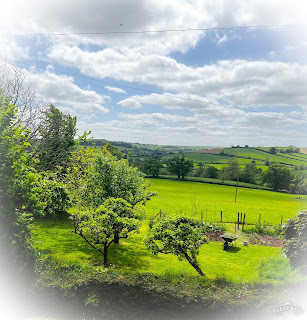

View toward Upton Hellion Barton from the church


River Creedy near Upton Hellions


    Perhaps it is ironic that Anne Dowriche, who was apparently recognised by those about her as esteemed Devon writer/poet, has seemingly left no memorial, (and neither are there any apparent monuments to her children) whereas her sister in law is for ever immortalised in one of the county's best parish churches, one of whose features are the array of wonderful C16 bench ends (see Genuki) - which incidentally, must have been set in the church during the period of the Dowriche and their extended family's presence in the locality. One wonders if some of the individuals on the C16 bench ends may be representations of people in their respective families.  

    There is no doubt that the Dowriches must have had regular contact with their Carew family kinsmen and neighbours. Through their sister-in-law's close relatives for instance (as I wrote in the previous piece) there would have been all kinds of possibilities:

Mary was a niece of Sir Gawen Carew; he had married a sister of Charles Brandon, second husband of the Duchess of Suffolk, who had become Mary Queen of France, after her first marriage to Louis XII, King of France. The Carews were known as a family of ‘zealous Protestants’ and Mary could have provided yet another link between poet Anne Dowriche and individuals who were, or had been, involved with events at the English and French courts. Her cousin Sir George Carew, Vice Admiral of the English Fleet, whose main estate in Devon was at Polsloe Priory, had distanced himself from his Catholic upbringing and openly supported Protestant groups. His wife, Mary Norris or Norrys, was maid of Honour to Anne Boleyn as well as probably to Jane Seymour, Anne of Cleves and Catherine Howard; she became lady in waiting to both Mary and Elizabeth and in 1545, after her husband’s death during the sinking of the Mary Rose, remarried Sir Arthur Champernowne. (See Scrapblog)

    (Mary's uncle Gawain Carew,'s memorial is  enshrined in Exeter Cathedral, with one of his wives and the couple's nephew Peter Carew. The Carew monument was placed in 1589, the same year as Anne Dowriche's long poem about the french wars was published).

     George Carew, President of Munster and 1st Earl of Totnes, (1555-1629) Mary's other brother, whose Devon home was at Upton Hellions, was prominent in the courts of Elizabeth I James I and Charles I, friend of Sir Walter Raleigh, and known for his distinguished military career, was also a renowned antiquarian, historian, genealogist and author, whose literary works included forty-two volumes concerning Irish affairs. See, for example The Carew Papers and The Carew Manuscripts.
And, similarly to other individuals I've remarked on already here, George Carew leads us to a link with Shakespeare, meaning that through her sister-in-law Anne Dowriche may have had some association with him. Here's an account about George Carew and his Shakespeare links via his proximity to Stratford on Avon. Perhaps it is not too far fetched to suggest that given their common literary passions, the unusual literary work of George Carew's sister's sister-in-law, the woman poet back down in his homeland territory in Devon might have popped up amongst the topics of their social conversations.

    A google search will bring up a variety of Carew-Shakespeare 'literary conspiracies', all intriguing and worth a glance with regard to the re-visioning of our uniquely special C16 Devon woman poet. 
George Carew and Thomas Bodley (cousin of William Hugh's sister's husband) are the leading male figures in a circle of learned and literary Devon men within reach of Anne Dowriche's close and extended family. The two men were said to be close friends, which is not surprising given their similar Devon roots and that they were (albeit distantly) related.
    
Stucleys and Affeton

     Before leaving the Dowriche tribe and Anne Edgcumbe Dowriche for the time being, I must mention the family link with the Stucleys, from Affeton near West Worlington, a parish less than five miles northwards from Lapford. The Stucleys weave their way down the C16/17 generations, as individuals from the family interlock with the Dowriche web. Hugh Dowriche, Anne's husband's maternal grandmother was Margery Stucley (died 1533), whose brother Hugh Stucley (died 1559) was Sheriff of Devon. The name Hugh is one of the names passed down the lineage of Stucley men, so perhaps Hugh Dowriche was named after his great uncle. Given the close family relationship, it is likely that he took his wife to visit kin at Affeton. 

Looking toward Affeton today 


    Now, if we jump up a few generations, we find that Hugh Stucley's great granddaughter Katherine Stucley became wife of Thomas Dowriche (Hugh Dowriche's nephew), eldest son of Walter and Mary (neé Carew) and heir to the Dowriche estate. Katherine was eldest daughter of John Stukely (1551–1611), lord of the manor of Affeton, Devon, by his first wife Frances St Leger (she was daughter of Sir John St Leger, of Annery in Monkleigh). Unfortunately (but typically given that she was a woman) as far as I know, there is not much information to tell us any more about Katherine Stucley Dowriche. Presumably she must have been of a similar age to her husband, who was born in 1568. However, the apparently turbulent events of the couple's marriage suggest that Katherine Dowriche may not have been involved in (or had time or energy for) literary pursuits. The story is that in 1609 Thomas gambled away the whole Dowriche estate over a game of piquet at nearby Kennerleigh) (see also Devon Notes And Queries).

    Katherine Stucley Dowriche may have been a fiery individual with a temperament matching that of her husband or/and uncle, Thomas Stucley, - the 'notorious English courtier, pirate, adventurer and soldier, [who] died at the Battle of Alcazar in Morocco in 1578, while serving in the army of King Sebastian of Portugal'. Stucley's infamous life inspired several writers, including one of the poets/dramatists of the period, to write about his life. For instance, George Peele's The Stukeley plays and The Battle of Alcazar by George Peele ; The famous history of the life and death of Captain Thomas Stukeley which was probably written in the early 1590's. Anne Dowriche the poet must have known of this work and of other works also inspired by her husband's ill-famed not-that-distant kinsman.

****

       Well .... as you'll be aware if you've taken the trouble to wade all through this post so far, the more I try to find about Anne Dowriche's association with Lapford during the mid to late C16 the more I slowly get out of my depths as I come up against brick walls and enter even more convoluted genealogical labyrinths! It may be that instead of unpacking the journeys of her life-story, I have confused the maze even more. But I hope that anyone out there who has read this and is, as I am,  fascinated by this still unknown Devon writer may take an interest in the poet and explore more about her extended family and possible local literary circles... 

     The day I last visited, before I left Lapford church, hoping for a soupçon of insight and clarity, I took time to try to picture the then young women, young mother and budding poet sitting on one of the pews set within the intricately designed seat-ends; she'd probably have taken pride in the webbed spans of the screen. Anne may well have been working on the manuscript of her epic poem whilst living in the village, before the family's apparent next move to her husband's next incumbency, at Honiton, circa 1587. In the preface to The French Historie Anne told her brother Piers Edgcumbe that ‘This hath beene my ordinarie exercise for recreation at times of leasure for a long space togeather’, which suggests a long period of gestation.
C15 Bench Ends at Lapford
which must have been put in the church
not too many years before the Dowriche's time there.
Photos Julie Sampson

      As I look round the church interior, I’m mulling over the complexities of Dowriche’s puzzling poem. Surely, I'm thinking, the text's focus on the complexities of religious wars in a foreign country is a far cry from the environment of Lapford, either now in the high-speed C21 world, or even five centuries ago, when life was conducted at a more leisurely pace. At that time, surrounded by equally peaceful rural landscapes, this village would have been quiet and tranquil. 

       And yet, I realise, when you stop and take time to consider what it might have been like to live in mid Devon during the Elizabethan era, especially in light of the decades of religious turmoil that had preceded the period, there may be more in common than first may be apparent between the everyday life of someone living there and the brutal society described in the poem. After all, no one in that tumultuous culture could be sure when their death would come, or by what means. As a result of the dictates of the governmental allegiance of the day not only disease, but the vagaries of fate and chance apropos a person’s religious affinity could strike at any time. During the long years of Tudor rule many harrowing persecutions took place in the Westcountry. It's not a time of peace and stability, to make a bee-line to in the idylls of one's dreams.


                                                                     ****

       But, before taking our own leave of Lapford in this Devon A-Z, we must take a big leap up from the mid C16 and briefly peep into the early C20, a time when Lapford and indeed its church and rectory, once again held close, rather strange links with a renowned woman poet of the time.  The Parson, the Poet and a Broadway Play tells the story behind Elizabeth Barrett Browning's connections with Lapford; the poet's letters written to her sister Henrietta languished for years in the village rectory. Anne Edgcumbe Dowriche may have been the first, but was not the last female poet whose life-journey left its vanished imprint - its eidolon - within the boundaries of this mid Devon parish. 
     
      As I leave Lapford's church through its lych gate and retreat to our car to travel home, I'm still musing over the literary treasures and labyrinthine secrets once held within the walls of several old buildings in this Devon parish, which if we could unravel them and see into the darkness of the past could reveal so much about the mystery of the remarkable C16 poet, who, during the years of later Elizabethan times probably regularly sat at worship on a bench in the nave of the beautiful church and returned home to the rectory to work diligently at developing the lines of her harrowing poem ... If only (Lapford) walls could talk so that we could peer into the past with new eyes.

Incidentally, throughout this piece, I have used Dowriche as spelling for the author's married name. You will find various spellings of the name, Dowrich, Dowreshe, Dowrick, Dowrish, etc

Featured post

  Finding a Forgotten Devon Author's Grandmother; Who was Edith Dart’s Granny Jane Sampson? Lanes, distant moor and ‘Lydcott’, a farm (o...