Followers

Showing posts sorted by date for query Woodland. Sort by relevance Show all posts

Centennials, Bicentennials and Other Celebratory years - Devon Texts and Dates 2022


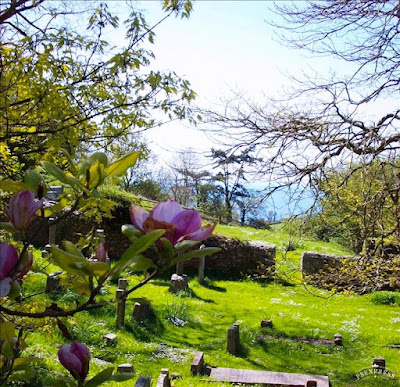
Churchyard at Salcombe Regis Church 

    Ten years ago I posted a piece A Handful of 2012 Anniversaries: Devon Women Writers; Names and Texts in commemoration of the anniversary dates of several women writers whose births or deaths or written texts were occurring that year. Then I posted a follow-up Devon Celebration 2016. So what follows here is another celebratory catch-up piece featuring a handful of writers with special events coming up during 2022. 
****
'Believe me, nothing except a battle lost can be half so melancholy as a battle won'.

Cover of Lady de Lancey at Waterloo

   I'll begin  200 years ago in 1822, when Madeleine De Lancey died, on 22nd July. 

            There's a post about Madeleine de Lancey on my earlier blog, Woman at Waterloo; Lady de Lancey; a Quiet Grave at Salcombe Regis. As I noted in that post Madeleine did not spend her life in Devon; in fact she was only briefly in Devon.


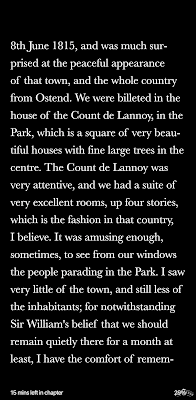
Photo of first page of A Week in Waterloo
The first page of Madeleine de Lancey's
A Week at Waterloo
     Lady de Lancey’s visit to Devon was short-lived as she'd been taken to the village to convalesce, after giving birth to a third child after her second marriage, but had sadly and poignantly died, on 12th July 1822, at the age of 28. The burial entry in Salcombe Regis registers states that Magdalene was 'Wife of Captain Harvey - formerly the widow of St William Howe de Lancey Quarter Master General of the Army under the Duke of Wellington'. As yet I've not been able to locate her grave in the churchyard at Salcombe Regis, although in principle I have had information which should help to find it (See the previous Lancey post). But the church and village is still an idyllic place to have an excuse to visit, so perhaps others out there will follow the quest to Madeleine De Lancey's Salcombe Regis grave.

     It is important to commemorate Madeleine's connection with Devon because of the one text that she wrote seven years before, A Week in Waterloo in 1815 , a personal diary/account of her own experience nursing her first husband following the Battle of Waterloo. The text can be read at The Project Gutenberg. The opening of the narrative can be seen in the photo next to this.

    Since I last researched Madeleine's life I've found that she was the sister of the writer Basil Hall a noted author on the subject of early American travel and that it was through him that she met her first husband. William Howe de LanceyA Week at Waterloo was also apparently written at Hall's request and the introductory material to the narrative tells us that Sir Walter Scott and Charles Dickens were both impressed by it. Did De Lancey's account influence Scott's own poem of the same name? That's a question I can't answer but it seems that Madelaine herself must have impressed him as she was said to be a model for a character in in novel The Bride of Lammermoor. There's an interesting comment on the diary and the fate of the de Lancey couple and the response of these other writers on  this All Saints' Church Belgium website:

In 1816, “Lady DeLancey’s Narrative,” an edited version of her diary, was published and stayed in print until 1906. The tragic tale of the beautiful, doomed newlyweds, set amidst the carnage of Waterloo, became one of the 19th century’s most compelling and iconic love stories. Charles Dickens sobbed when he read Magdalen’s story 5 , and Sir Walter Scott wrote not only an epic poem, “The Field of Waterloo,” but is believed to have Lady Magdalen as his inspiration for the character, “Lucy Ashton” in his 1819 novel, The Bride of Lammermoor.

 The same piece also provides a poignant postscript about Madeleine and her journal.

Crocuses in graveyard at Salcombe Regis Church photo JES
'In 1999, in a corner of an attic, Lady Magdalene’s great, great, great grandson made a startling discovery. Inside a dust-covered trunk, he found the widowed bride’s original diary, two portraits of young Magdalen and forty hand-signed letters.'
 Evidently there is more to be discovered about Madeleine, both concerning her brief stay in Devon in the context of her second marriage and with respect to her literary links and its wider inter-textualities. Something to muse on for later research, for me, or perhaps someone else out there ...


**** 
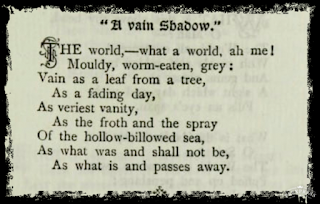


'A Vain Shadow' Christina Rossetti

135 years ago, during the winter of 1887, poet Christina Rossetti left London in search of the sun in Devon's Torbay.  As I begin to write this piece shortly after the Christmas celebrations, with carols still ringing at the back of my mind, I can't put aside Rossetti's most famous - and now iconic - lyric In the Bleak Mid-Winter (which she wrote and published before this period). Our present day worries about how to heat our winter/wintry homes with increasing fuel bills is probably nothing when compared to the problems that people in her time must have had to endure. I wonder how much of that poem came directly from the poet's response to the cold living conditions of her time.

    I wrote about Rossetti's stay in Devon in the context of the poet's life in the Scrapblog post Poets in Winter so won't repeat that here. Unfortunately for Rossetti Torbay that winter turned out to be cold and chilly and to top this inclement weather an earthquake shook the Riviera where her brother was staying whilst she was in Devon, which may have increased her anxiety about being away from her London home. 
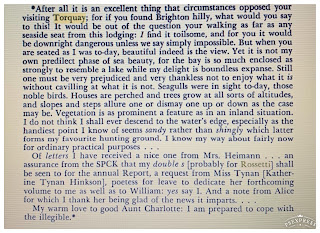
 The image of one of the writers letters, alongside this, taken from the biography Christina Rossetti by Lona Packer, tells us a little about Rossetti's experience of Torquay.
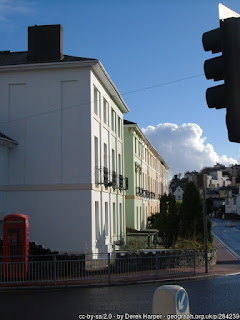
Abbey Road looking in the opposite direction
from the junction with Tor Church Road,
beside the Central Church.
On the right is Waldon Hill.
This photo is copyrighted but also licensed for further reuse.


I've not had a chance to find Abbey Road yet but I imagine the house where Rossetti stayed, in letters as 'Beechwood' might have been one of the terraced properties that appear in the photo, from Geograph:


I noted on the previous post about Rossetti in Torquay that I hadn't found any information about writing she may have been working on whilst in Devon, but I also surmised that it is possible she was mulling over her meditations and supplementary poems that were to be published in 1892 in the text Face of the Deep, A Devotional Commentary on the Apocalypse, (which according to the Palgrave Encyclopedia of Victorian Women's Writing, was Rossetti's last original text for the SPCK (Society for Promoting Christian Knowledge). The text was the poet's devotional responses to the  Book of the Apocalypse. There's a useful introduction to Face of the Deep on the Palgrave Encyclopedia of Victorian Women's Writing, reminding fans of Rossetti as poet that her intellectual and creative skills took on a wider remit; as well as poet, she was also 'theologian and contemplative': 
'These devotional practices take the form of anecdote, prayer, or poem, exposing tensions between theological interpretation and devotional response that Rossetti then interweaves.' (Palgrave Encyclopedia)
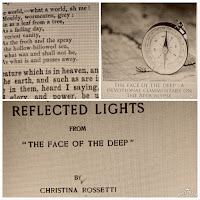

Images from Rossetti's Face of the Deep
Just as often happens with modern poetry some of the poems that the poet wrote for inclusion in Face of the Deep - such as 'A Vain Shadow', one image from which I've headed this short feature about Rossetti - were also printed and published in other collections of the writer's poetry. 'A Vain Shadow' appeared in Verses a collection of Rossetti's which came out in 1893. One commentary about that poem and about Face of the Deep suggests that a modern reader's interpretation of the poem should take into account the context in which it appears. (An observation that I'm sure is relevant to all poets and readers given that often poems re-appear in other and later collections). 

                              ****

'There is a little village in North Devon, sheltered from the sea by a low range of sand-hills that stretches for miles on each side of it. The coast turns westward here, and no cliff breaks that line of billowy sand; northward and southward it goes, with the rhythmic monotony of the sea. The sand-hills are dotted with tufts of the long star-grass, where the rabbits sit; inland they are covered with fine blades bitten short by the sheep. Seaward lies the hard ribbed sand, glistening with salt, and fringed with the white surf of the Atlantic'. (From Audrey Craven, by May Sinclair, first published 1897 - 125 years ago).
 

125 years ago, in 1897 May Sinclair - whose real name was Mary Amelia St Clair -  at the time an unknown woman writer whose links with Devon are generally not known about, published her first novel, Audrey Craven. One researcher labels the book a 'New Woman' novel (See The Creator); another publisher summarises the novel thus:
'Audrey Craven 'centres on a beautiful young woman, the eponymous Audrey Craven, who has managed to cultivate an entirely undeserved reputation for originality. Rather than being unique or original she is in fact a shallow self-centred and solipsistic heroine, whose only desire is to become a great muse to a great artist or thinker.' (See Delphi Complete Works of May Sinclair).
    Audrey Craven was published when May Sinclair was 33. Critical reception of the novel was agreeably positive considering that Sinclair was as yet an unknown writer. For instance George Gissing said of it that 

Had you not told me it was your first novel, I should have thought it came from a hand already practised ... For the work - if you will let me say so - it is very well written, in sound, careful, often polished English, assuredly such as one does not meet with every day. Moreover, the characterisation and construction seem to be decidedly good... I hope the critics will give it the attention it deserves.
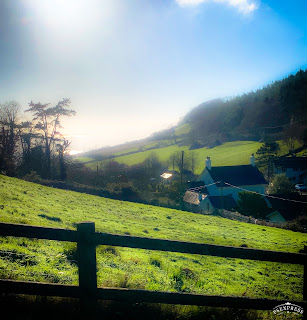
    Sinclair's life is linked with that of Madeleine de Lancey's in that Salcombe Regis was the village where they both stayed when in Devon, although Sinclair's stay there was many years after De Lancey's. Also, both women only spent a little time in Devon, although Sinclair did live in Salcombe for  a decade, whilst Madeleine's time there was very brief - and poor lady, given her state of health it is unlikely that she had a chance to appreciate her surroundings. Both women have left me with unfinished research as I have not been able to find the places where they stayed (or indeed Lancey's  grave and also I've now realised, the location of the graves of May Sinclair's mother and brother in Salcombe graveyard). As noted in A Novelist at Salcombe Regis (a previous post in  my other blog) I wrote about the St Clair family's stay at The Quest on Brook Hill, a place said to be high above the village. 

      As yet I've not located Brook Hill, but a helpful reader and distant relation of May Sinclair, who came across A Novelist at Salcombe Regis on my former blog recently got in touch and sent a fascinating sketch of the cottage/house where the Sinclair family lived, which it is thought was drawn by May's brother William.  My contact further commented,

 'The 1891 Census shows Mary Amelia Sinclair and her mother living at Brook Hill, Salcombe Regis (no mention of The Quest). By viewing the neighbouring houses on the Census, we believe the property was sited around the junction of Fortescue Road and Sid Road. The house may no longer exist as details of it finish around 1964. We have found another poorer but similar sketch of Brook Hill signed WS which strongly suggests that is William Sinclair, May’s brother (1851-1896)'. (See also note below)
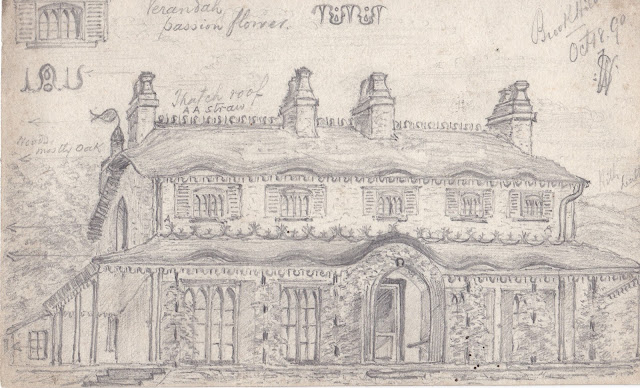
Sketch of 'Brook Hill', the house May Sinclair lived in Salcombe Regis.
Drawing attributed to author's  brother William Sinclair 

A Novelist at Salcombe Regis makes a tentative exploration about May Sinclair's connection with the village. Audrey Craven was apparently published around the same time as the author left Devon with her mother and returned to  London, so I'm assuming that she well have been working on it whilst living in Salcombe Regis. One source I came across suggested that the novel had been completed at least two years before publication, which again confirms that it was probably a manuscript the novelist was working on whilst in Devon. Devon does make an appearance in Audrey Craven, albeit briefly, as the quotation heading this piece indicates. 


May Sinclair's first novel is a precursor of the author's later fiction in that it suggests a writer whose characters are preoccupied with the nature of philosophical thought and the aesthetics of creativity, just as is suggested in biographies about her:

'She primarily wrote novels of ideas, as her precocious female protagonists grappled with Greek philosophy, Spinoza, and Christian mysticism'. (Campus Press Biography

Perhaps, in some ways prefiguring the later novel Mary Oliver, I read Audrey Craven as a semi-disguised - and somewhat loosely defined Bildungsroman - (perhaps it could also be considered a Roman à clef in that it is likely that several of its characters were modelled on individuals Sinclair knew).

      It is the chapter in which Devon's coastal landscape appears as a place of retreat from the whirl of London life for Audrey, the novel's main character, which for me left a clue that the narrative may conceal events and places taken from the author's own life, but that these personal similarities themselves may be masked. Rather than taking her character/heroine to the climes of south Devon - the location where she lived for several years -  Sinclair describes a north Devon coast landscape: 'There is a little village in North Devon, sheltered from the sea by a low range of sand-hills that stretches for miles on each side of it.' And yet, the place (a bungalow) where 'Audrey' stays whilst she takes her very brief break in Devon fits neatly into the author's description of the actual place that the St Clairs stayed at in Salcombe Regis, 'a long-low house high above the sea on the coast'. (See Novelist at Salcombe Regis). In the novel the location is described as 'On the coast, about a mile from the village ... a long one-storyed bungalow, built on the sand-hills. The sand is in the garden, where no flowers grow but sea-pinks and the wild horn-poppy'. In other words, the novel's location is transposed (from north to south) but at the same time seems to represent the actual place where the author stayed. 

    I think, in keeping with Oliver's stated disinclination to have her own life put on public show (see A Novelist at Salcombe Regis), that the author may have concealed herself within the character Katherine - who though not the leading female protagonist in Audrey Craven - is a kind of alter-ego, a foil, or mirroring character to that of the main 'heroine',  femme fatale Audrey. Instead of Audrey's selfish narcissism Katherine, gives us empathy, and self-awareness; instead of Audrey's vacuous 'constantly shifting' capricious personality, Katherine give us loyalty, a strong sense of self; instead of Audrey's projective dependence on others' opinions and creativity, Katherine gives us the dedication of a true artist who shapes her own opinions and creative projects. In today's terminology, unlike Audrey, the novel's main character, she has reams of  emotional intelligence. I think a reader looking to get a sense of the real May Sinclair at this stage of her writer life, could benefit from seeking her in her first published novel.

    I could, but must not continue here, or this celebratory feature will take me through too much of this year; but for anyone who enjoys reading early fiction by female novelists exploring the rapidly changing lives and roles of women during the period of early Modernism, then this early May Sinclair novel should be on this year's reading list.

                                                                         ****

'He opened the door with a crash, lurched about on the broken brick flooring of the place and finally came to anchor on a cane-bottom chair.' Wings of Desire

So, 110 years ago, in 1912  Wings of Desire, a novel by the important and long forgotten Devon author Mary Patricia Willcocks was published. I've written about Mary Patricia Willcocks in a previous Scrapblog post, M.P. Willcocks was a Writer from the West  and mentioned how I'd found about her through the writer/journalist Bob Mann of Longmarsh Press. There's also a brief commentary about Wings of Desire in A Handful of 2021 Anniversaries, 100 years after the novel's publication. 
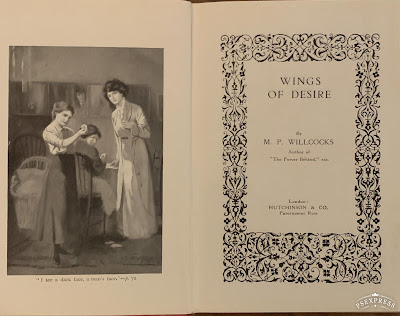
Page from  M.P. Willcocks' Wings of Desire

 Although now, well into the second decade of the C21 most books are obtainable one way or other, when I first tried to find M.P. Willcocks’ novels they were not easy to get hold of. Many years out of print, they were languishing in a dusty corner of one or other basement archive, in such repositories as that of the Exeter City Library, or a local Devon town library store. I was elated when I eventually located copies of both Wings of Desire and Widdicombe - which now you can read online. I began to understand the symbiosis between landscape and literary texts in a new way. Here was a woman from my home country who wrote about the local landscape and about the types of rural Devon women who could easily have been my own foremothers. Walking through the landscape of her stories, which often figure a local Devonshire woman herself wandering through typical county territories - crossing bridges, in damp woods, under trees, or on the moor - usually very aware of and susceptible to the vistas spread before her, I found myself re-living the days of my female Devonshire ancestors. 

    Ranging across the spectrum of the county’s topographies Willcocks' novels offer snapshots of Devon's lost corners. Reading her novels I was reminded of Mary Webb, whose fictional writings capturing the geni-loci of her home county seem synonymous with Shropshire’s essence; Willcocks’ fiction is to Devon as Webb’s is to Shropshire. I imagine that Willcocks was influenced by her near contemporary D.H, Lawrence (though given the dates of their respective fiction publications perhaps the potential influence was the other way around);  but just like Webb, who was also her contemporary, Mary Patricia Willcocks was born and spent most of her life in her home county; both women’s fiction focuses around the distinctive features of their respective home county’s landscapes. Willcocks’ work often has a backdrop of moor and sea, whilst her stories are awash with local (late C19/early C20), mostly rural characters. Preciously old-fashioned, but providing nostalgic, secure representation of an ordered world, her fiction resonates with a sense of place in which generations of ancestors lived and worked; her books are replete with what her fan Bob Mann calls ‘a mystical sense of the inseparability of past, present and future’. (Bob Mann, 'In Search of Devon's Forgotten Feminist', The Dart, June-July 1996, Number 95).


    Willcocks’ female characters project inner warmth, integrity and strength; the ethos of their very being crucially depends on an interior awareness of the longstanding rootedness of their own female ancestral inheritance within the county’s wildest landscapes, over which during the course of each novel, the women roam freely, frequently breaking free of societal expectations:
On the landing Anne paused, bright-eyed and mis-chievous. Leaning over the rail, she contemplated the hall below. It was as silent as the ancestors on the walls. Only the clattering of plates came from behind the baize-covered door that led to the older part of the house ... "Dare I?" said Anne to her sister, putting her head on one side like a bird when he raises a song to the god of raspberries. The next moment there came a slithering noise of skirts followed by a thud; Anne had slid down the ban- isters. Demurely Sara followed, wondering why Anne retained the jolly ways of a child or a man. But she knew, for Anne had been out in the world where one does things. She had not stayed at home listening to the wind in the trees, to the noise made by the footsteps of the future. It was the best thing that Sara had ever done, that sending of Anne into action. Very warm at heart, she followed the girl into the drawing-room, where Mr. Knyvett was still acting as a conduit. ' ' Harmony, ' Mr. Hereford was saying with his fingers neatly fitted in the shape of a pointed arch, "harmony is the thing we neglect in modern life. We must not jar, we must vibrate in unison. (M.P. Willcocks, Wings of Desire (John Lane, 1919). 30.

     As I read the novels I kept wondering how many of my unknown Devon female foremothers were made up of the same stock as the tough and resilient female characters to which Willcocks gave voice and presence.

    Wings of Desire's settings extend from Devon’s coasts (including Brixham) to the Magellan Straits. 
The novel relates the story of  and is focused around its heroine Sara, a concert pianist, whose marriage is wrecked by the controlling influence of her husband, writer Archer Bellew. The narrative follows Sarah's eventual rise to fame and then escape into the freeing arms of engineer Billy Kynvett, Sarah's sympathetic lover. A key speech of Sarah debates the female struggle around relationship and work:
'Year by year we are taught, we women, to live by love—that it is our highest work. I believed it till I was shaken out of the belief. He, my lover, had his work, the thing he was made to do. He put it first before me. . . . He would not take me. There would have been fuss, lawyers, letter-writing. He would not have been left with a mind free to his task. I saw for the first time my place in the scheme of things. I am only a light woman until I can do my work.' 
Molly Woodruffe, a political organiser and object of Archer's latest infatuation, is the other main female character in the novel;that pair's relationship is explored using the background landscape to reflect the unfolding emotional turmoil. The crux of the emotional encounter between Archer and Molly happens in the vicinity of what is now Meldon reservoir and beneath what was, in the early C20, the atmospheric gorge under Longstone Hill. The valley, running along the West Okement river, is known locally as Dartmoor’s 'valley of the rocks'; semi-fictionalised by Willcocks as the ‘Enchanted Valley’, the site becomes both a place of ‘quietude’ for Molly, (who, in today’s terminology is 'burnt out'), as well as a place that is used to mirror the fluctuating emotions of the impending lovers. The preliminary scene is summery, enticing the reader to jump in the car and drive straight to the sunny moor, with the river's ubiquitous background murmurations:

Sun warmed and sweet, over granite boulders where hang tufts of gorse that send golden lights across the deep brown pools, the river slips down the Enchanted Valley. Hills, grassy, patched with young bracken and scarred with grey stones, enfold it; only its swaying murmur, rising and falling like a pulse, can be heard to the summits where the sun beats down in dizzying splendour. ... Into this radiance stepped Molly and Bellew; here they sat on the rocks while the brown waters sparkled over patches of sand or gloomed across the weedy boulders (Wings of Desire, 140).

As the meeting between the couple becomes more angst-ridden, so does the description of the valley take on darker, sinister tones. A storm brews and Archer and Molly have to shelter from the moor’s dark mood:
Then she felt a physical chill fall on her and following her glance, Bellew looked up and exclaimed. Over the shoulder of the Longstone Hill, gathering across the wastes deep in on the moor, was coming a procession of clouds, inky black at the edges. The wind was shaking the trees. Low growls of thunder came from the left; it was of ill omen, thunder from the left, thought Molly. “Come,” said he, “we must hurry.” (Wings, 143).
    Wings of Desire’s last scenes between Sarah and Kynvett are set in an exotic fictional moorland wood, which it is not hard to identify as the real Black-a-Tor copse:

Photo from the last chapter of Wings of Desire
Near the ending of Wings of /Desire
"Between large slabs of granite overgrown with moss and fern grew stunted oaks, their gnarled and knotted trunks half hidden with carpeting of whort-bushes. In the warm, scented wind the tree branches waved above the woodland gloom that was dappled with point of gold. Everywhere was light and movement, thrilling upwards from the breast of earth towards the sun’s caress .. At the head is the wild moor toward Great Kneeset with its dun stretches of ling, a mantle of brown fur, broken here and there by solitary thorn bushes white with bloom and odorous with heavy scent"(Wings).

It is here that Sarah and Billy exchange their final love tryst: 'And she bowed her head for like a wonderful tree of life, their mutual trust in each other's honour bore but their love and passion as a flower' 

    In April 1912 The Freewoman Weekly Feminist Review carried what might be read as an ambivalent, perhaps even condescending, review of Wings of Desire, written by no other than writer Rebecca West who was - and is - one of the major writers of her time. West is somewhat critical of Willcocks' 'lack of dramatic instinct ... 'for her crisis never come cleanly and impulsively but are approached circumspectly over much unnecessary ground'. (Could there have been an element of envy/jealousy?) But West has plenty of complements for her fellow novelist. Willcocks' writing is 'strong and valuable'... 'Her novels express the passionate deliberations upon life of a wise and energetic personality ... she has an extraordinary ability for drawing characters ... they [yet] have the flush of life on their cheeks, the strength of the living in their limbs'. 

West describes the character of Sarah Bellow thus:
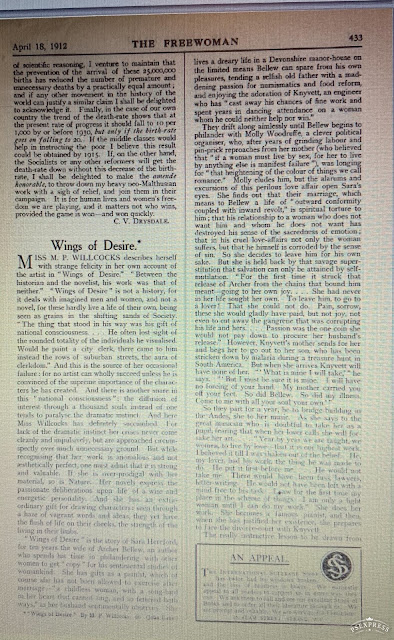

'She has gifts as a pianist, which of course she has not been allowed to exercise after marriage—" a childless woman, with a song-bird in her heart that cannot sing, and so fettered both ways, " as her husband sentimentally observes.' (See The Freewoman)


West concludes her review of Wings of Desire thus:

"In the panoply of our newly-found emancipation we women are as serious as a little girl in a new pelisse : we dare not unbend in so much as a smile. Perhaps that is why Miss Willcocks, having written a rattling good yarn about a reckless buccaneer of to-day who leads some fine gentlemen across the tumbling; tropic seas to the black snow-capped cliffs and yellow coves of South America in search of phantom gold, felt shy about publishing such a frivolous production, and weaved it into "Wing s of Desire " with the slenderest thread. It adds the last touch of riotous confusion to a book that almost faints under the weight of its own luxuriance. But what a magnificent fault!" (See The Freewoman)


    For another commentary about the novel Wings of Desire see The Oxford Companion to Edwardian Literature Given several other reviews of Willcock's fiction in The Freewoman and other similar respected journals, it is clear that she was a well-known and acclaimed author among the literary circles of the time. Perhaps then, it is about time that her books should be reestablished, given due respective attention by those now active in the C21 publishing and academic world.

****
My dear, go to your room. This is not right, You are acting in defiance of my known wishes, although, no doubt, thoughtlessly. Bid your sister goodnight and go.”
Val did not even wait to carry out the first half of the Canon’s injunction. She caught up her brush and comb and left the room. (The Optimist - Great War Fiction Plus)

Now, Centennial Literary Celebrations 100 years ago several books authored by Devon women writers were published. At the time several of - if not all - of these women were beginning to establish a reputation as writers of considerable status. The writers and texts were:  M.P.Willcocks' The Wicker Women, E.M. Delafield's The Optimist;and Margaret Pedler's The Vision of Desire.

    Published in 1922 The Wicker-Work Woman; a Chronicle of our Own Times (read on Project Gutenburgwas a novel by French author Anatole France, which I understand M P Willcocks translated into English. (Willcocks also translated France's The Elm on the Mall - possibly it was published two years later, in 1924). The Wicker Work Woman is probably easily available on the internet as searches bring up many links. However as yet I have not had a chance to read it nor have I found much about the novel and its background. One or two reviews mention that telling the story of a wife who ends her marriage the novel's subject is marriage breakdown, so maybe Willcocks' work translating France's novels influenced her writing of Wings of Desire.  
 __________

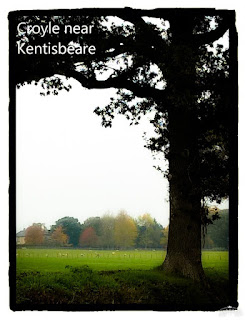
The Optimist by E M Delafield , was the first novel published by the author just after she returned to England following a couple of years when, newly married, she'd lived in Singapore with her husband and young son. (There's an earlier feature about Delafield at Sad December in Kentisbeare on my previous blog). According to her biographer Violet Powell in The Life of a Provincial Lady, The Optimist was written between August 1921 and March 1922; the family sailed back to England in the spring of 1922. Following their return to the UK and again according to her biographer Delafield and her family settled 'downalong to Devonshire'. Delafield had often stayed in the county with her mother and had loved watching the spring flowers unfolding there especially primroses which she still picked and saved in boxes every year as gifts for friends and family. The family rented a house called Westcott (I've not been able to locate where this was) before moving in September 1923 to their forever home at Croyle House near Kentisbeare. 


picture of tree with Croyle House at Kentisbeare in the distance
Croyle House across the field

The Optimist is another novel I've not yet had opportunity to read so any comments rely on others' responses to the book. Powell says that the novel was dedicated to C.A Dawson Scott, who had previously written a very encouraging review of Delafield's early novel Zella Sees Herself. 

Powell's view is that The Optimist 'is in some ways the oddest of all her [Delafield's] books'. Her biographer also suggests that the novel includes literary allusions to Charlotte Yonge's The Pillar of the House and Dickens' Bleak House. Charlotte Yonge was another writer whose memories of childhood holidays spent  with her cousins in Devon became encapsulated in her fiction. Delafield had a longstanding interest in Yonge's work which was put to good interest when she contributed the Introduction to Charlotte Mary Yonge the Story of an Uneventful Life,  Georgina Battiscombe's biography of the author, published in 1943. 


Several reviewers of The Optimist also pick up undercurrents of other prior women's texts. According to one source The Optimist, along with F M Mayor's novel The Rectors Daughter, 'offer a modern rewriting of and modern commentaries on Jane Austen's Mansfield Park and Persuasion'. (Janeites: Austen's Disciples and Devotees)

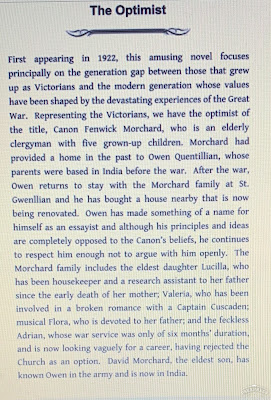
    The plot of The Optimist apparently revolves around the differences between different generations in the family of a certain Canon Morchard just before and following the First World War. A quick glance at Goodreads and Amazon reviews tells me that it has a mixed response from readers, ranging from those who find it engrossing such as this one from Amazon reviews:

'Some may find the character of the Canon just too tiresome, but he was so beautifully rendered in all his sometimes-tedious glory and piety, I couldn't stop reading. The detached and priggish main character is also a bit of a trial sometimes, but again, the uncompromising realness of all of the limited people who populate this novel is the book's great strength.' AmazonReview

But, another Amazon reviewer is not so impressed. 
'I'm afraid I found this very hard going. It just didn't hold my attention, I felt unable to make a connection with any of the characters, and I had to struggle to make it to the end. I do enjoy Delafields books and I feel she was a really talented author, but this was a disappointment to me'. Amazonreview

    Yet another reviewer is extremely complimentary about The Optimist judging it to be 'one of the most thought-provoking novels of the 1920s'; this review concludes that 'It [The Optimist] deserves a reprint'.  I hope to make up my own mind about he novel one day, and will be especially keen to note the intertextual links between The Optimist and Jane Austen. 

Please do get in touch if you've read and have views about this novel.

_______

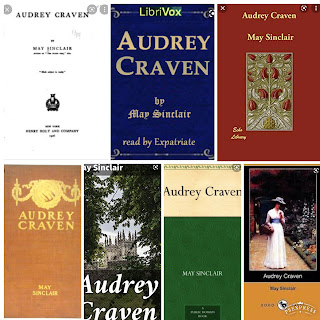
The Vision of Desire 


Covers of various editions of Vision of Desire

    The title of another novel published in 1922  by a Devon woman writer echoes that of Willcocks' Wings of Desire. Perhaps indeed Pedler's choice of title was influenced by the earlier work. You'll find my extended piece about Margaret Pedler on Scrapblog at A Zeal Monachorum Author who was 'Queen of Romance' so I'm not going to spend too much more time on her today except to reiterate what I said about her in that piece; I assessed that her work goes beyond the generic stereotypes expected with that of 'romance novel', that her fiction 'deserves our attention, especially for what it can inform the C21 reader about the ways in which, during a time when women's place in family and wider circles was rapidly changing, early to mid C20 women novelists depicted issues about female lives and roles in society'. I see Margaret Pedler as an author of 'middlebrow' rather than 'popular' romance novels. 

Review from The Scotsman of Vision of Desire in 1922

 Here, in the accompanying image, is a copy of one contemporary review which mentions The Vision of Desire - a 'good honest romance'. Another book-jacket reviewer calls the novel ' an absorbing romance written with all that sense of feminine tenderness that has given the novels of Margaret Pedler their universal appeal'. (Grosset & Dunlap publishers New York).
                                  

                                                           ****

And now, bringing this celebratory Devon chronology a little closer to us chronologically, and, for now, closing it - another novel by Margaret Pedler,

80 years ago, in 1942, another of then acclaimed and popular romance novelist Margaret Pedler's novels, Then Came the Test was published.
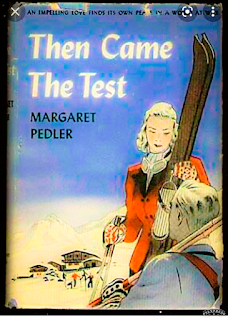
Annoyingly thus far a perfunctory search on google has only provided a brief synopsis of that novel. It summarises that plot:

'An English story of the extravagant Sherwoods, geared to horse and hounds, and coming up against sober reality when debt loses them their estate, and war breaks out. Familiar enough triangle pattern, with tribulation getting its tribute, and love eventually winning out'. (Kirkus)

Yes, fair enough there are several copies of the novel - including a scattering of first editions - available on sites such as AbeBooks, but they are few and far between and not cheap. I hope I'll return with more commentary about this long lost novel as soon as opportunity arises... 


Note: Re update following the sketch above of the cottage where the Sinclair family lived. I am very grateful to Jan Wood, archivist at Devon Heritage Centre who kindly assisted in helping to locate the house. Here is part of the email she sent providing details about the whereabouts of the property. '... named as Brookhill - on the 2nd edition Ordnance Survey map [dated to the early 1900s] on the Know Your Place website. It is in Grigg's Lane, which ran at the time from the junction of Sid Road with Fortescue Road (this area is now called Sidford) towards the east, in the direction of Salcombe Regis village. Just past Brookhill/Quest, close to Thornhill Plantation, and before reaching Salcombe Regis village, Grigg's Lane seems to have turned at that time into a narrower track or pathway. Brookhill stood on the south side of the lane towards the village. .. I have just found it on the 2019 basemap as well, named as Quest - so it may still be the same house - if it is not a rebuilt house with the old name still kept. The lane still turns into a trackway just past the house'.


Well there you have it, another year and a selection of the past's celebrated Devon women writers and texts. I hope I'll be here next year to catch up on some more literary anniversaries!

Ma(r)king the Way to Martinhoe


Old Schoolhouse Martinhoe


Writing Women on the Devon Land

A-Z of Devon Women Writers & Places

Marking the Way to Martinhoe

Old Schoolhouse Martinhoe

         The little parish of Martinhoe in north Devon has to represent the 'M' in this A-Z of Devon Women Writers & Places.
I began the journey toward writing a book about women many years ago, long before I researched then embarked on the written study of particular women writers. During the late eighties and early nineties, whilst researching and writing up my PhD, I ventured up to the remoter landscape north of the county to find where author/poet H.D.’s once stayed, in north Devon. She was there For several months in 196, during World War One she lived at Martinhoe then along the road at ParracombeJust as many other women writers associated with the South West, H.D. had significant connections with at least two of its counties, in her case it was with three (Devon, Cornwall and Dorset). 

      What fascinates me about writers whose lives and texts cross county boundaries is the way their experience feeds into a kind of communication with the land space on which they writers lived and wrote, the way it affected their individual and combined selves and the ways in which their textual, literary roots also branch out and extend far beyond the surface, creating and recreating an endless kaleidoscope of inter/intra personal intertextuality.

       Born in the U.S., H.D. (Hilda Doolittle), but much of her life and writing was influenced by our South Western shores and coasts. Without her presence I would not be here writing at all.  


Woodland Cottage Parracombe

I've already written about H.D.'s stay in Devon during 1916 in an earlier blog Scrapblog of the South-West and also in companion pieces on the same blog. and again here. There is also an essay I wrote about H.D. in Devon on the H.D. Web. I have no intention of repeating the same material in this piece. It is more of a marker, a page to mark H.D's importance in my whole project.

       However I will pop in some extracts from a chronology, which details some of the events of the writer's Devon stay. If you want to read more it is taken from Louis Silverstein's H.D. Chronology Part Two 1915-March 1919:
1916 February 22. HD. at The Schoolhouse, Martinhoe, Parracombe, North Devon

writes to Amy Lowell, her book [SEA GARDEN] has been accepted by Constable but will not come out in three months as she had hoped because of paper shortage; tells Lowell that she IS m Devon; discusses poems [Fnedman notes: not seen by LHS (H D. to Amy Lowell, [unpuL letter],

1916 February 24. HD. writes to George Plank; gives new address on envelope: "New address / c/o Mrs Dellbridge / Martinhoe / Parracombe / N. Devon"; says "some of us, no doubt all will turn up Isola Bella on Friday"; sets tune for 7:30; continues "we must be back early as we take mornmg tram' We are movmg our furniture to 44 Mecklenburg Square Fnday PM. Indicates that dinner will include herself, Aldington and John Cournos and perhaps F.S. Flint as they had asked 111m to dme With them that evenmg--they had planned a tea on Monday [for Plank and the wnutalls?] but it has all gone mentions confusion [LHS note: from this letter It seems as If the decrston to move to 44 Mecklenburg Square was a hurrted one]; mststs that dinner must be Dutch—says " we can't ask Flint otherwise & we can't impose on you forever and ever" (HD. to GP, [unpubl. letter]).
1916 March 6. HD. at Woodland Cottage. Martmhoe. Parracombe. North Devon writes to Harriet Monroe (Zllboorg notes).
1916 March 22 (?). HD. in Devonshire: writes to F.S. Flint: describes wanting actX1ttes and domestic life: says they are on their own trout stream (called the Heddon): the place is charming but there is only enough room for them and John Cournos (If he comes): speculates that Pound had expected to get Aldmgton's post on THE EGOIST had writtten a "charmmg Macheavelhan [SIC] note" to them which they had not answered: refers to widening gulf with Amy Lowell (HD. to F.S. Flmt.

1916 March 27. HD. at Woodland Cottage, Martinhoe. Parracombe. North Devon: Richard Aldmgton writes to F S. Flint and comments on her erotic attraction and his desire to sleep with her (Zilboorg introd. [draft)). Richard Aldington writes to Amy Lowell giving above address (Zilboorg notes: Houghton)

      And here is a few extracts taken from a piece written about the journey I took with a friend some years ago down to the far west of  Cornwall, on a follow-up quest to Martinhoe, to find the location of the poet's stay there, a couple of years after her trip to Devon ...

         
    .... This has to be near Lyonesse’, I remind myself, echoing H.D.’s own description some (clock-time) 70 years ago. Sun-slant time is low behind this haze of mist, which envelops us, just as it does twenty clock years later, up on the wild north Devon coast reaches, when I am try to locate H.D.’s temporary home, near Martinhoe. 

       Today we’ve been driving along the snake-like, zigzagging B3306, between Zennor and Cape Cornwall. My friend finds this place creepy and would, I suspect, be content to turn around and make tracks homewards. I decide not to tell her about Alistair Crowley, about witches and other slightly sinister past inhabitants and goings-on in the area. All she knows, after I told her during the journey down from Devon, is that for a while during, World War One, D.H Lawrence lived not far away from here, up at Zennor, and that in 1918, H.D., the poet, (who was a friend of Lawrence) also spent some time (clock) somewhere round here; that she came away from the war turbulence of London to ‘accompany’ the composer Cecil Gray at the house he had rented (with Lawrence’s guidance) near, or at Bosigran; that she first met her lifelong lover/companion Bryher here, when H.D. invited her for tea; that she became pregnant here; that the pregnancy had had a negative impact on her already threatened marriage to Richard Aldington; that whilst here she worked on several significant texts, including the roman-a-clef Bid Me To Live; A Madrigal.[1]

        My friend knows that, for both personal and academic reasons I wish to find the place where H.D. stayed. I want to feel the impact of this moor and sea-scape that forms the west Penwith peninsula, to let it inhabit me, as it had then possessed H.D. 

         I feel a stranger, an impostor. Traditionally, Cornwall, not Devon, is known as the Celtic land. And yet, the spiritual atmospherics of this part of Cornwall correspond with and complement that elemental landscape in north Devon, further east along the coast, which is also associated with writer H.D. For me, this landscape also resonates with that of  Devon’s central mid-Devon region set between the two moorland plateaux, with its subliminal sacred-roots. I can imagine how extended and underground labyrinthine root systems which some call ley-lines, might travel through and along the line of the counties, beneath the palimpsest layers of their mutual prehistory, under the ancient field systems, the archaeological strata, the high moorlands. I understand my home county as a distinct entity, but also view it as part of a more extensive tract of land, which is defined by its common geological, historical, anthropological and social histories.

        I shall absorb the mystic, mysterious aura of the peninsula's territory so as to bind me back into the atmosphere of her book, which, in turn will open perceptions toward re-membering the writer's time/thyme here, in 1918. For, it was H.D.’s affinity with this west Cornwall landscape that prompted my own preoccupation with landscape and text. After serendipitously coming across her writings one day, I began to understand the magical sacred appeal of my child-landscape with fresh eyes and to see why the location of my roots had such an emotional pull. In turn, that enabled me to explore the implications, both for self-identity and for my own writing. 

      That’s why I’m here; I want to breathe in this Penwith air, absorb the intoxicating essence blend of place and poem, the mix of panorama and prose; read the elaborate script set in the exquisite scene:


      ‘The jagged line of cliff, the minute indentations, the blue water that moved far below, soundless from the height, were part of her.[2}


       ....We stop in this car-space beside the old mine-shaft by the road, and after a sip of coffee begin to make our way along the tinners' tracks, which define this strip of coast land reaching out onto the cliffs. Walking along the edge of exhilarating South Western coasts, we should soon be able to see beyond these cliff-paths. But, though seemingly guided by unseen presences, we can not see far A fog-horn's booming in the seaward direction and disembodied voices whisper to us, stealthily as the mist. We do not know the language, yet can follow the trail of hieroglyphs seaward/sea/w/ree/a/ds.


Though mystified, we know which track-fork to take when it splits, as it seems to, every few yards. Hiss-hiss. Here-here. Hiss-hiss. Mist here must represent the spirit/s of the place, I think. And, we have been travelling along the snake-road, genius-loci of Cornwall’s most sacred space. I do not feel threatened by stories of this area as an oppressive ‘spiritual black country’. On the contrary, the mist wraps itself comfortably around us and as we saunter across the grassy sward tracks, begins to trail into ribbons and then to lift, to disperse, so that by the time we reach what is left of the fortifications of Bosigran Castle, the sun is hovering over the Atlantic spread below us. Other than the springy, tangy and lightly scrubby heath at our feet, which is stippled with tiny violets, we are cocooned in a blue shroud. A heaven of Cornish seas; the bliss of springtime South Western skies.

My friend, sun-worshipper, wants immediately to bathe in one of the ‘room’ enclosures that are formed between the castle’s esoteric relics. I wonder if H.D. had occasion to do the same, to remove her garments and lie out in the sun when she visited the ruins. But then, I also wonder if, when she was here, the stone walls of this place were, at least to some degree, still intact. A lot can change in clock-time over seventy years. In its hey-day Bosigran must have been a massive and magnificent castle; it ran across the neck of the headland and may have been a ceremonial site. I remind myself to look out my copy of Bid Me to Live when I get home, so that I can re-visit the place as though from H.D.’s eyes, follow the footsteps of the poet as she trailed around the paths of this coastline.

It is whilst we are doing a recce of the castle that we hear the knockings. They are loud and are echoing over from the next hill of this broken line of headlands that culminates at Cape Cornwall. Instantly, I remember that Cecil Gray – and possibly H.D. herself - spoke of experiencing these phenomena and that the knockings were rumoured to be the ghostly after-echoes of tin miners quarrying in the locality. My friend shrugs, grimaces. I do not know what to think. Although this region is known for its mystical goings-on, both historically, and now, I am not really a believer in ghosts; just interested in the enigmatic possibilities of mysterious cryptic occurrences, which could as easily be interpreted in psychological as in psychic terms. But those knockings are for real; we both hear them. I allow them to melt and merge as soundscape to accompany the inner map of H.D. in Cornwall beginning to form in my mind.

Next question is, where did she stay? Where was this large house that was called ‘Bosigran Castle’ or, in H.D.’s novel BidMe to Live, ‘Rosigran’? Was it purposely named after this ancient ruined castle?[3] We venture down other tracks looking to find the site where a once ‘sizeable’ cottage may have been, may still be. But there are no buildings here and no evidence of any. We realise that we may not be at the exact location, that the site may be a little to the north east and that the house's name may have confused us. Did H.D.'s then lover Cecil Gray and his companions want their friends to think they were living in the castle? It’s also possible that the house may have gone, some years ago.

Today we have no more time to explore. We will return. H.D’s words buzz  around my head:
            I suppose we will come back ... I will never see you again ... I will go on scribbling.’[4]
I shall return to H.D’s South Western sea lands; even if I have to cover, or cross, the same ground.
It seems as though yesterday, though in clock-time is a long time.
In clock-time it’s a long-time; it still seems as though yesterday
.[5]


There is also a sequence of my poems written in commemoration of H.D.'s time in Devon published in Shearsman Magazine 111/112: see a few extracts below.


Shearsman 111/112

Driftwood 
        Breathless, 
at last we are here, 
at the sea-shrine, 
though few seem to venture to this abandoned plot, 
where at the time of the latest tide 
             a twist of drift left 
behind figures 
           for us, 
the gravitational curve, 
a centenary   - the sea's-time.

 'you are useless, O grave, O beautiful' (H.D. 'The Shrine') 
........

At the Fort; The Beacon, Martinhoe
We arrive from the old Roman carriageway
high 
above the sea, next the sky, 

                                    way below 
in coastal chasms, white against white 
gannets and gulls 
              beating,
                   breaking surf -
        at home 
our multimedia screens still on 
flashing in-perpetuum into our comfort-zone rooms,
every opportunity, we whip out phones from pockets or bags, 
photos flash,
burst from our finger-tips - 
we remain alive with interactive possibility, 
yet find it impossible to conjure a picture from the swiftly lit 
spark of a stated fact. 

Here    only flashes, a series of dots and dashes 
cracking along faults of the rocky screes on this north Devon coast
from long-ago beacon fires
intended for those, rudderless, 
tossed in the turbulent sea, 
                            waiting, 
                    in the Channel, 
watching for life or death landings.

'I have stood on your portal/and I know-/you are further than this, still further on another cliff' 
(H.D. 'Cliff-Temple') 

1. In which the name of the heroine, Julia Ashton, an avatar of H.D. herself, always seemed to me to be a close sound-echo of my own name. H.D’s writing sound-effect, or phonotext, is always significant, so this closeness had hooked me into the book.
2. From H.D., Bid Me to Live; A Madrigal.
3. Returning from her solitary walk along the cliff tracks, H.D./Julia in Bid Me To Live, briefly describes the house as it ‘loomed suddenly like a greyship, rising from the sea’ and someone noted it was a ‘big lonely house on the edge on the wildest part of the coast ... with seven rooms and a great view out towards the Scilly Islands out the front’ and that it was ‘near Gurnard’s Head’ (Mark Kinkead-Weekes, D.H. Lawrence Triumph to Exile, vol. 2, 1912-22; The Cambridge Biography of D.H.Lawrence (Cambridge University Press, 2011). Interestingly, H.D. did not refer to the castle itself in her book, which seems strange, given its size and historical importance.
4. Bid Me to Live. I have been down to Penwith several times since, including once with participants of the ‘H.D reading party’, in the early 1990’s, when a group of us manoeuvred the lanes and byways from Trevone Bay toward Cape Cornwall. Again, not one of us could work out where the house in which H.D. lived for several months was sited. I remember some heated discussion; but eventually we gave up our search in return for the delights of a local Cornish cream tea.
5. H.D.

Featured post

Agatha and Other Anniversaries

  Gravestone of Jean Rhys, Cheriton Fitzpaine churchyard,  view from Salcombe Regis Churchyard,  in the vicinity of the home of May Sinclair...