Followers

Ann Mason Freeman Devon Breakaway Bible-Christian, Quaker, Letter-Writer, Memoirist and Passionate Preacher


Map with Northlew showing Horrathorn

           From the first moment I came across references to her the C19 female Devon preacher/memoirist/ letter writer Ann Mason Freeman caught my attention.  Here is the opening of her Memoir:


        You will find various online sources which feature Ann, so she's not entirely extinguished from Devon's history. But she is one of the lucky ones, records about Freeman's life and her memoir only survive because of her links with the Bible Christians, one of the evangelical movements which sprang up in the westcountry during the C19. Initially Ann Freeman intrigued me because her home background, a farming family in west Devon, was similar to that of many of my own ancestors and as well she had lived not far from the parishes with which branches of our family were also rooted for hundreds of years. Broadly speaking, that takes in parishes that lie within a triangle formed by the point of Okehampton, Barnstaple and Bude - Broadwoodkelly; Dowland; Monkokehampton and other neighbouring parishes.

         One of my great great grandmothers was  Mary Parker, who was born at a farm in the parish of Dowland, which is just 20 miles east of Sutcombe, where one of the farms that the Mason family held is situated. Mary Parker was born in 1791 just a few years before Ann Mason Freeman. When you take into account Devon's proliferation of parishes, the distance between these parishes is small enough for the rural families of our farming ancestors to extend out genealogical tendrils and link up one with another in many and various complicated networks. Also, when it comes to the main narrative themes of Ann Mason Freeman's life, that geographical triangle is sufficiently compact to allow a reconstruction of patterns of inter-relationship in past communities in terms of their religious interests and associations. When I read about Ann's life, writings and travels I kept wondering if some of my foremothers or forefathers may have encountered her or others in her social circle; or indeed, if any of my great, or great great grandmothers, - such as Mary Parker - might themselves have become caught up in the world of the once celebrated Bible Christian/Quaker female iterant evangelical preachers, just as did Ann. If so, then sadly their religious fervour, memories and letters have long ago dispersed into dust and earth. In any case, as far as the Westcountry is concerned it is unusual (indeed, as far as I am aware, probably unique) for any texts written by a woman from this period to have survived, which in itself make the Memoir of the Life and Ministry of Ann Freeman written by herself and An Account of her Death by her husband Henry Mason, a special book.

        Yes, fair enough, Ann Freeman's text only exists because of its links with evangelical sects of her time and its remit is a narrowly focused religious rhetoric, but even so the memoir provides a way of allowing us a glimpse into the mind-set of women from rural Devon communities during the early C19, so even though my own foremothers' personal diaries don't survive, texts such as that penned by Ann can fill out a background context for family history social records. 

        I assume that one of the reasons that the text written by Freeman -which includes the narrative of her life-journey - survives, is because it was taken up by her husband after her death, then edited, extensively prefaced and published as her biography, by him. Hers is not the only story of a woman who wrote who would have disappeared into the ether if not for the actions of a male relative following her own demise. In other words, Ann Freeman is fortunate to have such a legacy - and indeed her 'fame' within the restricted circuits of evangelical networks, which means that she has a biography in sources such as Oxford Dictionary of National Biography (which as I write this during lockdown 2020 is allowing free access for a while through some library memberships)  - is probably mostly due to the biography accorded to her by her husband rather than other more peripheral historical sources. Henry Freeman's prefacing commentary about his late wife's Memoir (which was published not long after her death), suggests that he has omitted passages and as well he has edited some of her words.

 'The following memoirs do not contain the whole of what my dear partner wrote as that would have swelled the book … the whole of the memoirs are in her own words except the     alterations of I believe very few expressions that the reader may have a better understanding of the real meaning'. (See Memoir
        It is of course impossible to know how much Henry left out or indeed how much of the text he altered, but I think for a contemporary researcher reading a woman's text like this which has been shaped by a man, it is always important to have at the back of one's mind that the writing includes alterations and therefore may not be presented the way its author intended.

        It's also important to point out that another reason Ann Mason Freeman's memoir has survived is because of its provenance as a text written by one of the women acclaimed inspirational woman preachers from an important sectarian movements of the early C19. Designated as a 'Female Special Agent' Ann was one of a network of women preachers, many from Devon and Cornwall (several of them were her friends) who were encouraged and supported during the early years of the Bible Christian movement. During some of the years in which they were active in the south west some thirty per cent of the preachers taken on by the sect were women. Thus Ann's own memoir is an excellent source book for those who might be researching other women preachers of that time. The Bible Christian website provides the following information on Bible Christian women preachers.


From the very beginning, female preachers played a significant part in the work of the Bible Christians. Mary Thorne, the mother of James Thorne, had preached around Shebbear at the very beginning. Catherine Reed did much work to establish the circuits in Kent and London. The preaching of Mary Thorne, née O'Bryan, was described in The Maiden Preacher by her son, Samuel Ley Thorne, in 1889. Mary's mother, Catherine Bryant, had become a Bible Christian preacher. There are others: Johanna Brooks, Elizabeth Courtice, Elizabeth Dart, Anne Mason, Mary Ann Verry and Mary Toms. (The Bible Christans).


From Ann Mason Freeman's Memoirs

         According to her own memoir, Ann Mason was born 24th June 1797 at Horrathorn, or Horathorne, near Northlew (which you can see on the map which heads this post). Her parents were William and Grace Mason, who as far as I understand were of the established Anglican church (but I'm not quite sure of this fact). The beginning of her memoir (see illustration) relates that Ann was fourth of the Mason's thirteen children.  Compared to that of the life-span expectations of current generations, Ann's life was brief. She died at the age of 26, but albeit in conformity with the religious norms of her time, managed to pack into her short life-span a veritable wide-ranging box of experiences, including several homes, wide-ranging travels, extensive preaching and a number of texts including letters to a variety of relations, friends and acquaintances. When she was fifteen, just as many daughters from farming families, she was apprenticed to a dressmaker and shortly after this her family moved 18  miles north west of Northlew to another farm, Northcott (you can see Northcott on The Ruby Trail Map), which is between the parishes of Sutcombe and Bradworthy.


Map of Bradworthy showing Northcott

       In her book Prophetic Sons and Daughters, Deborah M Valenze remarks that the Masons, 'like the majority of the inhabitants of the area' were 'small farmers', and surrounded by 'moorland terrain', but I'm not quite sure she is correct in that assumption

       I find it rather intriguing that according to Ann Freeman's Memoir all the Mason siblings 'were early instructed to read, to say prayers mornings and evenings and on first-day evenings were catechised'. Ann must also have been a fluent reader and writer. In my own family history research apropos farming ancestors from Broadwoodkelly and neighbouring villages - which are also parishes in the nearby territory of west and north Devon - I've not always found that the women of the same era were able to write, for only a few of our foremothers signed their own marriage record. Of course they may have learnt to read; it's not possible to know, but I'm tempted to suggest that the women of the farming families of the Westcountry of Ann Mason's generation (late C18/earlyC19 were not generally literate. Perhaps she and her siblings were in the minority; or perhaps it was her religious and familial backgrounds which were the determining forces. 

Lane just south of Northcott (credit on image)

          The next fact we find about Ann in her memoir is that in the year before her family's move to Northcott farm, presumably while they still lived at Northlew, she fell under the influence of a Methodist Minister who came to preach in the parish, but during the same period she was bothered by inner spiritual turmoil and began to suffer from the physical ailments that eventually ended her life. She describes a trip to 'Oakhampton' where she was supposed to be confirmed, but because of inner turmoil - the 'dark' and 'death' in her  - confirmation didn't happen, and it was 'ministry' with a 'soldier' that helped her to see 'the beauty in religion' and prompted her to feel the 'power of Grace'. This experience was apparently a reawakening for Ann. It appears from her narrative that there followed many turbulent spiritual times, but this intense encounter started her on a new life-path of dedication to the role of 'pilgrim', a spiritual inner world from where she could minister for her God. Soon after the family's move north to Northcott, during  'midsummer', Ann and her sister Mary became 'spiritual companions' and joined the Northcott Methodist Society. This caused ructions in the family, and their father promptly banished them from the house, but evidently Ann won the battle and all too soon her mother and at least four other siblings were also converted and joined the 'breakaways'.

      During the next few years Ann describes a 'great revival of religion in the neighbourhood' and she began travelling away from home to attend various evangelical meetings. One such meeting was 8th September 1816, when she walked six miles to 'hear a stranger preach' and on another outing the following month she fell under the spell - the 'fame of love' of  the breakaway Bible Christian minister James Thorne. Thorn and another minister William O'Bryan had led the split of the Bible Christians or Bryanites from the Wesleyan Methodists a year before, in 1815. (Their first meeting was held at Lake Farm in Shebbear. It doesn't seem as if Ann was present at that meeting, which is perhaps surprising given that Shebbear is only 8 miles east from Sutcombe and during these years Ann apparently thought nothing of walking long distances).


Another lane south of Northcott (credit see image)

        By the time she was definitely drawn into their orbit the group were becoming highly influential in the westcountry. On 1st January 1817 Ann attended the fifth quarterly Bible Christian meeting at her aunt's barn at Alsworthy (it may be this barn at Alsworthy in Bradworthy but probably is also in the neighbouring parish of Alfrardisworthy), where she says 'The Lord poured out His Spirit'. I'm assuming that Alsworthy is the farm of that name in the parish of Alfardisworthy, which is about five or six miles south-west of the Mason's farm at Northcott.  It was after this meeting that Ann left the Methodists and became a class leader and preacher with the Bible Christians. So, despite increasing respiratory problems, she began many years of travelling, often involving long-distance walks to open air meetings all over the county and down into Cornwall, where as itinerant preacher she spoke to the people who flocked round her. She apparently thought nothing of walking thirty miles in a day to reach a destination. Her appointments included the position of preacher for the Shebbear circuit, and then, for North Cornwall.  

       I'm not going to follow Ann Freeman's spiritual journey, or preaching career to the end of her life, which, following her marriage to |Henry Freeman in London, encompassed years away from her home-patch, in London and Ireland. I prefer instead to focus on her time and life down in Devon, her homelands, to try and unpick a few of the tangled threads of her family and associative network, because I'm sure this unusual farmer's daughter didn't just suddenly transform her persona from rural 'ugly duckling' into passionate, gifted evangelical performer without, either inheriting traits and talents from family members close to her, or/and absorbing skills from other inspirational individuals as they went out and about on the local Bible Christian circuits. My investigation here is only preliminary. I'd love one day to focus on long-term focused research about Ann and other women in her circle who became involved in these west Devon breakaway sects, because there is much yet out there to discover which will be relevant both to those interested in Devon's forgotten literary-linked women and to those who may have family roots in the area.  I am rather ashamed to admit that before I was led along the local archive mazes to Ann Freeman I was one of those, who though passionately interested in both Devon genealogy and Devon's literary women, had not ever really taken much notice of Bible Christians; but now since encountering this Devon memoirist and preacher I am aware that there is much yet out to there to re-discover. However, as far as this blog post is concerned, my intention is to just send out a few feelers to others out there, who might want to pick up my threads and follow the journeys of Ann and others in her network.

       In his unfinished book  A new history of the Bible Christian Church 1815-1907 (Jamaica Press, Hartland, 1997 - the whole text can be found online) Michael Wickes says

 'Bible Christians … should be of interest to most local and church historians, as well as to genealogists trying to trace families of Westcountry descent. The Bible Christians played an important role in the social and political development of the South West during the Victorian era but too many histories of Devon and Cornwall have almost completely ignored their presence. Many contemporary inhabitants of the South West have never heard of the Bible Christians, despite the fact that Bible Christian chapels still form part of the local rural landscape'. New History

        Well, my as yet tentative research to explore gaps in what is known about Ann's immediate (and even extended family) brought up so much material (as is often the way with these kinds of 'Who do you think you are?' kind of searches) that I hardly know where to begin. I suppose I started with the thought that this young farmer's daughter might/must have had a rather different background that the foremothers in my own (also north and west) Devon farming family. As noted above, I've not yet found any three times great grandmother from that north and west Devon branch of our family who was obviously educated to any level other than (sometimes) basic literacy, I also had my doubts about the assumption made about the social standing of Ann's parents. Were they really just  rather poor yeoman farmers with only a small farm holding as Valenze in her book Prophetic Sons and Daughters concludes? I'm not sure.

         When I started to look at the online genealogical sites (especially making use of the Lockdown free access briefly made possible), it was not easy to trace William Mason, Ann Mason's father's family and background; there seemed too many alternatives to make it possible to establish his identity. So instead, I began with Ann's mother's family. With the help of FindMyPast it was easy to find her parents' marriage, at Bradworthy, on  23rd May 1791, and so discover that William was 'husbandman'  and her mother's maiden name was Grace Ashton.


Record of William \Mason and Ashton marriage banns

Both William and Grace were identified as  'from' Bradworthy and both signed their names. Thus opened a flood-gate of  Bradworthy Ashtons, taking in other researchers' family-trees - which inevitably meant some disparity as to identities of Ann's mother Grace's parents (Ann's maternal grandparents). I had to choose between two possibilities, both of which led back to probably one family of Ashtons from the Sutcombe/Bradworthy area, who it seemed to me were likely to have been aspiring freeholder yeomen, possibly a step away from 'gentlemen' status.

       There are quite a few Ashton wills (or lists of) and other documents available via Discovery and/or Devon Record Office, one of which I believe may be that of Ann's maternal grandfather, Samuel Ashton. 'Yeoman of Bradworthy'. A Lawrence Ashton is also listed as Yeoman in several files which relate to land conveyancing sales of parcels of land in the parish. Lawrence may be Samuel's father and thus Ann's great grandfather. (If so, Ann's maternal great grandmother, Samuel's wife, was Margaret Tremeere (another family who seem to have had long-standing roots in Bradworthy).

       The Bradworthy website comments that the Ashton family purchased the Manor of Bradworthy early in the C19. I also read somewhere (but have mislaid the source) that the Ashtons owned Lower Alfardisworthy (farm) for nearly 200 years. (Could this be the same farm as that of the site of the barn where the transformative Bible Christian meeting was held where Ann was 'converted'?|) This suggests to me that when they moved from Northlew to Northcott near Bradworthy, the Masons were possibly returning to Grace's maternal roots. Was it then being farmed by one of her maternal aunts? If so, which one? All this indicates to me that Ann Mason Freeman's maternal inheritance was affluent. I doubt that her mother's parents (or father) were poor tenant farmers. If I am correct then it explains Ann's apparent high level of  literacy, which I have puzzled about ever since I found that she learnt to read early in life. I believe there must be much more to find about the Ashton family and their links with Bradworthy. (However, if the brilliant researchers on Ancestry are correct, then at least one branch of the Ashton ancestors had Cornish links, for Lawrence Ashton's birth is listed as at Morwenstow. Perhaps when Ann travelled to Cornwall to preach she knew that she was returning to a place where some of her forbearers had called home.)

      Well, as noted above, Ann's father's parentage and birth place is not so certain than that of her mother's Ashton family. But yet again, eventually Ancestry came up trumps and provided some clues, which led me to a William Mason who I think may be Ann's father. That William Mason was baptised in Hatherleigh, a parish less than five miles from where the Mason family farmed at Northlew. He was a son of another William Mason, his mother born Mary Hole. That couple had been married in North Tawton, another nearby parish. I have not been able to find anything more about the Masons of Hatherleigh but Mary Hole may be interesting as the Hole family of North Tawton were a well-known landowning family who were renowned as local clerics and several of the family had literary connections. I have to stress here that the genealogical research I note here is only tentative and others out there may well find I have gone down - or up - the wrong tree/s! But I wanted to include all these suggestions as if they do prove correct then Ann Mason Freeman's family background may be rather different from that which tends to be assumed. 

       It is also important to stress that Ann had several female friends who, like her, became preachers and memoirists. Each of these women deserves to be attended to and slotted into the context of this significant group of south west's non-conformists. Regrettably, at the moment, I am not able to spare more time to research them all, but I hope one day others will do so and that eventually there will be a chronology and compendium providing a source text about these fascinating women and their influence on the religious non-conformist groups that were so important in Devon rural communities during the late C18 and early C19.  

      Whatever the definitive facts about her ancestors, and about her social background, Ann Freeman does seem to stand out amongst the crowd of other evangelical women preachers of her time. Given that she suffered from poor health throughout her short life, it's striking that she was mentally able to withstand the hostility which was often directed towards her as she walked and preached her way around the Westcountry. And Ann was evidently gifted with a swift and sure intelligence; she could argue theological debate fluently, and even take on Bible Christian's male leaders; so much so, that during the last years of her life she had the courage to challenge these leaders and leave the Bible Christians to become a Quaker.

        Through the centuries there have been a handful of self-appointed eccentrically motivated so-called religious women born and brought up in the heart of Devon who managed to create a stir not only within the county, but extending out way beyond its boundaries. It's beyond the scope of this blog-post, but I have often wondered whether a couple of Devon's eccentric females of the C18 and early C19 had any links with one another and further, that women preachers such as Ann Freeman might have been influenced by these other 'alternative', eccentric country women. Even within the conventions of the mores of their own times  Joanna Southcott (self-designated prophetess, born 1750), and Princess Caraboo/ Mary Wilcox (exotic fantasist/impostor, born 1792) were utterly unconventional. When I first read about them I couldn't help but wonder whether there were links between the two women. Southcott and Caraboo had similar rural backgrounds and Caraboo's work as farm-hand may have meant that she heard rumour, gossip and general chit-chat coming from other parts of her own county which led her to find out about the bizarre life of Southcott. In 1803, when Caraboo was about twelve, Southcott’s Prophetic Box, which contained all her completed writings, was being conveyed from Exeter to London. Southcott, who was now 53, was a figure of national notoriety especially because of her deluded conviction that she was 'Woman of the Revelation'. It's certainly possible that Mary Wilcox heard about the older kinswoman’s escapades and that Southcott's notorious life led the younger woman to begin to dream up her own (arguably) even more outrageous future.

        Perhaps the contemporary milieu matched with the unsettled centennial opening years of the opening century had some bearing on these women's eccentricities. By the early C18 Devon was split between the dualities of its rural territories and its growing more urban areas; you could get lost in the intricate geography of high hedges and long narrow lanes, which were still mostly rutted tracks, but the county's reputation as a locality that could provide urban delights was growing; parts of Devon was becoming fashionable for the famous to frequent. Add to the mix the volatile effects of the Napoleonic Wars, with their concomitant dramas and scandals, and perhaps the extraordinary palavers initiated by Mary Willcocks and Joanna Southcott are already partly explained. And maybe there is some connection between these two women and the passionate evangelical women preachers of Devon and Cornwall, including Ann Mason Freeman - who was yet another farmer's daughter (or, as Caraboo, linked with farming) who popped up from the depths of Devon's C18/19 rural community. Maybe something in the female psyche during this time of momentous religious and social changes was ignited and (comparable to the contemporary chains of association between today's flourishing female song-writer/singers) led to a chain of influence, as each woman discovered the stories of those who preceded her and responded with an 'evangelising' flourish of her own.

      Devon must have remained special for Ann Mason Freeman, for even after her marriage and extensive travels she returned to her home at Northcott during the last weeks of her life, and died there on 7th March 1826. She was buried at Sutcombe burial ground (which I believe may be the same as Sutcombe's Free Church Cemetery), on 13th March. As I write I'm looking forward to the time when following our release from recent lockdown, - (during which I'm researching and writing this piece) I can get out and about on the literary trail again, so I can take off to the rural corners of north and west Devon in pursuit of Ann Mason's homeland. I hope to find one or two sites linked with this young country woman, who 'cheerfully gave up' the dutiful roles convention expected of her as a Devon farmer's daughter, 'to be a pilgrim'. When I do will add more photos to the post.  

Postscripts to Post 

  1.        As so often happens when I start to research a woman from the past who had literary links with Devon, when I was researching Ann Freeman's genealogy, another woman-who-wrote leapt out of the archived names. Lois Deacon, who I have written about in a previous post in my earlier blog - who is most remembered for her research into hidden stories about Thomas Hardy's life - also researched and wrote a biography titled So I Went My Way, about her great grandfather, another Bible Christian, who like Ann's father, was also a William Mason. This William Mason was also apparently known as a wrestler. As far as I know Lois didn't ever establish the definitive family for her William, (here is the record in A2A) but he certainly had associations with the same area, as Ann Mason Freeman's parents at Bradworthy, and the co-incidences between his life and that of hers suggest strongly that there must have been a blood relationship between him and her family. He was likely to have been her younger brother, who was baptised at Northlew in 1799. There is evidently much more out there to discover about Ann Mason's extended family, all of which could help to fill out the background context from which this Devon woman preacher and memoirist leapt out from the thicket of Devon rural lanes and left a literary legacy which even now enrichens our own understanding of religious non-conformity in the late C18 and early C19 and also, for those of us whose own ancestors came from these parts, gives us a little cameo about the lives of our forebearers. Perhaps someone out there may be able to further unravel the complex family networks ...

2.  Another frequent happening when I'm researching one or other Devon-linked woman writer is that the archives, or a google search, turns up another fascinating literary Devon associated woman. Finding about Ann Mason Freeman's home sites and reading up about Bradworthy parish I ran into several references to Mrs Desmond Humphreys, a celebrated novelist who wrote under the pseudonym 'Rita'. Humphreys travelled down through Devon in the 1920s and apparently stayed in Bradworthy, which later appeared in her novel Asenath of the Ford; A Romance of Red Earth Country:

'the long lovely avenue that leads to Bradworthy' where 'the trees bent towards each other on either side entwining bough and branch with loving intimacy, as friends link arm in arm, or lovers clasp hands'. (See Bradworthy).  

     I am not familiar with 'Rita' nor her novels, but will look forward to becoming acquainted with her when I have a few spare hours...


Delving into Devon's Literary Archives in search of Women Who Wrote


Archive record of Dorothy Holman at Devon Heritage Centre


After rather a long gap posting, during which I’ve been busy catching up with other neglected writing duties, here I am again. This year my main plan is to concentrate on women who have not yet featured in this blog. In this first post I intend to delve into some of the local archives in search of texts by women writers who were linked with Devon. Many of these writings and their authors have virtually disappeared from public awareness.

In 2016, Anna Boyd Rioux published an article entitled Erased from history: 'Too many women writers -- like Constance Fenimore Woolson -- are left to languish in moldy archives. What will it take to bring them back?' Rioux continued:

'Feminist scholars have done the hard work of recovering women writers, but we're not there yet. Far from it' ... Two of the books on many of the best-of-2015 lists were written by women who died in virtual obscurity, Clarice Lispector in 1977 and Lucia Berlin in 2004. The republication of their stories was big news last year, bringing them to the mass audiences denied them in their lifetimes. Lit Hub even declared 2015 “The Year of Rediscovered Women Writers,” in its list of the top five literary stories of the year. How could these gifted writers have been erased from history, so many wondered? We shouldn’t be so surprised. There are many worthy writers languishing in moldy archives, and I would venture to say that the majority of them are women. Feminist scholars spent much of the 1980s and 1990s recovering forgotten women writers, generations of Shakespeare’s and Melville’s sisters, as some called them. But virtually all of the dozens of writers they reclaimed, with the exception of Zora Neale Hurston and Kate Chopin, never made it out of academia’s cloistered walls and into the public consciousness. As a result, many of them are disappearing again.'


    This is so sad.  I want to do my bit to helping to rectify the situation. So far most of my own research about the history of Devon women writers is missing a large chunk of the county's literary heritage; it only occasionally references the variety of women writers from or with Devon connections whose texts are as yet unpublished, often held in archives. Therefore it seems useful at this stage of the blog, perhaps indeed imperative, to peer into the spaces and let some of the manuscripts and their writers have some light and air. 

At this stage I am concentrating on the archives held within Devon, either at the Devon Heritage Centre, or the North Devon Record Office. To start with I shall just list names, along with a brief summary about each entry. At a later time I may also expand out and add information from sources such as University of Exeter archives and perhaps venture even further afield. The one criterion I have at present is that all the women will have had a close connection with Devon in one way or other. And I must add, for the most part I do not intend to include recent writers (say after 1965 ish). Following that I hope to look at some of these neglected writers in more depth in future posts. Unfortunately in some (many) case the research trail soon grows cold, but maybe others out there may be tempted to pick up the thread and help fill in missing pieces of this lost literary Devon jigsaw. I have decided for the most part not to provide research catalogue numbers, but am instead naming some of the details of the manuscripts themselves. Information contained in this post is taken from the records themselves but I intend to update information about each women as and when I find something of interest from other sources.

 Names; Links; Texts
Devon Heritage Centre

Christian Henrietta Caroline Acland 1776-1778  Manuscript copy of Journal
The Journal describes Acland's journey from England to America and her experiences there during the War of Independence when her husband was a Major of Grenadiers under General Burgoyne 
Christian Henrietta Caroline Acland of Killerton, nee Fox-Strangways, 1750-1815.

Joan Mary Bishop  Joan M Bishop Papers. 26 boxes Consists of a family 'catalogue' but includes a Diary and Journals and Remininscenses of Childhood in Exeter in 1930's. 
Joan Bishop may have come from Exeter or Crediton. At the time of compilation of this list the record is closed and waiting for listings.

Doris Mary Bradbeer (Documents held in the 'Bradbeer family Box'). 
The records include the following:
Correspondence and articles by Miss Doris Mary Bradbeer, 1978-1986 Submitted to various magazines for publication. 
Manuscripts by Doris Mary Bradbeer, undated: Two typed copies, with handwritten corrections, of "On my Way 1898 - " by D. M. Bradbeer of 20 Riverside Road, Topsham, Exeter. Both copies are incomplete. Stories of her life and travels.
Manuscript by D. M. Bradbeer, n.d. Handwritten copy of parts of a manuscript. Appears to be part of "'On My Way" - see 8732M/4/1/1. 
Manuscript by D. M. Bradbeer, n.d. Incomplete copy of a manuscript for a book to be called "Fragile Evidence" or "Frail Evidence". Includes hand written copies of a letter submitting part of the manuscript to an agency. 
Manuscript by D. M. Bradbeer, n.d. Manuscript of a novel. No title. 
Manuscripts by D. M. Bradbeer, n.d. Two copies of a manuscript - "An Island Adventure" Manuscripts by D. M. Bradbeer; short stories and articles Seven short articles - "The Life and Death of the Paddle Steamer" (including newspaper clippings); "Starlings"; "The Miracle of the Sugar Cane"; "Country Ways. Old Linen"; "A Brush with Authority"; "The Duke and Duchess of Devonshire" on paddle steamers; and "Re-establishing an Ancient Country Craft. Racing Dinghy Building". Six short stories - "The Old Man's House" with drawing; "The Avenue Children"; "Willie Worm" 2 copies; "Snakes and Ladders"; "The Diver's Tale" 2 copies; "The Crescent Children" 2 copies. Four photographs of paddle steamers and a sailing boat to go with article.
Manuscripts by D. M. Bradbeer; Includes three copies of "One November Day"; three copies of "Jaunty - The Dog That Never Gave Up"; stories about The Avenue; pages 1 - 151 of a book with no title and two drawings for children.
Manuscripts by D. M. Bradbeer for books, short stories and articles, 1959-1983. Correspondence relating to article on "Establishing an ancient West Country Craft" and a copy of the article; Letter to Devon Life, and a copy of article "The Duke and Duchess of Devonshire" on paddle steamers; Article on starlings; letter from the BBC and article on late day weddings; Article on the fastnet race; 1982 newspaper article on Exmouth Challenge a yacht to be entered in the Round Britain and Ireland Race; four parts of articles and stories with no titles.

The above records state that D. M. Bradbeer lived at 20 Riverside Road, Topsham, Exeter and that she wrote the books "Story of the Manor and Port of Topsham" (pub. 1969) and "Joyful Schooldays: A Digest of the History of the Exeter Grammar Schools" (pub. 1971).

Barbara Isabella Buller (nee Kirkpatrick)
C1820 Diary
Barbara Buller was born Barbara Kirkpatrick in South Molton. However she probably moved on marriage, as her will (1849) records her address as 12 Stanhope Place, Hyde Park, in London.
 UPDATE: Since these notes I have found much more about and written about Barbara Buller in the post  Letters and Journals written by Two Women from the C19 Devon Buller family - 2.  'Balls, the Boys, & Barricane Beach'; Barbara Kirkpatrick Buller's Devon Diaries. 

Lilian Mey Cronne -
Weather and gardening diaries 1966 -1999.
Lilian Cronne spent her retirement years in Cheldon Devon.

Gwendolyn Gwen Connor 
 (volumes or poetry (2) 1944, with biographical note and some later family papers).
The above records note that Gwen Connor (1885-1950, married H.Tapley Soper, Exeter City Librarian, and lived at 44 Wonford Road, Exeter, 1942 to her death), 'Dawn and Sunset at Topsham, Devon' 'Songs of Youth and the 'Desire after Knowledge', 1944 (with attached biographical note, 2009, by Karola Sartor, wife of G.E. Connor's nephew, and current - 2009 - owner of 44 Wonford Road), and "Springtime in Devon" (However, note that these records are restricted and 'not available for public inspection nor use until 24th April 2039'.


Beatrice Feodora Clara Augustus Grace Cresswell
Commonplace book of Beatrix F. Cresswell 1876 
Diaries of Beatrix and Richard Cresswell with notes and newspaper cuttings, photograph, dance card and obituary 1848-1940.
Notes on Books Read 1928-1933, 1933 -1938.
Diaries of Beatrix F Cresswell 1898-1899, 1901-1940.
Antiquarian and Literary Papers 1877-1924 (Westcountry Studies Library).
Diaries, commonplace book, notes on books read etc., 1876-1940
Beatrice Cresswell who died in 1940 is one of the few women writers you'll find in this list whose name is still widely recognised within Devon. In the early C20 she was a prolific writer of historical and travel books, features and various texts all, or most of which were concerned with Devon. I've already made a few notes about Cresswell in a post in my older blog (A Handful of 2012 Anniversaries)  Maybe this will be the year that I begin a Cresswell Quest.

Amy Frances Emma Durnford 
 C19  journals (9) of Amy Frances Emma Durnford,
There is no information about Amy Durnford but the documents are a sub-set of the Durnsford Family of Teignmouth Files, so at present I'm assuming that Durnford had a connection with Teignmouth.


Emily Sabine Baring-Gould - Compiler of Nursery Rhymes -
Illustrated book of nursery-rhymes with tunes. 1835. 
Emily Baring-Gould was the daughter of Revd. Sabine Baring-Gould of Lewtrenchyard.

Diana Amelia Baring Gould -
Notebook diary, journal of trip to America 1799 - 1857.
Born Diana Amelia Sabine, in May 1755, she was daughter of Colonel Joseph Sabine and Sarah Hunt and sister of Arctic explorer Sir Edward Sabine. She married William Baring Gould - who inherited Lewtrenchard - on 8 March 1801  died 1858 and was thus grandmother of Revd Sabine Baring Gould of Lew Trenchard through her son Edward Baring Gould and his wife Sophia Charlotte Baring Gould. Diana died in 1858. Before they moved to Lewtrenchard she and her husband lived at Ivy House, in Teignmouth. Diana according to some sources was very much a 'society lady' whilst her husband was nicknamed 'The Adonis of Devon' because of his good looks. The couple had six children. 
UPDATE 2021: I have not see these diaries but understand from the record office that they consist of noted entries, each  'rarely more than a single line'. 

1904 83 diaires, incl. as a VAD nurse in Paris and Alexandria in WW1 and incl. refs to setting up of Topsham Museum.
Dorothy Holman's family lived at Teignmouth in Devon then various addresses in London between 1904 and 1939, when she moved to 25 The Strand, Topsham.

Mary Jenneret - 
Journal of Visit to Devon 1833.
Mary Jenneret may be the same woman as the widow Mrs Mary Jenneret of Bletchley


Elizabeth Knight -
Commonplace Book incl. genealogical information, remedies and accounts of a steward of Lady Clifford.  1667-1801? This collection is held privately (Enquiries to Devon Heritage Centre).
1667-1739 notebook with additions from family members.
Elizabeth Knight may have been steward at Ugbrooke near Chudleigh.

Catherine Lloyd -
Diaries fl1853 - 1856
Catherine Lloyd was wife of Revd. Lloyd of Tiverton. She may be the following:
Rev. John Daniel Lloyd (born about 1807), Uley, Gloucestershire, (in 1851 Census recorded as Rector of Clare Portion, Tiverton), and Catherine Hellings (born about 1811 in Tiverton, Devon), married in Tiverton in 1839 (1839 April-June : Tiverton &c. : Vol 10 : page 456 : entry unverified). 

Victoria Alexandria Marker 
Family diaries 1859-74 and diaries of tours in Scotland 1849, Germany 1854 and Switzerland 1862.
Victoria Marker, of Combe, which is Combe House in Gittisham. She was daughter of Edward Digby 9th Baron Digby of Minterne, Dorchester, Dorset and married Richard Marker of Combe in 1865.

Elizabeth Popham 
Manuscript music books belonging to her and others with music by her and others (C19)
Manuscript music book inscribed by Elizabeth Leyborne Popham music by her and some others 1858. 
Elizabeth Popham seems to have been a member of the Buller family from Downes, near Crediton as the documents are held in the family folders. Strictly speaking the 'music manuscripts' held in the Devon Heritage Centre are not in the category of 'lost women's writing', but I decided to include them here as they are part of Devon's forgotten artistic work by its female creators. She may be from the Buller - Leybourne - Popham family of Huntstrete. (records in Somerset Record Centre).


Elizabeth Simcoe 
Letter from Mrs Elizabeth Simcoe to Caroline Simcoe, c1839.
I'm just listing one item in this extensive archival catalogue for Elizabeth Simcoe, which is mainly kept in the Simcoe Family Archive. Some of these manuscripts have been published in various sources. I have written one post featuring Simcoe (See Down the Devon Lanes to Dunkeswell).

Emily Mary Sparkes 
Notebook used as a Diary by Emily Mary Sparkes (Nee Lyster) 1899-1891. Covers voyage by ship out to India, arrival there on 22nd November, and first weeks in that country.
Ends with a memo added in 1923 to the effect that the1891 diary was eaten by white ants.
Three separate sheets enclosed recording events of 3rd - 10th February 1891.
The Devon archive hold a number of files of  Emily Sparke's documents. The diaries cover the writer's residence in India 1890-1910, and the First and Second World War period, a memoranda book, and numerous loose enclosures. Diary entries are very detailed, especially about weather and family
Emily Mary Sparkes was born c1859 and died in 1954. Following her marriage she lived at Oakcliff, Dawlish Warren, then at Warren House Dawlish Warren

Anna Georgina Trollope (1873-1956)
Diaries Letters and Accounts 1904-51 No more information on the A2A website but Trollope's family contexts suggest these may be interesting. Anna Trollope was wife of the 13th Baronet Trollope, who was Sir Arthur Grant Trollope (1866-1937). Anna was daughter of Franklin Prestage the engineer who constructed the Darjeeling Railway. Her mother was Eliza Cary from the Cary family of Torre Abbey in Devon. UPDATE 2021. I have not see these diaries but understand from the record office that they consist of noted entries, each  'rarely more than a single line'. 

Edith Wheeler
C20 Literary and Historical notes, scripts, press cuttings and other papers.
Edith Wheeler was a Devon Local Historian and Broadcaster.

Elizabeth Ellen Wood
This is quite an extensive catalogue so I have just provided a selection of items:

Diaires of Elizabeth Ellen Wood (nee Williams) of Brixham, Torquay and Plymouth, 1895-1972 (10 Volumes)
Diary Elizabeth Ellen Wood (nee Williams) 1941. This is written in a printed diary with a small section for each day. Covers a variety of war issues including keeping a shop and family concerns.
Reminiscences of Elizabeth Ellen Wood (nee Williams) 1914-18. Reminiscences about sharing a room with two friends from 1915 during the First World War. The diary has been transcribed and is associated with Devon Remembers First World War Collection.
Reminscences of Elizabeth Ellen Wood (nee Williams) 1895-1918. Describes her life from birth in 1895 - Daily life, school, political elections. The diary has been transcribed and is associated with Devon Remembers First World War Collection.
Diary of Elizabeth Ellen Wood (nee Williams) 1944-45. Printed diary with small sections to complete for each day. Some days are missing. Working at YMCA and includes comments about the war and at the end about the celebrations at the end of the war in Plymouth 'dancing, singing and looking on a roaring bonfire and fireworks from ships'.
Elizabeth Ellen Wood (Williams) may have been born in Brixham but evidently also lived in Torquay and Plymouth. Her diaries are evidently extensive and may prove useful for sources apropos both First and Second World Wars.

Laura Woodhouse 
Edited Diaries of Laura Woodhouse by RvO Hancock.
A visit to Lympstone 1840-1, extracted and edited by R O Hancock from the diaries of Laura Woodhouse, younger daughter of Sir John Trevelyan of Nettlecombe Somerset and wife of the Revered John Woodhouse, Rector of Huish Champflower, Somerset.
Journal related to a visit to Lympstone 1840-1.
According to the records noted above, Laura Woodhouse (nee Trevelyan), 1840-41 was from Nettlecombe and Huish Champflower in Somerset. I have included the record as, because they feature a Devon parish, as probable travel diaries  they are relevant to this study.


         …  Well that's a start. I'll be looking into other local archives and libraries in future posts and also endeavouring to take a close look at some of the writers listed here and their manuscripts. Watch this blog-space!


A Zeal Monachorum author who was 'Queen of Romance' - Margaret Pedler's 'big R' fictions and Devon

     Women Writing on the Devon Land


A-Z of Devon Women Writers and Places  

Z is Zeal Monachorum


A passage taken from The Splendid Folly, Pedler's first novel, published in 1917.


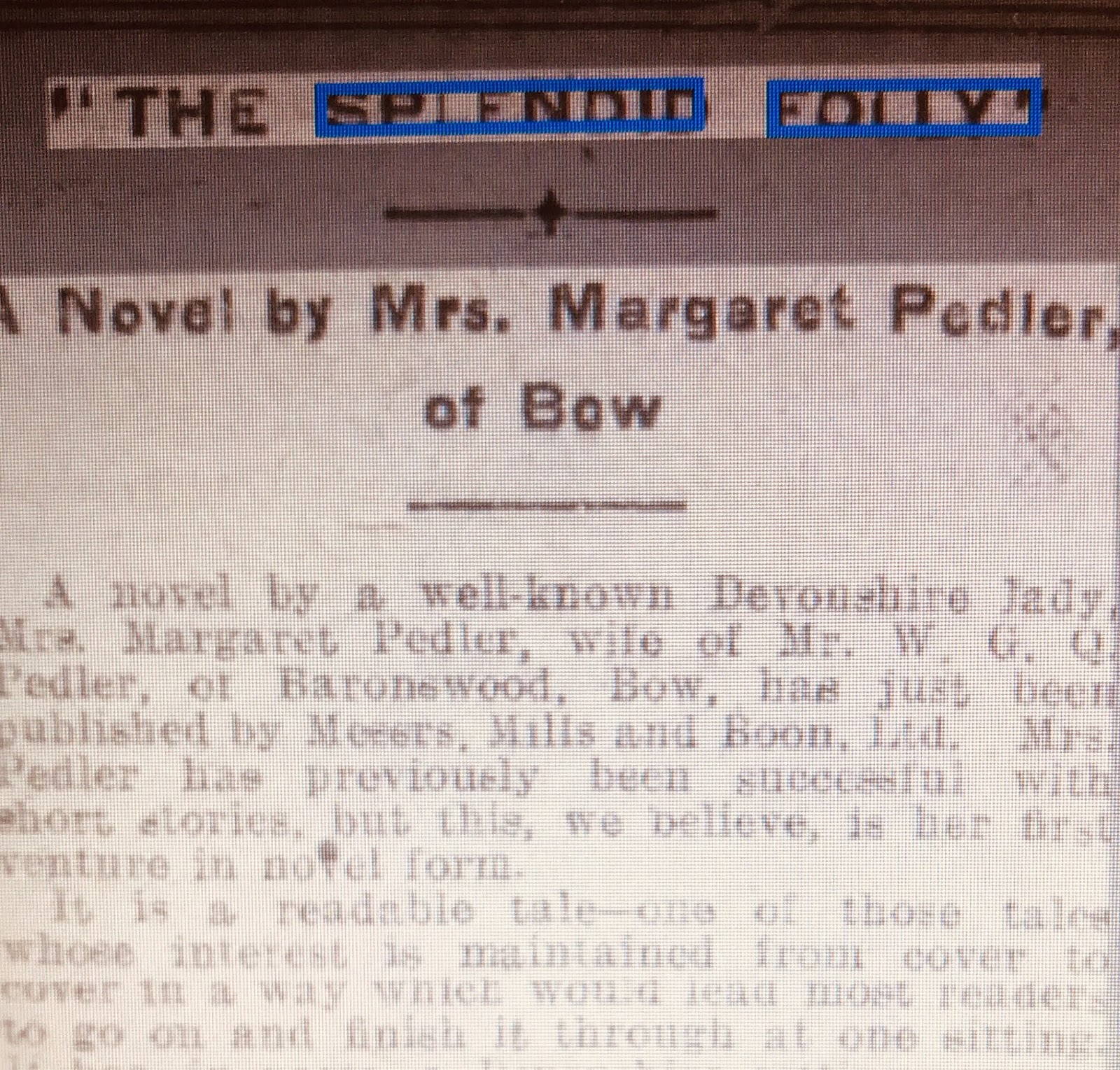
It is not just Devon's 'Queen of Crime' Agatha Christie whose prestigious textual contribution to the genre of crime left its distinctive mark on the literary achievements provided by women writers from the author's home county. Less well-known nowadays - and admittedly, some might judge, a less 'worthy' Devon writer than Christie - was 'Queen of Romance', Margaret Pedler, whose first novel The Splendid Folly, was published just over one hundred years ago, in 1917. The novel received fair reviews from newspapers at the time, including The Western Times, which reported that 'Mrs Pedler would herself make no high literary claims for The Splendid Folly. She set herself simply to write a readable, entertaining, love story with a touch of Devonshire setting and a topical thread running through its plot'. That reviewer's conclusion may be valid; I cannot say whether Margaret Pedler would have assessed her work in these terms, but in any case over the years, as (similarly, in terms of her prestigious literary output to Christie), Pedler produced more and more novels, her fans apparently raved about her them and she became increasingly popular. As I read through some of the many reviews picked up by her work, the contemporary public acclamation of Pedler (whose works came out regularly between 1917 and the 1940s) - became evident. 


Review of Pedler's first novel The Splendid Folly,
 in The Western Times, 28th March 1917

       And Pedler didn't have to wait long to achieve success, for soon after the publication of The Splendid Folly, a silent film adaptation of the book starring Manora Thew was produced by Arrigo Bocch. The film's treatment of the novel's plot, in which the repercussions caused by the jealousy of a girl (who's established a career as a famous singer) of her husband, whose royal connections she is initially unaware, unfolds against the dual backdrops of Devon and London. In part set in luxurious Capri, rather than at the rural and subdued Devon landscapes of its literary original, it may have been the film version of her story that initially propelled public interest in Pedler's writing.

Taken from a review of the film of Splendid Folly, published 
in The Bioscope, 11th December 1919.


A review of the film Splendid Folly, in The Bioscope, in 1919, noted that its stand out features included the 'enchanting glimpses of the Naples seaport'. However, the review concluded that although 'the tale is well suited for film treatment … the scenario, by Hegley Sedgwick has been somewhat clumsily constructed'. Whatever its ultimate appeal, the film version of the book must have brought public attention back to the budding author in Devon, who must have felt encouraged to pen more novels in the romance mode; as you will find if you look her up on Wikipedia, by the time of her death, in December 1948, Margaret Pedler had about thirty novels to her credit. Newspaper coverage around the time of many of their publications promotes her work in such terms that public demand must be assumed. Catchy headlines such as 'Book of the Week'; 'It's a Pedler Story'; 'Margaret Pedler Writes AGAIN for The Red'; 'New Book by Margaret Pedler'; or 'Wonderful New Romance by Margaret Pedler', appeared in a variety of nationwide newspapers and magazines. (I'll add a few images here to give you an idea of the variety of media coverage that Pedler's books received).
Vision of Desire, 'good honest romance', advert in The Scotsman, 1922.
Synopsis of The Shining Cloud in Hastings Observer 1935


Red Ashes, in Dundee Courier, 1924


          Promoting her third novel House of Dreams Come True, The Red Magazine even declared that 'Margaret Pedler is without doubt the most popular woman author of the day', which indicates that her rise to celebrity status in what contemporary C21 'Queen of Romance' Nora Roberts labels 'the big R', fictional genre, happened swiftly. Pedler's popularity evidently continued for some years, for during the interwar years several sources name her books as best sellers.


        However, the young writer had not chosen to take up writing as first choice of artistic career. One source suggests that before completing The Splendid Folly, she may already have written short stories. However, as a young and talented musician who studied both piano and singing at The Royal Academy of Music, Pedler, or, as she was born, Margaret Bass, initially composed and published classical songs. I found two of Margaret Pedler-Bass' songs held at The British Library, including 'Where we Met at Morn' (see inserted image). a traditional classical lyric, which is reminiscent of songs such as 'Linden Lea' or 'Silent Noon' written by Pedler's contemporary, Vaughan Williams.
Page taken from song Where we Met at Morn
by Margaret Bass/Pedler
   
       Here is a copy of the record the Academy forwarded after I requested information from them about Miss Margaret Bass:


Name: Bass, M.
Home address: Greenroyd, Teignmouth, S. Devon
London address: 35 Dorset Square N.W.
Date and place of birth: 4 August 1877, Streatham S.W.
Father’s name, address and occupation: Deceased
Guarantor’s name, address and occupation: Emma Bass, Greenroyd, Mother
Date of entrance exam: 21 September
Date of entering Academy: 25 September
Principal study: Singing
Second study: Piano
Harmony
Elocution
Extra studies: Italian, Sight singing
Achieved bronze medal for singing (level of attainment, not a prize)
Margaret Bass attended the Academy between 1899 to 1902.


       Interestingly, Bass/Pedler's musical passions show up in several of her later novels, either in the form of repeated refrains, which preface and then reappear throughout the text, or/and with a heroine who is an outstanding musician, either as singer, or pianist, dancer, or composer. At least one book has a plot which revolves around the dilemma faced by its heroine concerning the conflict between the demands of her musical career and the need to relinquish her own career for the sake of the man she loves. But, I'll return to that in a minute.
   
         As I explained in 'House of Dreams Come True', a short feature about the writer in my previous blog, I already knew a little about Margaret Pedler when I was a child growing up in mid Devon. But at the time I wrote that piece and then included a revision of it in the manuscript about Devon women writers, I'd not had a chance to look in more depth at the author's life and books. So, I decided for this blog piece I'd explore the background of her life a little more, and although Romance books per se as a genre, are not exactly my own reading cup of tea, I'd also give Margaret Pedler's novels a bit of a go. Given that she was once an acclaimed Devon woman writer, I owed her the reading-time; I'd hang-out with her books via kindle, for a week or two. (After noticing that mid-Devon featured as one of The House of Dreams Come True's important locations, I'd already skimmed that novel - the second she wrote (published 1919) - and included a bit about it in House of Dreams 1919); but, I had not then allowed myself to drift into the text, to follow the plot and get a feel for the characters.

                                                                                       ****


        I knew that Margaret had married, as his second wife, William George Quick Pedler, a well-to-do yeoman farmer from Zeal Monachorum in mid Devon, whose family were well established in the area. Although she evidently spent time in London after her writing career took off, Baron's Wood was probably Pedler's Devon home for many years and its location in the parish of Zeal Monachorum is the reason I decided to feature this half-forgotten author for this concluding post of this series, A to Z of Devon women writers. As well as Baronswood and Reeve in Zeal Monachorum, in the mid C19 one of Pedler's forefathers held estates in North Tawton (Great Hole and Great Wooden - See Will of William Pedler 1841). A2A holds other files about the Pedler family which I've not had a chance to look at as yet - see Pedler Family of Zeal |Monachorum. William was cousin of William Carter Pedler, the builder of Reeve Castle. (See the previous blog-post House of Dreams Come True).


Baron's Wood at Zeal Monachorum

      Margaret Pedler appears in the 1911 Census, at Baronswood, with her husband and three servants - a cook, a parlour maid and other servant. However, I wanted to explore Margaret's own birth family to see if I could find more about her early background than the facts of her musical training. Margaret's father's name was given on online sources, which stated he was 'from Teignmouth', but unfortunately he didn't show up on any records I could find via various genealogy websites. I thought I was stuck and that Margaret's own identity was to remain elusive. However, I struck gold when, after finding he had recently given a talk on Margaret Pedler, to a local group, I contacted Dr Nigel Browne of Bow in Devon, who was very generous in providing me with fascinating new information about Margaret's birth family. I am indebted to Dr Browne for the following account of Margaret's early life:


'Margaret Pedler ... was born Margaret Bass, to Thomas and Emma Bass. Thomas was born in about 1830 in Ripley, Derbyshire, the son of George Bass, corn miller, and by the age of 21 was working for a tea dealer in Halifax, to whom he may well have been apprenticed. In 1857 he married Emma Firth of Haworth, daughter of a worstead spinner, and by this time he had established his own business in Halifax as a tea dealer. In the mid 1860s he moved to London and established a wholesale tea dealership in the City. This evidently prospered, for by 1871 he was living in a large house in Christchurch Road, Streatham Hill with his wife, four children and five servants, and his eldest son, Charles, was at Clevedon College, Northampton. He seems in all to have had five daughters and three sons, of whom the eldest, Charles, entered the Anglican ministry. / Margaret Bass was born in the third quarter of 1877, seemingly the youngest of Thomas and Emma’s daughters, and benefitted from a thorough and liberal education. She was sent to Laleham School in Clapham Park, a boarding school founded and run by a remarkable lady, Hannah Pipe, who was both a devout Methodist and a progressive educationalist, who employed some very able teachers and gave the girls in her charge a broad and thorough education. Miss Pipe herself came from the Manchester area, and many of her earlier pupils were from Lancashire and Yorkshire, and this may possibly have been a factor in Thomas Bass’s choice of school./ Laleham was a large house on the Clapham Park Estate, laid out by Thomas Cubitt with his own palatial house at the centre. The school had ample room for the 25 girls, and large grounds including a lake, lawns and shrubberies. Hannah Pipe retired while Margaret was still a pupil, but the school continued to be run on the same lines by her successor./At some time in the 1890s Thomas Bass retired from active business and moved to Teignmouth, where he died at his house, Greenroyd, Woodway Road, on 6 April 1898, leaving almost £30,000. His estate was to be held in trust to provide an income for his widow and children, with his sons Arthur and Thomas to manage the tea business'.


          So, here was a wonderful way of entry into the genealogy websites to see if I could stumble upon and expand the information concerning Margaret Pedler's parents' families, the Basses and the Firths. Interestingly, what I found apparently slightly contradicted the facts about Thomas Bass's birth place and family. After following the census of 1871, which, though it confirmed Thomas, Tea Dealer, in Christchurch Road, Streatham (and married to Emma with their four children, governess and servants) - also stated Thomas' birth place as being Langar, in Nottinghamshire - rather than in neighbouring Derbyshire. Out of curiosity, I whizzed back along the archives to see if there was a matching birth for a Thomas in the parish of Langar. Sure enough there was, a Thomas baptised there in 1829, but the entry opened up more questions than it answered because it noted Thomas' mother as Amy Bass - and no father's name was given. After that I only came up with blanks - no easily found facts about who Amy (Margaret Pedler's paternal grandmother) was. One of the Bass daughters (one of Margaret's elder sisters) was christened Amy, which perhaps confirms Thomas' mother's name. I'm including this about Thomas just in case any one else decides to research Margaret Pedler's life; there may be more confirmation required as to the background of her father's family. 

      I had a little more luck when it came to finding Margaret's maternal family; but again, what I found apparently branched a little from the information so far obtained. On the 1871 census in London, the record states that Margaret's mother Emma, born Firth, came from Sowerby Bridge, in Yorkshire, which is just west of Halifax, already mentioned in connection with Emma's parents and about ten miles south of Haworth. Sure enough, an Emma is recorded baptised at Sowerby in 1839, daughter of Thomas Firth and Ann. Emma appears also in the census 1841, three years old, and in the 1851 census, 'scholar', twelve years old, where the family are at 'Green Terrace', Halifax and Thomas, 65, is listed as 'Retired Yarn Agent'. Thomas is listed as coming from Rastrick and his wife Ann from Worley. A Thomas, son of Joseph Firth is baptised in Rastrick in 1786; he may well be one and the same as Margaret's maternal grandfather. Other Firths are recorded in Rastrick during this time, which suggests the family were based in the area over a long period.

       The following may be a red herring, but it is possible there is a connection between Emma Firth's father's family and a Quaker family of Firths who, during the C18/19 owned an estate called Toothill, in Rastrick. Perhaps it is just coincidence, but the names listed as owners of the house are also Thomas and Joseph. If this family should be related to Margaret Pedler's maternal ancestors then these sources will be valuable for anyone who wants to find more about the author's background. I have a feeling there is more out there to find when someone has time to pursue the Firths. 

         But time constraints meant I had soon to take my leave of Margaret Pedler's family, so reluctantly I closed the genealogy websites and opened up my kindle to begin reading her own books. To be honest, other than showing up more Devon-links-as-locations in her novels, I expected to be bored; I assumed my 'big R' read would be more duty than anything else. This time around, after I'd downloaded from Kindle (free or very cheaply) four of Margaret Pedler's books from the early group - including the first, The Splendid Folly, and House of Dreams Come True, Moon out of Reach and Lamp of Fate, then spent a few hours for a day or so in their company, I was agreeably surprised. In each case, once I'd swiped through the pages of the first few chapters, and once I'd accepted the pat-formulae of the plot construction, and the completely contrasting-with-our-own moral universe within which the novels' plots unfolded, I found I was drawn in to the characters' worlds and actually, wanting to find the heroine's 'fate', felt quite compelled to know how they panned out. Noticeably, Pedler's command of language impressed me. Several times, with each novel, I found I needed to resort to kindle's word definition tool; here was someone who had a sophisticated vocabulary and more to the point, knew full well how to employ her understanding to its best advantage. Not to be scorned in our own day and age I thought, given the prolific drip-feed of new often self-published fiction available out there, much of which is hardly worth picking up, or downloading on kindle.

      As far as my own research about women writers with important links with Devon is concerned, Pedler's novels held much of interest. What soon occurred to me was that most of the books I read - or browsed - pinpointed Devon (or if not Devon, other westcountry places) locations as meaningful sites, each one important for the plot's unfolding. So, although, other than the fact her father had retired to Teignmouth in Devon, genealogical research tells us that Margaret Pedler's family background was apparently not closely associated with Devon, the county appears to have become a beloved home territory for the writer. Admittedly I must qualify that statement, as at least one out of this early groups of novels - Moon Out of Reach - features Cornish rather than Devon sites; but it is still safe to conclude that for Pedler the westcountry became a favoured place of retreat and source of creativity.   

       Even DoveGreyReaderScribbles, Devon's popular bookblog, is apparently unaware of our county's once famous romance-writer, (although maybe DoveGrey does not feature books written in the 'big R' genre). However, Pedler's books have caught the attention of at least one recent book blogger, whose assessment of the C20 writer is unfortunately dismissive, scathing and distinctly unfavourable. LeavesandPages's piece on Pedler's novel Bitter Heritage - which came out in 1928 - describes 'A hugely predictable melodrama about a young woman whose father has disgraced himself' and judges it 'of “period piece” interest only, and forthwith shelved accordingly.' 

       As I've already said, I'm not a huge reader of books written in escapist fictional/romance genre, but I believe that this blogger's judgement of Pedler after reading only a sample of her books is rather cursory and hasty. Although, by default Pedler's novels are judged as 'middlebrow', exemplars of popular mass market fiction, with predictable plot lines and somewhat stereotyped characters, they are worthy of scrutiny. It wasn't for nothing that Pedler became an acclaimed novelist during her lifetime, when (as already noted in the previous blog-post), her reputation was compared to other then sought-after women romance writers such as Ethel M Dell and Ruby M Ayres, and sometimes her novels' titles featured as 'books of the week' with such notable authors as Lawrence Durrell. (See for instance Bournemouth Graphic in 1935, which names her latest title The Shining Cloud as 'Book of the Week' alongside his new novel).  There are other indications of the contemporary popularity of Pedler's work: it was often serialised in popular literary magazines (see for example, The Red, 1919, where one headline states that 'Margaret Pedler writes for The Red'); and during the 1930s her books were often held in school libraries. 

      Pedler's work, like so many of our country's half-forgotten women writers, deserves our attention, especially for what it can inform the C21 reader about the ways in which, during a time when women's place in family and wider circles was rapidly changing, early to mid C20 women novelists depicted issues about female lives and roles in society. For someone who is fascinated with westcountry (and specifically Devon) territories, her books can also be telling in their representation of local landscapes - and particularly the ways in which the author interweaves Devon settings with experiences and concerns from her own life. 


Cosdon on Dartmoor from near Zeal Monachorum
        Time constraints and an already over long blog-post mean I need soon to bring this piece to an ending, but as an example of what I mean, Pedler's first novel The Splendid Folly is an excellent book to consider. Ostensibly, in several ways the novel's plot matches its author's own life trajectory. Similarly to the young Margaret, its heroine, named Diana Quentin, whose 'adopted' home is at the rectory in 'the primitive [and'tiny'] Devon village of Crailing', where she was brought up by its rector, her guardian Alan Stair, is building an established career as musician, a singer. As the book begins, Diana is dividing her life between Devon and her boarding-house in London and back down in Crailing, which frequently appears in the novel as a place of reflection, refuge and safety.  The Devon locations in the novel (just as others that appear in other and later novels by Pedler) are fictionalised; but there are reasons to assume that they are sometimes, if not all, based on the author's own life in the county and therefore are places with which she was familiar.  It is tempting to guess and match the imaginary locations with the real-sites - although of course Pedler may well have simply cast them all from her writerly imagination! (I've already conjectured in my previous blog-post House of Dreams, that the house in House of Dreams Come True, her second novel may be modelled on nearby Reeve Castle). 

      In The Splendid Folly Devon's familiar and famous Dartmoor landscape pops up as a place where Diana and her beau Errington take long pleasurable drives, 'tramping ... with the keen moorland air, like sparkling wine, in their nostrils...'. Dartmoor is unmistakable, but other locations in the novel are more uncertain.
Of course, there could be other such apposite examples, but when I read about the 'Crailing' rectory entrance as the narrative describes it, my imagination sped to such a door leading to the old rectory in North Tawton (the neighbouring parish to Zeal Monachorum in rural mid Devon):

'The little wooden door, painted green and over-hung with ivy, was never bolted...The little green door innocent of lock and key, stood as a symbol of the close ties that bound the rector and his flock together...' 

However, quickly we learn that the fictional church is square-towered (so not North Tawton), that Crailing is a 'tiny fishing village', full of thatched roofs, that 'it straggled down to the edge of the sea in untidy fashion', where the 'bold headland of red sandstone, Culver Point, … thrust itself into the blue of the water'. A mid-Devon rural location is therefore out of the question (unless, which is also quite possible, the author mixed and matched her imagined real sites). The red cliffs may take us down to Dawlish, which was once a small fishing-village. The Dawlish area also makes sense for the main Devon setting of this first novel in accordance with the last home of Margaret's father at nearby Teignmouth, where presumably after their move during the 1890s the young Margaret must have spent much time in between school and college terms. It is at a headland site named 'Culver Point', 'which thrust itself into the blue of the water like an arm stretched out to shelter the little village nestling in its curve from the storm of the Atlantic', where 'great red cliffs … reared up against the sapphire of the sky', that Diana experiences heightened emotion, danger, revelation and drama. A dramatic location, it establishes and reflects the novel's emotional tone, crucially as the site of the climatic scenes of its heroine's passionate love encounters. Perhaps Culver's scenery with it 'numerous little bays that fringed the foot the great red cliff' is based on the coastline around Teignmouth, between Hope's Nose and Holcombe. 
   
         Even more interesting, in light of the writer's own life and career - especially with regard to our current obsession with the place of women in the early C20 - it's fascinating to look at the way in which Pedler's first novel tackles some then topical gender issues, especially apropos woman's role in the contemporary world. Specifically, as the narrative explores its heroine's journey-to-find-her-self, the fiction probes the conflict regarding a woman's individual career with her 'duty' as wife. It's hard not to read the story as a take on Pedler's own young self as she negotiates the conflicting needs of her own developing vocation (first as musician, then as gradually highly successful author), with contrasting societal expectations, which demanded that a married woman forfeit her own talents and careers for the sake of her husband's needs. In The Splendid Folly Diana first relinquishes her own rapidly burgeoning career as singer in favour of her new husband; but then she decides to return to her abandoned profession and to find that lost self. Given that the book is defined by its romance novel mode, its heroine's fate is curiously uncertain, for at the ending the narrative strays from its expected happy-ever-after certainty. Its title's potential is shown to be apposite. Is she wise in her choice to leave? Will she regret her decision? We do not know. In keeping with its title, Diana's soon to be future to follow 'love', join her husband in a foreign country, which will take her far away from the professional environment of her singing career, leaves us with suggestively sinister connotations as to her possible 'folly'. It is left to her long-term male singing master to warn:


For long he argued and expostulated upon the madness, as he termed it, of Diana's renouncing her career, trying his utmost to dissuade her. ..
You haf not counted the cost! he fumed at her.
But Diana only smiled at him.
Yes I have. And I'm glad it's going to cost me something - a good deal, in fact - to go back to Max. Don't you see Maestro, it kind of squares thing the tiniest bit? .... and it's such a little price to pay - for love.' …
 
'So, then, the most marvellous voice of the century is to be wasted reading aloud to a Grand Duchess! Ah! Dearest of all my pupils, there is no folly in all the world at once so foolish and so splendid as the folly of love'.


         Given the contemporary C21 fascination with women from our past apropos many disciplines, it seems to me that it is so important not to cast literary-linked names aside as if their achievements were inconsequential to our heritage and as though, because their writings were categorised within genres considered 'non-literary' - 'trivial', 'populist' - their accomplishments were therefore less worthy than those whose books became exemplars of literary endeavour. When I took a little downtime to read a selection of Pedler's novels I found them a true breath of fresh air. Not only was it intriguing to try and work out where the various fictional Devon places in the narratives were really located. Given the current ultra sophisticated online world and unstable cultural milieu with its chaotic and fluctuating moral compass, these novels provide a means to an escapism to a more stable world, where (although occasionally tedious when viewed from our C21 lens and where a woman's own role in society is sometimes questioned) self control, self sacrifice and moral integrity are held up as standards to be emulated. Once you discard your initial annoyance with their predictable narratives, it can be healing and restorative to take a few hours out and revel in these novels' company; ideal perhaps for someone needing to reduce their online social-media, news-obsessed screen-time to wallow instead in the camaraderie of individuals, who greet us, as though drop-ins from another parallel universe....


Well, there we have it, it's taken me much longer than intended but I've now blogged (almost), a post about one or other Devon parish or place and its connections with one, or in some cases, several women writers. If you're out there keeping an occasional eye on this book related blog, do check in sometime in to see where in Devon I'm going next and more to the point, which woman writer from the past will be featuring ...

See also From the Devon Ridge Where a Book Began


Featured post

  Finding a Forgotten Devon Author's Grandmother; Who was Edith Dart’s Granny Jane Sampson? Lanes, distant moor and ‘Lydcott’, a farm (o...